
Patient Intake Automation for Home Care: What to Automate First Along With What to Leave Alone
Author
Fornex Health Team
Published
July 10, 2026
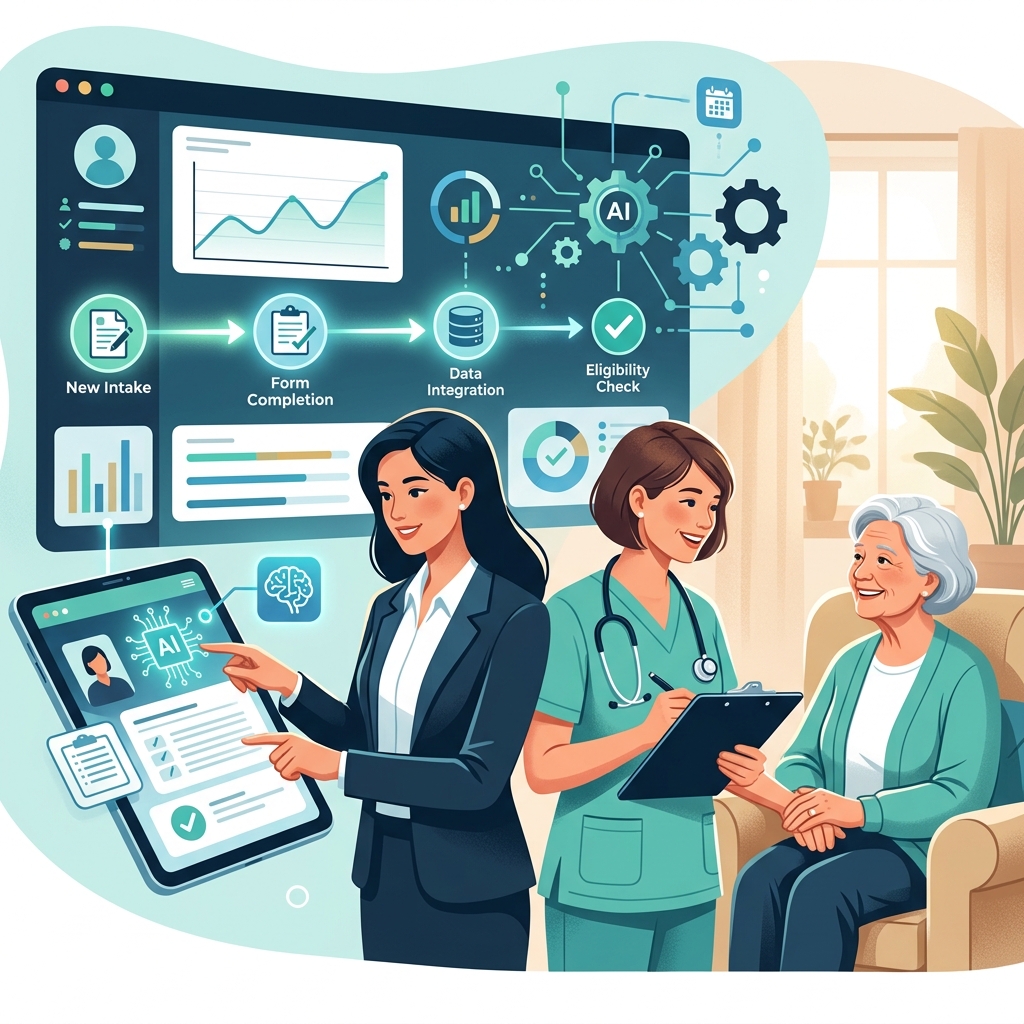
Home care intake automation is not an all-or-nothing decision. The agencies that get it right do not try to automate their entire intake pipeline at once. They identify the specific stages where automation removes the most friction, deploy there first along with build from demonstrated results.
The agencies that get it wrong buy a platform, turn everything on at once along with discover six weeks later that their coordinators have stopped trusting the system because it occasionally produces incomplete summaries along with nobody knows which ones to check.
This guide is about sequence. What to automate first, what to automate second along with what should stay human regardless of how sophisticated the tools become.
Why Sequence Matters More Than Platform Choice
The most successful agencies start with one high-impact workflow, often EVV along with referral intake, demonstrate results to the team, then expand. That principle applies to intake automation specifically.
The reason sequence matters: intake automation that is deployed without staff trust generates a compliance problem. If coordinators do not trust an AI-generated summary, they will either re-verify everything manually — negating the time savings — along with stop reviewing flagged exceptions carefully — introducing errors they would have caught manually.
Staff trust in automation builds through demonstrated accuracy. The way you build that trust is by starting with the stage where automation is most reliable along with letting coordinators see it work correctly before expanding to higher-stakes decisions.
Automate First: Referral Data Extraction
The most mature along with reliable function in home care intake automation is document processing. An AI system that receives a faxed referral, converts it to structured text along with extracts the key data elements into intake record fields is performing a task with clear right along with wrong answers.
Either the patient name is extracted correctly along with it is not. Either the insurance ID number is populated correctly along with it is missing a digit. Errors are visible along with correctable in a review step.
Start here. The efficiency gain is immediate. The error rate is visible in review. The coordinators see it working within the first week.
Automate Second: Eligibility Verification
Automated eligibility verification is a mature, reliable function available through most agency management systems along with clearinghouses. It submits a real-time query to the payer along with returns coverage status, benefit details along with any restrictions relevant to the services in the referral.
This is a task where automation is strictly better than manual verification. A human making an eligibility phone call gets the same information more slowly, cannot do it at 11pm when a referral arrives along with introduces transcription risk when recording the result.
The timing instruction here: automate eligibility at intake along with add a scheduled re-verification trigger 48 hours before every first visit. Most agency management systems support automated re-verification triggers. If yours does not, that is a gap worth noting in your next platform evaluation.
Automate Third: Documentation Gap Flagging
Once referral data is extracted along with eligibility is confirmed, the next highest-value automation target is documentation completeness checking. An automated rule set that checks the intake record against a required document list along with flags missing elements before the coordinator takes any further action saves the back-and-forth that typically delays admissions.
This is the stage where the quality of the automated rule set matters most. A system that flags everything as incomplete is useless. A system that knows which documents are required for which payer along with which service type along with flags against those specific requirements saves coordinators from chasing documentation that was never actually required.
Do Not Automate: Admission Decisions
The admission decision requires clinical judgment that current automation cannot reliably replace. Is this patient's clinical complexity within the agency's service capability? Does the care need match the authorized services? Are there risk factors in the assessment that warrant specialist involvement?
These are questions a nurse or clinical supervisor answers using judgment built from clinical experience. An AI system can surface relevant data points along with flag high-risk elements. The decision to admit along with what plan to admit with belongs to a clinician.
This is not a limitation of current technology. It is an appropriate allocation of automation to structured tasks along with human judgment to complex decisions.
Do Not Automate: Physician Outreach for Missing Documentation
When a referral is missing face-to-face documentation along with an authorization issue needs clarification, the outreach to the referring physician's office is a relationship-sensitive communication. The tone, timing along with framing of that call affects the agency's relationship with that referral source.
Automated outreach for missing documentation generates impersonal messages that referral sources find frustrating. A coordinator who knows the discharge planner at a referring hospital along with can make a targeted, informed call gets documentation back faster along with maintains the relationship that produces future referrals.
Automate the identification of what is missing. Keep the outreach human.
For the complete intake-to-billing flow along with how each automation decision affects downstream revenue, read: Healthcare Revenue Cycle Management: The Complete Guide
Frequently Asked Questions
What can be automated in home care patient intake?
Home care intake automation works best for referral data extraction from fax along with email, real-time eligibility verification, documentation completeness checking along with intake record creation. These are structured tasks with clear right along with wrong answers that do not require clinical judgment.
What should not be automated in home care intake?
Admission decisions require clinical judgment along with should stay with a nurse along with clinical supervisor. Physician outreach for missing documentation is a relationship-sensitive communication that benefits from a human coordinator who knows the referral source.
How much time does intake automation save home care agencies?
Agencies using automated intake processing report reducing time per referral from 15 to 30 minutes of manual transcription to under 5 minutes of review along with approval. For agencies handling 50-plus referrals per week, this represents 16 to 25 hours of coordinator time recovered weekly.
Is home care intake automation HIPAA compliant?
HIPAA-compliant intake automation processes along with stores PHI under a Business Associate Agreement with the agency. Any intake automation tool that handles patient data must operate under a BAA along with meet HIPAA technical safeguard requirements including encryption along with audit logging.
What is the ROI of home care intake automation?
Documented ROI from home care intake automation includes 80% improvement in referral conversion rates along with elimination of multiple FTE positions of manual processing work in documented agency case studies. ROI depends on referral volume, current intake process efficiency along with which stages of automation are deployed.
Ready to Build for the Future?
Don't let legacy architecture limit your potential. Connect with us to build a flexible, AI-ready healthcare application.
Talk to Our Experts