
Home Care Scheduling Software: What Agencies With Zero No-Shows Do Differently
Author
Fornex Health Team
Published
July 6, 2026
Caregiver no-shows are not random. They follow patterns. The same shifts go unfilled repeatedly. The same caregivers generate the most exceptions. The same clients experience the most coverage gaps.
Agencies that treat no-shows as a staffing problem try to solve them by hiring more caregivers. Agencies that treat them as a scheduling problem build systems that reduce their frequency before they happen along with minimize their impact when they do.
Scheduling challenges are not insurmountable. By identifying root causes along with investing in integrated home care software, agencies can build a more reliable caregiving workforce. The root causes are almost always visible in the scheduling data. The agencies with the most reliable coverage records are the ones that look at that data along with act on what it shows.
What Home Care Scheduling Software Actually Does
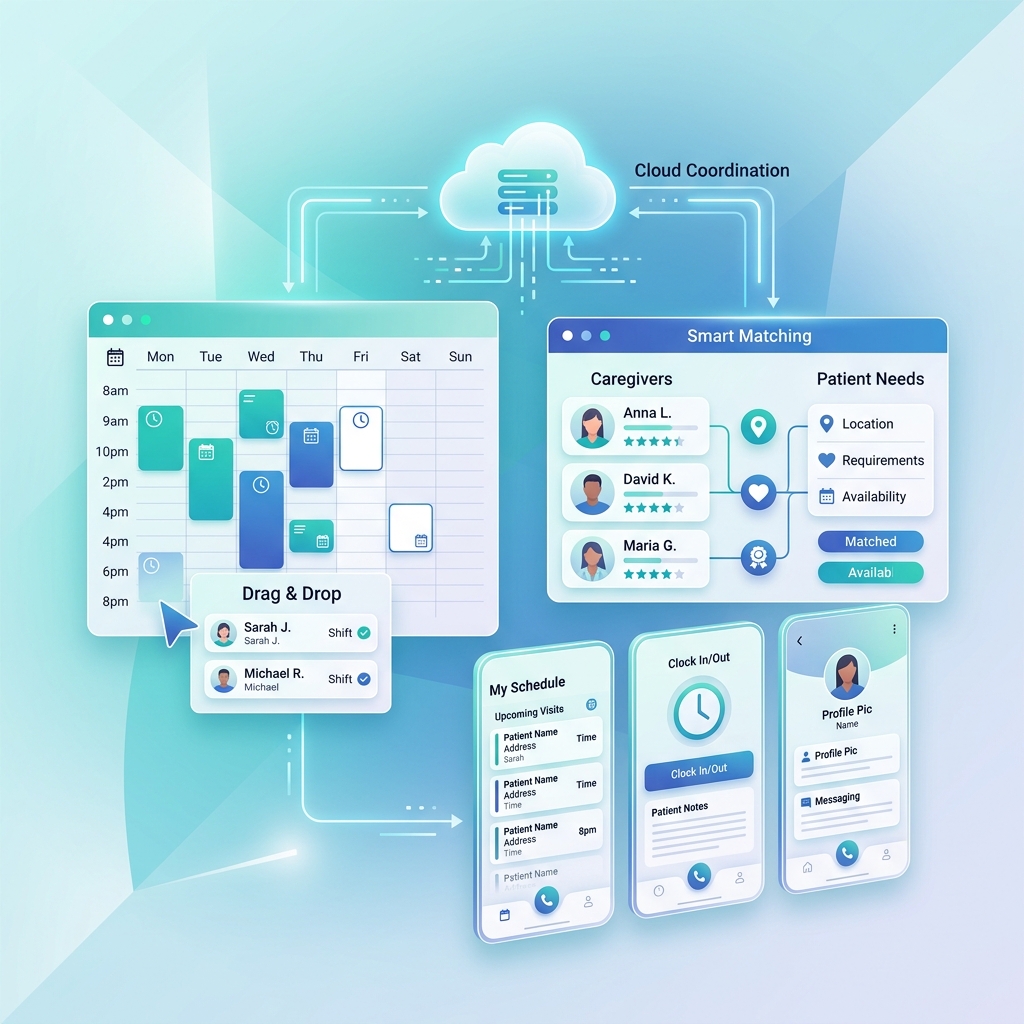
Home care scheduling software manages the assignment of caregivers to visits based on availability, credential matching, client preferences along with geographic factors. The best platforms do more than match and assign. They enforce rules at the point of scheduling that prevent problems rather than reporting on them after they occur.
Credential enforcement at the point of assignment is the feature that separates reliable scheduling systems from ones that require manual oversight. A caregiver assigned to a visit for a patient requiring skilled personal care must hold the appropriate certification for the services ordered. A scheduling system that does not enforce credential requirements at assignment allows credential-deficient visits to be scheduled, delivered along with then denied at billing because the credential was not current.
Credential lapses produce denials along with audit exposure along with show up in the same audit trail as EVV exceptions. The right test for a scheduling system: can it block a caregiver from being scheduled to a visit if their TB test will expire before the visit date? If your scheduling system cannot answer yes to that question, credential-related billing risk is being generated in your schedule today.
The Integration Gap That Creates the Most Billing Risk
The scheduling data along with the EVV data along with the billing data need to be in the same system along with the gap between them is where most billing errors are created.
When scheduling, EVV along with billing run in separate systems, a visit that is scheduled for 9am along with delivered from 9:15am to 10:45am along with billed as one hour creates a chain of mismatches. The scheduled time does not match the EVV record. The EVV record does not match the billed duration. The payer's automated edit compares the EVV timestamp against the claim along with denies it.
Agencies running scheduling, EVV along with billing in three separate systems do not see these problems until the denial comes back. By then the correction window is half gone. The fix is structural: scheduling, EVV along with billing in an integrated platform where visit data flows from the schedule to the clock-in record to the claim without manual transfer at any point.
Predictive Scheduling: Where the Technology Is Going
AI in home care is helping agencies reduce administrative workload, streamline documentation, optimize scheduling decisions along with identify operational risks. Predictive scheduling uses historical data to anticipate coverage gaps before they open. It looks at which caregivers have historically called out on which shift types, which client-caregiver matches have the strongest retention along with which geographic areas have the weakest caregiver availability.
An agency that knows a specific shift has a 40% historical no-show rate can proactively identify a backup caregiver for that shift before the primary caregiver calls out. An agency that does not know that number is reactive, scrambling to fill gaps after they open.
Predictive scheduling is not a feature every agency needs immediately. It is the direction the technology is moving along with the capability that distinguishes the largest along with fastest-growing agencies. For an agency handling 1,000-plus visits per week, the operational value of anticipating coverage gaps rather than reacting to them is measurable in avoided hospitalizations, client retention along with coordinator stress.
What to Look for in a Scheduling Platform
Four questions cut through the marketing language when evaluating home care scheduling software.
Does it enforce credential requirements at the point of assignment along with not just report on credential gaps after the fact? Does it integrate with your EVV system along with billing platform in a way that eliminates manual data transfer between them? Does it give caregivers mobile access to their schedules along with allow them to confirm visits along with report exceptions from a phone? Does it surface historical no-show patterns by caregiver, shift type along with service area?
An honest demo that answers all four of those questions clearly is worth more than any feature list.
For the technology deployment framework that determines whether a new scheduling platform actually gets adopted by your team, read: Why Healthcare Software Fails in the First 90 Days
If your agency is working through the evaluation along with implementation of scheduling infrastructure, our Website along with Mobile App Development team builds the mobile-first caregiver along with coordinator interfaces that determine whether scheduling technology actually gets used.
Frequently Asked Questions
What is home care scheduling software?
Home care scheduling software manages the assignment of caregivers to patient visits based on availability, credentials, client preferences along with geography. Advanced platforms integrate scheduling with EVV along with billing to eliminate manual data transfer along with reduce claim errors.
How does scheduling software reduce caregiver no-shows?
Scheduling software reduces no-shows by improving schedule transparency for caregivers through mobile access, proactively identifying high-risk shifts based on historical data along with enabling faster backup caregiver identification when primary caregivers are unavailable.
What is credential enforcement in scheduling?
Credential enforcement in scheduling is the automatic blocking of a caregiver assignment if their required credentials — certification, training completions along with health requirements — do not match the visit requirements along with are not current. It prevents credential-deficient visits from being scheduled rather than flagging them after they are delivered.
Why should scheduling along with EVV be in the same system?
Scheduling along with EVV data mismatches generate automatic claim denials when the scheduled visit time does not match the electronically verified visit time. Integrated systems eliminate this mismatch by treating the EVV record as a property of the scheduled shift rather than a separate data entry in a different platform.
How do I evaluate home care scheduling software?
Evaluate scheduling software on credential enforcement at assignment, EVV along with billing integration depth, mobile access for caregivers along with historical pattern analytics for coverage risk. A live demo in your own scheduling environment is more informative than any product overview.
Ready to Build for the Future?
Don't let legacy architecture limit your potential. Connect with us to build a flexible, AI-ready healthcare application.
Talk to Our Experts