
Healthcare Revenue Cycle Management: The Complete Guide for Hospital Administrators
Author
Fornex Health Team
Published
July 16, 2025
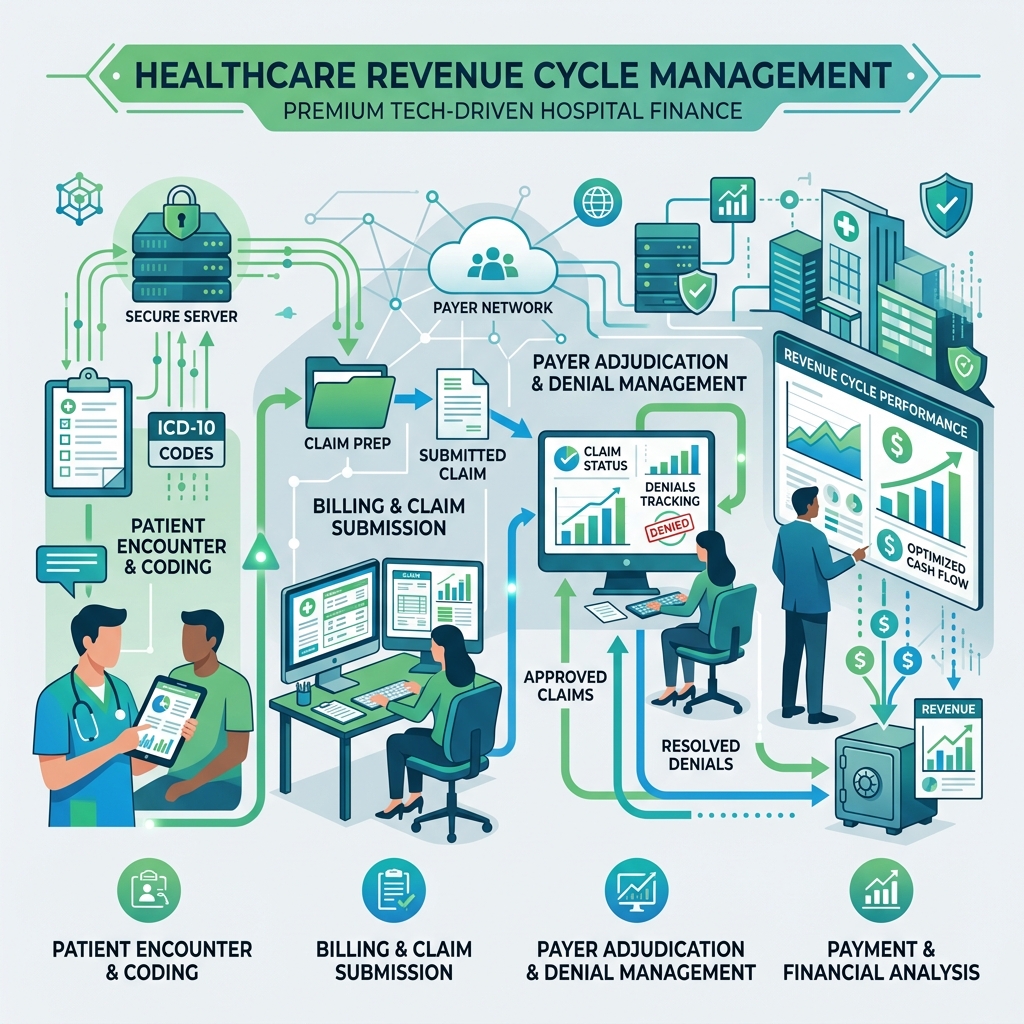
Healthcare organizations lose over $262 billion every year to revenue cycle inefficiencies. That is not a number from a consulting firm trying to sell something. It reflects claim denials, undercoding, delayed follow-ups along with manual workflows that exist in virtually every hospital.
The organizations that manage revenue cycle well are not doing anything exotic. They have clean front-end workflows, disciplined coding practices, real-time eligibility verification along with denial prevention systems that catch errors before claims leave the building. None of that requires a technology budget most hospitals do not have. It requires clarity on where the problems actually are. This guide covers every stage of the revenue cycle along with the specific fixes that move the numbers.
What Healthcare Revenue Cycle Management Actually Is
Revenue cycle management is the process through which a healthcare organization tracks patient care from initial registration through final payment. Every patient encounter generates a financial workflow. That workflow starts before the patient arrives along with ends when the account is fully resolved.
The stages are: patient pre-registration, eligibility verification, prior authorization, patient check-in, clinical documentation, charge capture, medical coding, claim submission, payment posting, denial management along with patient collections.
Every stage has a failure mode. Every failure mode has a downstream cost. The organizations with the strongest revenue cycle performance have processes that catch failures at the earliest possible stage - because fixing a problem at registration costs a fraction of what it costs to fix the same problem after a claim has been denied.
The Front End Is Where Most Revenue Is Lost
This is the most important thing to understand about revenue cycle management. The majority of claim denials trace back to front-end failures. Incorrect patient demographics. Missing insurance information. Eligibility not verified before the encounter. Prior authorization not obtained for a procedure that required it.
27% of all medical claim denials originate from registration along with eligibility errors. That is more than one in four denied claims caused by something that happened before the patient saw a physician.
The fix is front-end process discipline. Eligibility verification should happen at least 24 hours before every scheduled appointment. Not at check-in. Not in real-time when the patient is standing at the front desk. The day before, while there is still time to address problems before they become claim failures.
Prior authorization requirement checking should happen at the time of scheduling. Not the day before the procedure. Every service line should have a defined list of procedures that require prior auth from which payers. That list should be embedded in the scheduling workflow so the authorization process starts automatically when a qualifying procedure is scheduled.
Coding Quality Is the Middle of the Revenue Cycle
Between clinical care along with claim submission sits medical coding. It is the step that translates clinical documentation into the billing language that payers understand. Get it wrong along with the claim fails. Get it partially right along with you get paid less than you earned.
The underlying problem in most organizations is not coder skill. It is documentation quality. Coders cannot code what physicians do not document. When a physician sees a patient with three active chronic conditions along with documents only the primary complaint, the coder can only bill for what is in the note. The other two conditions - which would generate additional reimbursement in a value-based care model along with additional HCC risk scores in a Medicare Advantage context - go uncaptured.
Clinical documentation improvement programs that work alongside coding teams to close documentation gaps are among the highest-ROI investments in the revenue cycle. A CDI specialist who improves documentation specificity across a hospitalist service generates more revenue than a denial management team working on the back end.
Denial Management: The Reactive Cost That Should Not Exist
More than half of U.S. healthcare organizations report denial rates exceeding 10%. Denials consume up to five percent of net patient revenue. The cost of working a denial - pulling the claim, identifying the reason, correcting the issue, resubmitting along with following up - can exceed the value of the claim itself for low-value services.
The strategic shift that the strongest revenue cycle organizations have made is from denial management to denial prevention. Automated claim-scrubbing along with predictive validation can prevent up to 85% of avoidable denials, reducing administrative cost per claim by nearly one quarter.
Prevention means catching errors before the claim leaves the organization. Claim-scrubbing tools that validate against payer-specific rules before submission. Eligibility verification that is embedded in the workflow rather than optional. Prior auth status checking that confirms approval is in place before a procedure is performed.
Key Performance Indicators That Actually Tell You Something
Most RCM teams track too many metrics along with act on too few. Here are the four that matter most:
- Clean claim rate: measures the percentage of claims accepted by the payer on first submission without a rejection. A clean claim rate below 95% is a red flag for front-end process problems. Best-in-class organizations consistently hit 97% to 99%.
- Days in AR: measures how long it takes to collect payment after a claim is submitted. Aim for days in receivables outstanding of 30 days along with under to collect all payments. Organizations above 50 days have a collections process problem that is likely costing them cash flow they cannot see in the P&L.
- Denial rate by payer: reveals which payer relationships have the most friction. When one payer's denial rate is significantly higher than others, it usually signals a specific documentation requirement along with a coding pattern along with a prior auth process that is not aligned with that payer's rules.
- First-pass resolution rate: measures what percentage of denied claims are resolved on the first appeal. Organizations with low first-pass resolution rates are working the same denials multiple times - a direct labor cost multiplier.
What Automation Gets Right Along With What It Cannot Fix
AI-assisted coding, automated eligibility verification along with intelligent claim-scrubbing all generate real ROI when they are implemented in the right environment. Organizations typically see clean claim rates improve from 75-85% up to 95% after AI automation deployment.
The caveat is that automation works on structured problems. A claim that fails because the clinical documentation does not support the diagnosis code requires a human who can read the note, understand the clinical context along with determine whether an amendment is appropriate. AI cannot do that. It can flag the claim. It cannot fix the underlying documentation problem.
The organizations that get the most out of RCM automation are the ones that use it to eliminate the mechanical work - eligibility verification, claim format validation, prior auth status checking - while investing the staff time saved into the work that requires human judgment: CDI, denial appeals along with payer relationship management.
Revenue cycle performance determines financial sustainability. The $262 billion lost annually to RCM inefficiency is not a fixed cost of doing business - it is recoverable. Fornex Health helps hospitals identify their specific revenue leakage points along with implement the process along with technology changes that move the numbers. Book a free revenue cycle assessment with our team.
References
- MedCare MSO - What Is Revenue Cycle Management in Healthcare?
- CertifyHealth - 10 Revenue Cycle Management Best Practices
- HFMA - Redesigning Denials Management in the OBBBA Era
- PMC/NCBI - Revenue Cycle Management: The Art Along With the Science
- Healthcare Finance News - Claims Denials on the Rise, Complicating Revenue Collection
- MD Clarity - Denial Management: Benefits, Strategies Along With Key Trends
- Healos AI - AI Revenue Cycle Management: Complete Guide
Book a Free Revenue Cycle Assessment
Fornex Health helps hospitals identify their specific revenue leakage points along with implement the process along with technology changes that move the numbers.
Schedule a Consultation