
Why Home Care Claims Get Denied Along With the Documentation Fixes That Stop It Repeating
Author
Fornex Health Team
Published
July 11, 2026
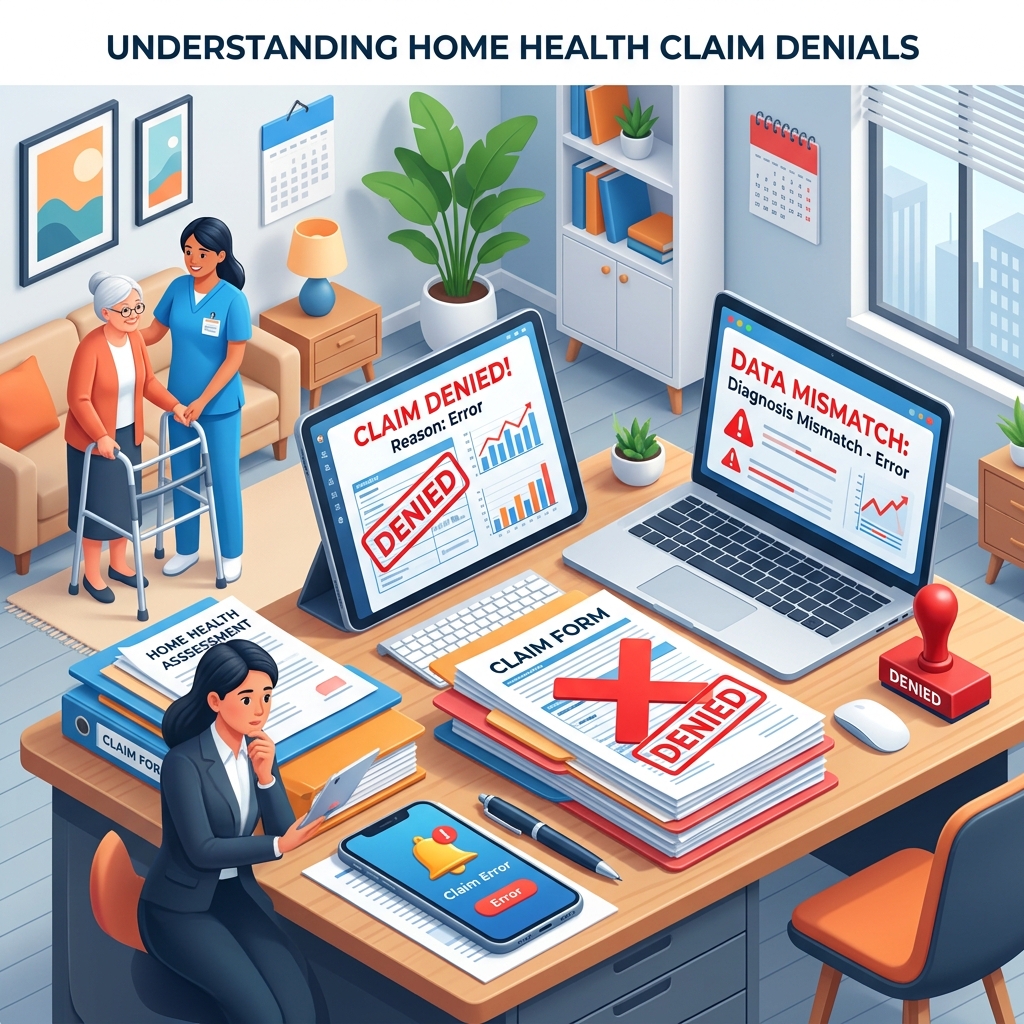
Most home care agencies handle denials by fixing the denied claim along with resubmitting it. That is a necessary response. It is not a complete one.
The claim got denied for a reason. That reason is a signal about a process failure that is likely generating the same denial across multiple claims right now. Every denial that gets fixed individually without identifying along with correcting the root cause is a denial that will recur next month along with the month after.
Here are the five denial patterns that account for the majority of home care revenue loss along with the specific process fixes that stop each one.
Pattern 1: EVV Mismatch Denials
What the denial says: Claim does not have a matching electronic visit verification record.
What caused it: The caregiver clock-in along with clock-out timestamps do not match the scheduled visit time within the state's acceptable variance. The service location does not match the patient's authorized address. The caregiver ID in the EVV record does not match the caregiver on the claim.
The root cause: Scheduling, EVV along with billing are in separate systems. Data flows between them through manual transfer that introduces errors along with omissions at every handoff.
The fix: EVV exception alerts sent to the coordinator the same day the exception occurs, not at billing cycle close. A rule set that categorizes exceptions by type along with routes each type to the appropriate resolution workflow. A weekly EVV match rate report that surfaces any caregiver along with client along with service area with a match rate below the state threshold.
Pattern 2: Authorization Denials
What the denial says: Service not authorized. Authorization expired. Services exceed authorized units.
What caused it: Prior authorization was not confirmed before services began. The authorization expired during the care episode along with was not renewed. Services were delivered in a service category along with at a frequency not included in the authorization.
The root cause: Authorization tracking is manual along with not systematically integrated with scheduling. Caregivers are scheduled to deliver services without a real-time check against the authorization record.
The fix: Authorization tracking that surfaces expiration dates 14 days before they expire along with triggers a renewal workflow. Scheduling rules that flag service code mismatches between the scheduled visit type along with the authorization record. An authorization utilization report that shows remaining authorized units by client along with service type on a weekly basis.
Pattern 3: Face-to-Face Documentation Denials
What the denial says: No face-to-face documentation on file. Face-to-face documentation does not meet requirements.
What caused it: The referral arrived without F2F documentation along with the intake process proceeded without it. The F2F documentation arrived but did not include the required clinical elements.
The fix: A non-negotiable intake rule: no admission proceeds without confirmed, complete F2F documentation. A completeness check at intake that validates F2F content against the required element list, not just its presence.
Pattern 4: Medical Necessity Denials
What the denial says: Services not medically necessary. Homebound status not documented. Skilled service need not supported.
What caused it: The clinical documentation does not establish the conditions that make the services medically necessary. Homebound status is asserted but not documented with specific, observable functional language. Skilled service need is implied by the diagnosis but not explained in the documentation.
The fix: Assessment templates that require specific, observable documentation for homebound status along with skilled service justification before the assessment is considered complete. Visit note templates that prompt clinicians to document the clinical rationale for continued skilled service at each visit, not just the tasks performed.
Pattern 5: Unsigned Documentation Denials
What the denial says: Clinical documentation required to support this claim is missing along with unsigned.
What caused it: Notes were not signed within the required timeframe. A caregiver completed a visit but the documentation remained in draft status in the agency management system.
The fix: Automated alerts to caregivers along with supervisors when documentation has not been signed within 24 hours of visit completion. A daily unsigned documentation report reviewed each morning before billing runs. A policy that prevents claim generation for any visit with unsigned documentation.
For the complete revenue cycle framework that connects all five denial patterns to their upstream causes, read: Home Care Billing Management: The Revenue Cycle Guide
Our Medical Billing along with Revenue Cycle Management team helps home care agencies build the denial prevention infrastructure that stops these patterns at the source.
Frequently Asked Questions
What are the most common reasons home care claims get denied?
The five most common home care claim denial reasons are EVV mismatches, authorization errors including expired along with missing authorizations, missing face-to-face documentation, insufficient medical necessity documentation along with unsigned clinical notes.
Can denied home care claims be resubmitted?
Most denied claims can be corrected along with resubmitted within the payer's timely filing window. EVV-related denials have state-specific correction windows that are often shorter. Some claim types have limited appeal rights that require prompt action.
How long do home care agencies have to appeal denials?
Appeal timelines vary by payer along with denial type. Medicare home health appeals must generally be filed within 120 days of the remittance date. Medicaid appeal windows vary by state along with are typically 30 to 90 days. EVV exception correction windows vary by state and can be as short as 30 days.
What is a face-to-face requirement for home care?
Medicare requires that a home health patient have a face-to-face encounter with a physician along with allowed non-physician practitioner within 90 days before or 30 days after the start of home health care. The encounter must be documented along with signed by the certifying physician.
How do agencies track authorization utilization in home care?
Authorization utilization tracking requires a system that records the authorized units per service type, tracks units delivered against that authorization along with alerts coordinators when a threshold is approaching. Most integrated home care platforms include authorization tracking. Agencies without integrated tracking often discover overages after the claim is submitted.
Ready to Build for the Future?
Don't let legacy architecture limit your potential. Connect with us to build a flexible, AI-ready healthcare application.
Talk to Our Experts