
The Real Cost of Sticking with a Legacy EHR (Hidden Fees, Workarounds, Lost Productivity)
Author
Fornex Health Team
Published
July 2, 2026
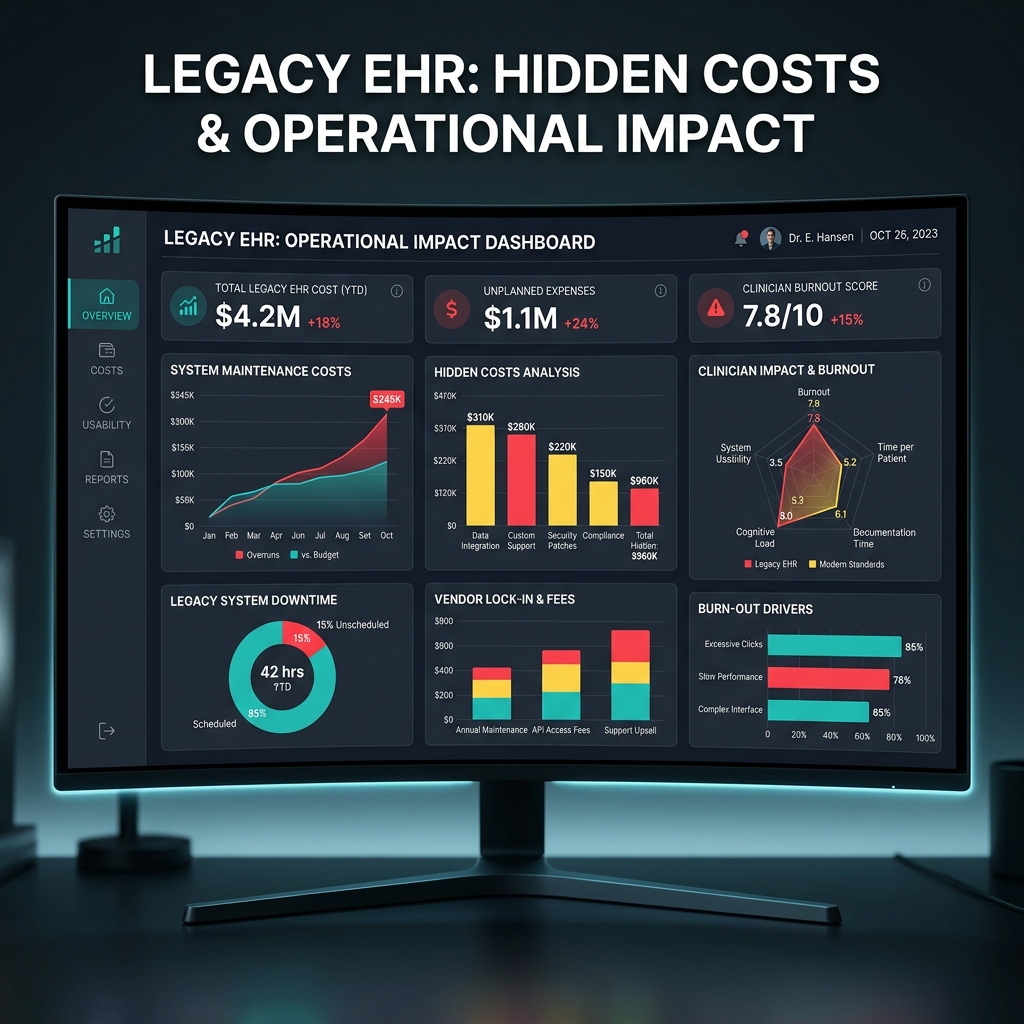
Quick answer: The sticker price of a legacy EHR, Epic, Oracle Health (Cerner), or Athenahealth, is rarely the real cost. Implementation, annual maintenance, staff training, workaround time, and clinician burnout stack on top of licensing fees, often doubling or tripling the number an organization budgeted for. For large deployments, total cost of ownership has run into the tens of millions; even mid-sized implementations routinely exceed $500,000 before ongoing support is factored in.
If your team is frustrated with your current EHR and wondering whether switching is "worth it," the honest answer starts with understanding what staying is already costing you.
The licensing number is just the entry fee
Published pricing for the major legacy platforms varies widely by vendor:
- Epic typically starts around $1,200 per user, or a minimum of roughly $500,000 for larger deployments, and large health system rollouts have run well past that. One well-known hospital system's recent Epic rollout reportedly exceeded $1 billion.
- Oracle Health (Cerner) offers more predictable cloud-based pricing, often starting around $25 per user monthly, which makes it more approachable for mid-sized organizations, though Cerner customers are currently navigating a disruptive migration of the legacy Millennium platform to Oracle Cloud Infrastructure, and some organizations report spending more on that migration than they spent on the original implementation.
- Athenahealth and other ambulatory-focused platforms generally land in a lower band, but still carry substantial implementation and integration costs for anything beyond a basic single-location deployment.
None of these numbers include what happens after go-live.
Implementation and annual maintenance add up fast
For Epic specifically, implementation projects often exceed $500,000 even for mid-sized organizations, and annual support/maintenance typically runs 15–20% of licensing fees, which can mean hundreds of thousands of dollars a year for a large hospital, indefinitely. Oracle Health's Cerner tends to run lower, often around $100,000 annually for an average-sized hospital, but "lower than Epic" is not the same as "affordable."
For organizations evaluating whether to keep investing in a legacy platform, the honest math includes:
- Enterprise licensing
- Infrastructure (servers, network equipment)
- Implementation and integration services
- Organization-wide training programs
- Data migration from whatever came before
- Annual maintenance and support, recurring every year the system is in use
Large practices commonly land in the $2M–$5M range for a comprehensive implementation over 18–24 months. Enterprise hospital systems with 200+ physicians can see $10M–$30M or more, spanning 24–36 months, with $1.5M–$3M in ongoing annual costs after that.
The costs that never show up on an invoice
The line items above are the visible costs. The ones that actually erode a practice's day-to-day operations rarely make it into a vendor contract:
- Workarounds. When a legacy system doesn't fit how a specialty actually documents care, staff build informal workarounds, extra clicks, side spreadsheets, sticky-note reminders, that quietly become part of the daily workflow. Every workaround is unpaid, unmeasured labor that a purpose-built system wouldn't require.
- Clinician time and burnout. Physician burnout tied to EHR usability isn't a fringe complaint, it's a documented, widespread factor in clinical staff turnover. Time spent fighting a system that wasn't built for a specific specialty's workflow is time not spent with patients, and it compounds across every provider, every day, for years.
- Vendor lock-in and integration fees. Connecting a legacy platform to a new tool, a patient logistics system, a specialty charting add-on, a lab interface, routinely costs $25,000–$100,000 per interface. That's a recurring tax on every improvement a practice wants to make, on top of the platform's base cost.
- Platform uncertainty. Some legacy vendors are mid-transition themselves. Oracle Health's move from Cerner Millennium to a cloud-native platform is still in limited deployment as of early 2026, which means organizations on that platform are absorbing risk and disruption on a timeline they don't control.
A more honest way to compare "keep it" vs. "replace it"
Before renewing or expanding a legacy contract, it's worth building out total cost of ownership (TCO) rather than comparing sticker prices:
| Cost category | Often visible in the contract? |
|---|---|
| Base licensing | Yes |
| Implementation | Usually, but frequently underestimated |
| Annual maintenance | Yes |
| Per-interface integration fees | Rarely quoted upfront |
| Staff overtime from workarounds | Never |
| Clinician turnover tied to usability | Never |
| Delayed care from system friction | Never |
The categories that never show up on an invoice are frequently the largest ones over a multi-year horizon, they're just harder to attach a dollar figure to, which is exactly why they get ignored in renewal decisions.
Why some organizations are moving to custom-built alternatives instead
Custom EHR development isn't the right call for every organization, for a large IDN with existing Epic infrastructure and Epic-to-Epic data exchange relationships, ripping and replacing rarely makes sense. But for specialty practices, growing multi-location groups, or organizations that have spent years accumulating workarounds around a generic platform, a system built around the actual workflow, rather than one the workflow has to be bent to fit, often changes the cost equation entirely: fewer workarounds, less integration-fee bleed, and no dependency on someone else's migration timeline. If you do decide to switch, the risk isn't the decision itself, it's how the data moves from the old system to the new one.
Frequently Asked Questions
Is switching away from a legacy EHR ever cheaper than staying?
It depends on scale and how deep the workaround problem already runs. For large IDNs deeply embedded in an Epic or Cerner ecosystem, switching costs can dwarf staying. For smaller or specialty practices paying enterprise-platform overhead for features they don't use, staying can be the more expensive path over a 3–5 year horizon.
What's the biggest hidden cost people underestimate?
Per-interface integration fees. Every new tool a practice wants to connect to a legacy EHR can cost tens of thousands of dollars, and that adds up fast for organizations that are actively trying to modernize piece by piece.
How do I calculate my organization's real TCO on our current EHR?
Start with the visible numbers (licensing, maintenance, implementation amortized over its lifespan), then add a conservative estimate of staff overtime from known workarounds and per-interface costs from the last 12 months of integration work. That number is almost always higher than what's in the original contract.
References
- Epic EHR Pricing 2026: Costs, Fees, and AI Optimization
- Epic EHR Cost 2026: Pricing Per User, Per Month & By Hospital Size
- Epic vs Cerner vs athenahealth - 2026 EHR Comparison
- Epic vs Oracle Health (Cerner): Full EHR Comparison for 2026
- Best EHR Vendors 2026: Epic, Canvas, Athena & Custom Builds
- Reducing Risk in Cerner to Epic Data Conversion
- Cerner vs Epic: EHR Comparison, Costs & Key Differences
Ready to Build for the Future?
Don't let legacy architecture limit your potential. Connect with us to build a flexible, AI-ready healthcare application.
Talk to Our Experts