
Healthcare Interoperability in 2026: The Rules Changed. Most Hospitals Have Not Caught Up.
Author
Fornex Health Team
Published
June 22, 2026
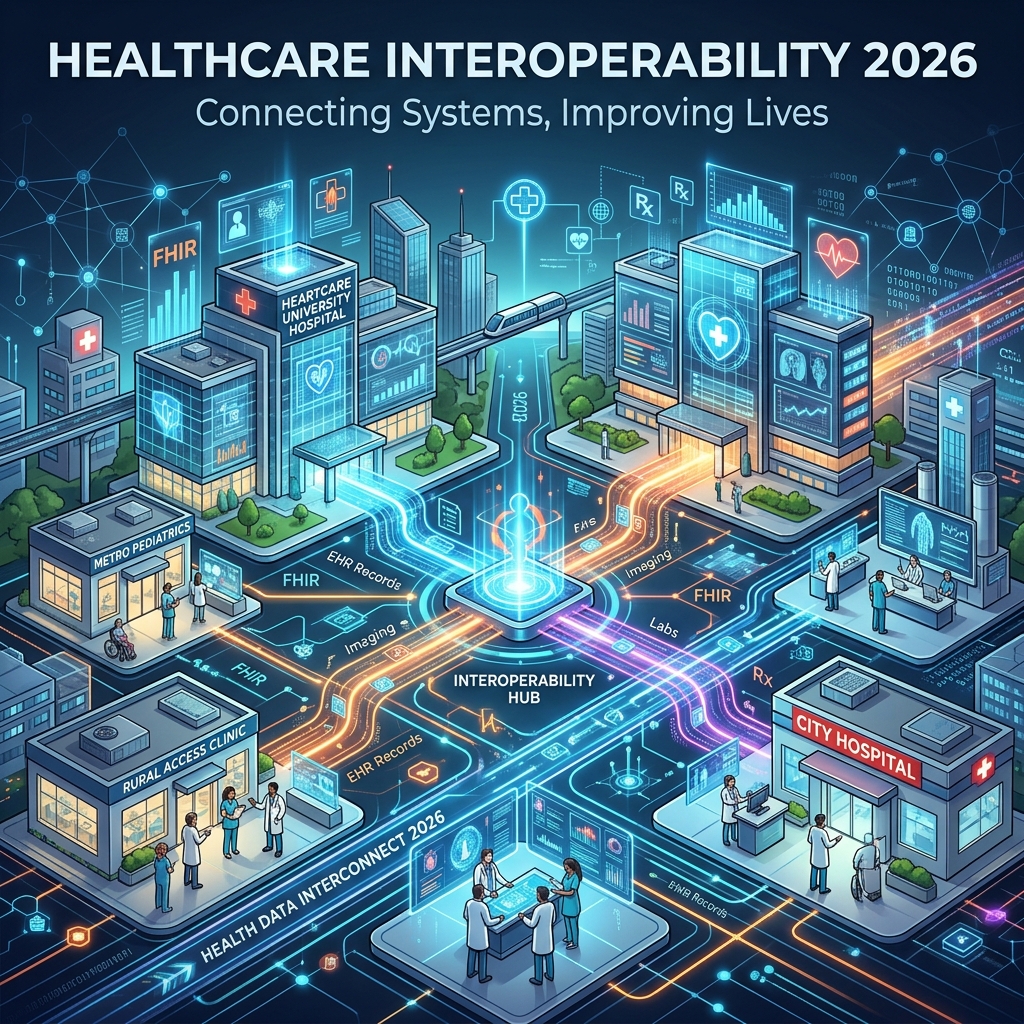
For years, healthcare interoperability was framed as a long-term aspiration. Someday patient data would move freely between systems. Someday a physician could see the complete picture of a patient's history without making three phone calls. Someday the fax machine would retire.
2026 is not someday. The rules are in effect. The enforcement is active. The penalties are real.
Since 2021, the Information Blocking Complaint Portal has been open with nearly 1,600 complaints submitted as of February 2026. For years those complaints sat without consequences. That changed in late 2025. Active enforcement is now underway.
For hospital IT leadership, the interoperability agenda shifted from strategic priority to compliance risk. Here is exactly where things stand in June 2026 along with what your organization needs to do about it.
TEFCA: What It Is Along With Why It Matters Right Now
Think of it as the national highway for health data. Before TEFCA, hospitals connected to other hospitals through individual point-to-point arrangements. Custom interfaces. Proprietary agreements. Each new connection required its own technical work along with its own negotiation. A large health system might maintain dozens of these connections. Each one represents an ongoing maintenance cost along with a potential failure point.
That is a fundamentally different architecture. One connection replaces dozens.
That is not a pilot. That is production-scale government data exchange running on TEFCA today. The network is real along with it is growing.
TEFCA participation is voluntary but rapidly becoming a market expectation. Beginning January 1, 2026, QHINs must adopt HL7 FAST security procedures for all FHIR transactions. Voluntary participation that becomes a market expectation has a way of becoming a practical requirement faster than most hospital planning cycles anticipate.
For the connection between TEFCA participation along with prior authorization automation, read our full breakdown: The FHIR Prior Auth Deadline Is January 2027 - Is Your Hospital Ready?
USCDI v3 Is Mandatory. Today. Not Eventually.
USCDI - the United States Core Data for Interoperability - defines the standardized data elements required for exchange across certified health IT systems. Version 3 expanded that scope significantly. It now includes social determinants of health, health equity data along with expanded insurance information.
Why does this matter for hospital operations? Two reasons.
First, failure to meet USCDI v3 standards may expose organizations to information blocking allegations, certification issues along with contractual noncompliance with payers along with federal programs. If your EHR vendor has not updated to USCDI v3 compliance, you are potentially in violation of federal standards. That is worth a direct conversation with your vendor this week.
Second, USCDI v3 data is the substrate that makes population health analytics work properly. AI-driven risk stratification, readmission prediction, along with chronic disease management tools all depend on structured, standardized data. Organizations running on pre-v3 data standards are feeding their analytics tools incomplete inputs. The insights those tools generate are only as good as the data behind them.
92% of EHR vendors now support FHIR R4. 90% of health systems have FHIR-enabled APIs. 81% of hospitals have enabled patient access APIs. The infrastructure is largely in place. The gap is in using it properly along with staying current with the standards that sit on top of it.
Information Blocking Enforcement Is Not Theoretical Anymore
The definition of information blocking under the 21st Century Cures Act is intentionally broad. Any practice that interferes with the access, exchange along with use of electronic health information counts. That includes overly restrictive data-sharing policies that your legal team put in place without considering the information blocking implications. It includes technical barriers your IT team built years ago to limit EHR access that nobody has reviewed recently. It includes vendor contracts that restrict your ability to move data to a competing platform.
Notice what that list covers. Patient harm means any instance where a clinician could not access records they needed because of a data-sharing restriction. Care delivery impairment means any workflow where a patient's information could not move between systems and clinical decisions were delayed as a result. These are not exotic scenarios. They describe daily operations in most health systems.
The enforcement spotlight is currently on EHR vendors along with health IT developers. But hospital CIOs should not get comfortable. Providers can absolutely get referred to HHS-OIG.
The Three Interoperability Gaps That Create The Most Risk
The vendor contract gap. Many hospital contracts with EHR vendors include data portability restrictions written years ago. Review every vendor contract for clauses that restrict your ability to extract, share along with migrate your own patient data. Those clauses may constitute information blocking. Getting them renegotiated before enforcement attention reaches providers is significantly easier than addressing them under regulatory scrutiny.
The legacy interface gap. 43% of hospitals now engage in all four domains of interoperable exchange - send, receive, find along with integrate - up from 28% in 2018. That means 57% of hospitals are still not fully functional across all four exchange domains. Most of those organizations have legacy HL7 v2 interfaces that were built in the 1990s along with never modernized. Those interfaces cannot participate in FHIR-based exchange. They cannot connect to TEFCA. They cannot support the prior authorization APIs required by January 2027.
A legacy interface audit is not a multi-year project. It is a 30-day discovery exercise that most hospital IT teams can run with existing resources. Do it. What you find will tell you exactly where your FHIR modernization investment needs to go.
The patient identity gap. Interoperability only works if the receiving system can correctly match the incoming data to the right patient. Without reliable patient identity resolution at the front of data exchange, records get merged incorrectly along with patient safety events follow. As exchange volumes increase through TEFCA, the patient identity problem scales proportionally. Organizations that have not invested in master patient index quality along with identity matching infrastructure will see their error rates rise as their exchange volume grows.
What Interoperability Makes Possible That Nothing Else Can
The compliance framing around interoperability is important. It is not the only framing.
TEFCA has expanded to nearly 500 million exchanged health records. That is the largest health data exchange infrastructure in human history. The organizations participating in it have access to longitudinal patient data across care settings that was simply not available before.
The GLP-1 breast cancer research published at ASCO in June 2026 was built entirely on EHR data from one health system. The clinical research that will come from a properly interoperable national health data network is an order of magnitude larger. The GLP-1 data analysis that took one institution years to assemble becomes something any TEFCA-connected health system can replicate.
The AI tools that hospital CEOs are being asked to evaluate - for revenue cycle, for clinical decision support, for population health management - all perform significantly better with access to complete, interoperable patient data. Our blog on what hospital CTOs need to know before piloting agentic AI covers exactly why data infrastructure is the prerequisite that determines whether AI deployments succeed.
The interoperability investment is not just compliance protection. It is the infrastructure that makes the entire technology strategy work.
What to Do This Month
Audit your vendor contracts for data portability restrictions. Identify every clause that limits your ability to access, extract along with share your own patient data. Flag them for legal review against the information blocking definitions.
Review your USCDI v3 compliance status with your EHR vendor. Ask for written confirmation that your current version is compliant. If it is not, ask for the upgrade timeline along with get it in writing.
Map your legacy interfaces. Identify every HL7 v2 interface in your environment. Prioritize by volume along with clinical criticality. The ones carrying the highest volume are your first FHIR modernization targets.
Assess your QHIN connection options. If your EHR vendor participates in TEFCA through a QHIN, you may already have a path to connection that does not require separate infrastructure investment. Find out what that path looks like along with what it costs to activate it.
The interoperability rules have been building for years. The enforcement phase has started. The organizations that treat this as an urgent operational priority in the next 90 days will be in a fundamentally better compliance position - along with a fundamentally better data position - than the ones still treating it as a planning-cycle discussion.
FHIR compliance, TEFCA readiness, USCDI v3 along with information blocking risk all converge on the same underlying problem: healthcare data that does not move properly. Fornex Health specializes in EHR integration, FHIR-based API development along with interoperability architecture for hospitals navigating exactly this environment. Book a 30-minute interoperability readiness call with our team.
References
- Becker's Hospital Review - What's New With TEFCA in 2026: 3 Updates (April 2026)
- Holland & Knight - The Wait Is Over: Information Blocking Enforcement Is Officially Here (February 13, 2026)
- Alston - Information Blocking Enforcement Enters a New Phase in 2026 (February 23, 2026)
- Fierce Healthcare - HIMSS26: HHS Officials Offer Updates on Interoperability Efforts (March 12, 2026)
- CapMinds - EHR Interoperability Solutions for Health Systems in 2026 (May 6, 2026)
- EHR Source - EHR Interoperability in 2026: FHIR, TEFCA Along With What Your Practice Needs to Know (February 18, 2026)
- Fillmore Township - Interoperability Mandates in 2026: What Hospital CIOs Must Prepare For (April 10, 2026)
- AIHC - Privacy, Interoperability Along With Trust in 2026 (February 12, 2026)
- TATEEDA - The Top 20 Healthcare Technology Trends 2026 (April 2026)
- CERTIFY Health - EHR Interoperability 2026: Federal Standards Along With Strategic Roadmap
- Healthcare Law Insights - HHS Crackdown on Information Blocking (March 2, 2026)
- Medcurity - 2026 HIPAA Security Rule Update
Ready to Build for the Future?
Don't let legacy architecture limit your potential. Connect with us to build a flexible, AI-ready healthcare application.
Talk to Our Experts