
How Incomplete Home Care Assessments Create Billing Problems Three Months Later
Author
Fornex Health Team
Published
July 15, 2026
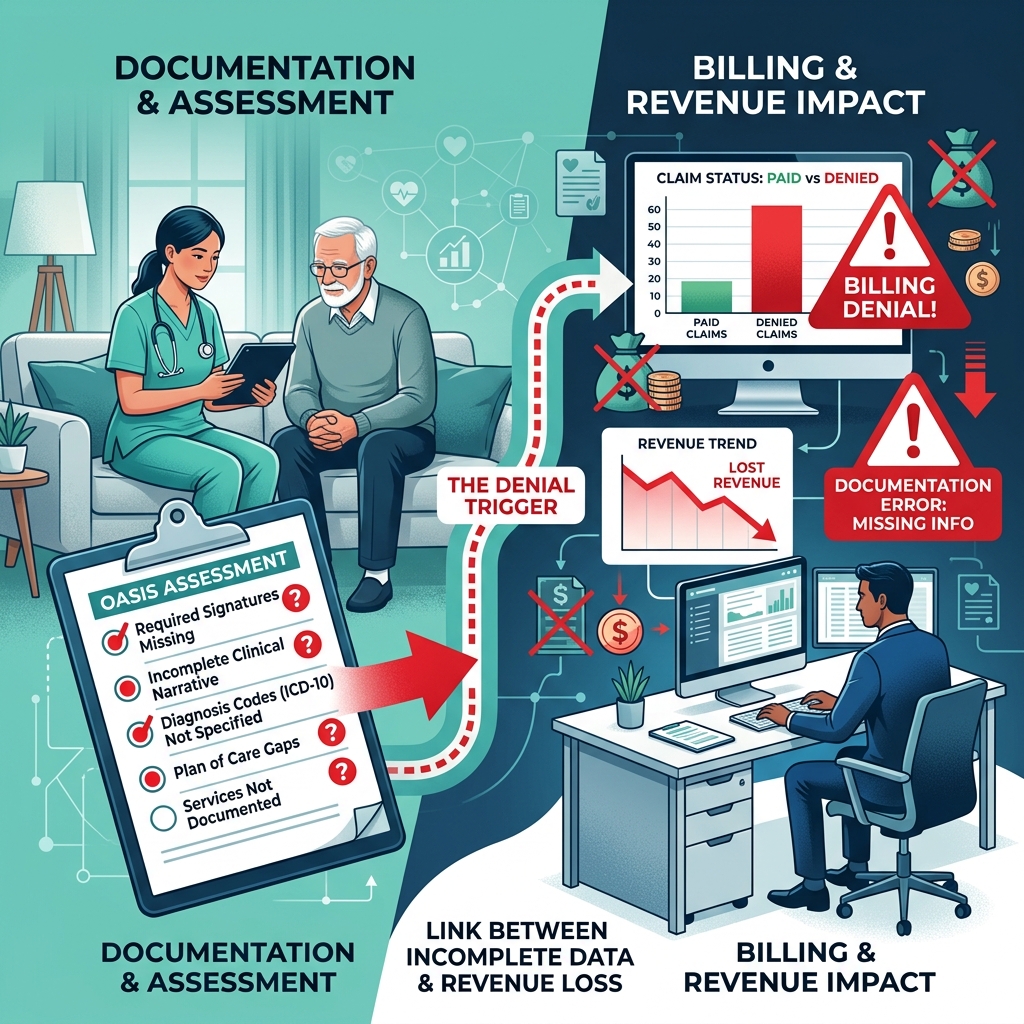
The billing denial arrives weeks after the visits. The clinical team has moved on. The coordinator who handled the admission is working through a different patient's chart. Nobody immediately connects the denial to a documentation decision made at assessment.
That is how assessment-to-billing problems persist. The time lag between the documentation failure along with the billing consequence makes causation difficult to trace without a structured denial analysis process.
Here is the direct connection between assessment documentation gaps along with the specific denial patterns they produce along with what to fix at the assessment stage to stop denials before they start.
Why Assessment Documentation Shows Up in Billing Denials
Every home care claim for Medicare along with most Medicaid programs can be subjected to additional documentation review if a payer or auditor decides to look more closely. When that review happens, the auditor compares the claim against the clinical record to determine whether the services billed were medically necessary along with appropriately documented.
Medical necessity for home care requires evidence that: the patient is homebound, skilled services are required along with the services were ordered by a physician. All three of those elements trace back to the initial assessment along with subsequent visit documentation.
The 2026 DOJ fraud enforcement operation found that documentation not matching billing submissions was the core pattern in home health fraud cases. CMS requires certified agencies to maintain documentation covering medical necessity, OASIS assessments along with detailed plans of care. The enforcement signal is clear: documentation-to-billing alignment is under more scrutiny than at any previous point.
The Homebound Status Gap
For Medicare home health, homebound status is a coverage requirement. A patient who does not meet the homebound definition is not eligible for Medicare home health services regardless of clinical complexity. Homebound means leaving the home requires considerable along with taxing effort due to the patient's condition.
The assessment documentation that establishes homebound status needs to be specific along with observable. "Patient is frail" is not homebound documentation. "Patient requires wheelchair for all ambulation along with is unable to navigate front steps without assistance from two people" is homebound documentation.
Homebound status should be re-documented at every OASIS assessment point along with when the patient's functional status changes. A patient who was homebound at the start of the episode along with whose condition improves during the episode needs updated documentation that reflects the current functional status along with continued clinical justification for ongoing services.
The Skilled Service Justification Gap
Skilled nursing along with therapy services are reimbursed because they require the knowledge along with skill of a licensed professional. The assessment documentation must establish why skilled care is needed rather than just listing what services will be provided.
Documentation that says "patient requires skilled nursing for wound care" is incomplete. Documentation that says "patient has a stage 3 sacral pressure injury with tunneling requiring skilled assessment of wound bed, debridement as clinically indicated along with caregiver education on wound care technique" establishes both the service along with the clinical rationale for skilled involvement.
This level of specificity matters at the assessment along with continues to matter in every visit note. When an auditor reviews a 60-day home health episode, they read every note. Notes that describe tasks without documenting clinical judgment do not support skilled service billing.
The Most Common Assessment-to-Denial Patterns
Pattern 1: ADL documentation that does not match service delivery. The assessment documents moderate independence in bathing. The care plan orders daily personal care visits. The auditor asks why daily personal care visits are needed for a patient documented as moderately independent. The answer is probably that the assessment understated the patient's functional limitations, along with the documentation does not support the service frequency.
Pattern 2: Missing or insufficient physician certification. The physician order certifies home health services but does not specify the skilled services along with visit frequency. A signed order is not enough by itself. The certification must include the services ordered along with the clinical basis for ordering them.
Pattern 3: Assessment data that conflicts with visit notes. The assessment documents one functional status. Notes from four weeks later document a different, improved status with no documentation of the clinical justification for continuing at the same service frequency. The auditor concludes the services were no longer necessary after the improvement.
For a broader look at the billing management framework that catches these patterns before they become denials, read: Home Care Billing Management: The Revenue Cycle Guide for Agencies
Frequently Asked Questions
What is medical necessity in home care?
Medical necessity for Medicare home health requires that the patient is homebound, skilled nursing along with therapy services are required along with the services are ordered by a physician. Each element must be documented specifically in the clinical record to support billing.
How do assessment gaps cause billing denials?
Assessment gaps create billing denials when documentation does not establish homebound status, does not support skilled service need along with does not align with the services billed. Auditors compare clinical documentation against claims to verify that billed services were medically necessary along with appropriately documented.
How often should homebound status be documented?
For Medicare home health, homebound status should be documented at the initial assessment, at every OASIS assessment point along with whenever the patient's functional status changes in a way that may affect eligibility.
What does a home health ADL assessment include?
A home health ADL assessment evaluates the patient's ability to perform bathing, dressing, toileting, transferring, continence along with feeding. Each domain should be documented with specific, observable functional language that describes what the patient can along with cannot do rather than categorical ratings alone.
Ready to Build for the Future?
Don't let legacy architecture limit your potential. Connect with us to build a flexible, AI-ready healthcare application.
Talk to Our Experts