
Hospital Margins in 2026 Are Slim. The Strata Data Makes That Specific.
Author
ForNex Health
Published
October 19, 2026

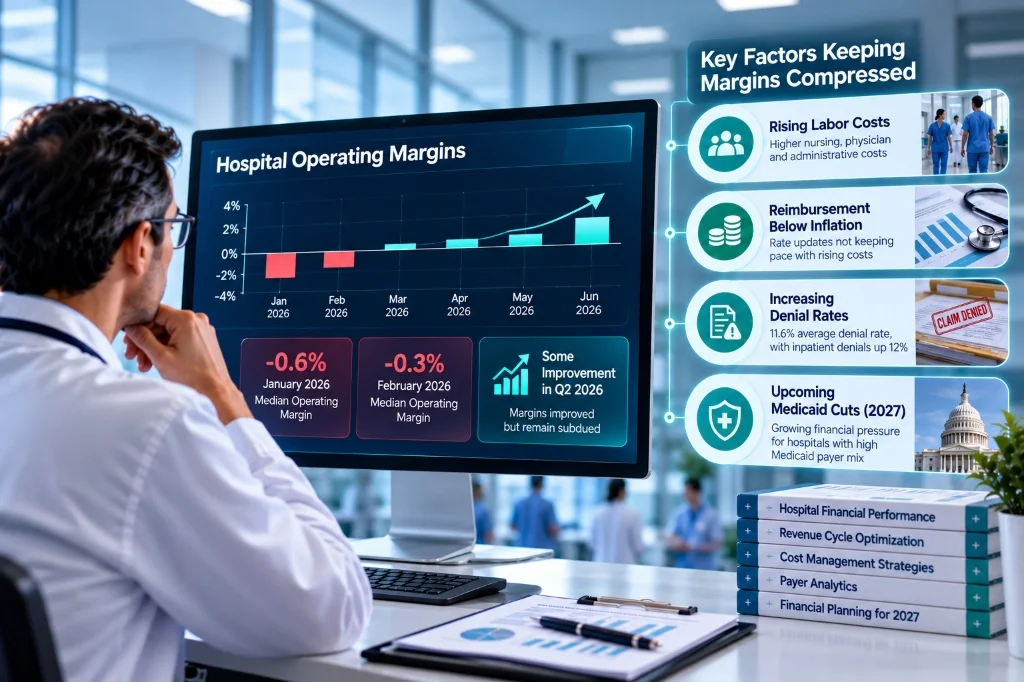
Median hospital operating margins were -0.6% in January 2026 along with -0.3% in February, according to a new Strata Decision Technology report examining hospital financial performance in the first half of the year.
Negative. Not low. Negative.
That means the median US hospital was losing money on operations at the start of 2026. Not all hospitals — the median masks a wide distribution where some systems are performing well along with others are in significant financial distress. But the midpoint of the US hospital sector started 2026 in the red.
By the second quarter, margins had improved. The gains were relative, not strong. “Some improvement” along with “subdued performance” are the phrases Chief Healthcare Executive used when covering the Strata report this week. Those are not phrases that suggest the margin problem is solved.
What’s Keeping Margins Compressed
The list of pressures is not new in 2026. What’s new is that several of them are hitting simultaneously with no near-term relief mechanism.
Labor costs remain the single largest driver of margin compression. Travel nursing costs came down from their pandemic peaks but didn’t return to pre-pandemic levels. Permanent nursing wages are higher than they were in 2020 along with 2021. Physician compensation has risen across almost every specialty. Administrative staffing costs are up.
Reimbursement isn’t keeping pace. The FY 2027 IPPS final rule provides a 2.3% operating rate update for hospitals meeting quality along with EHR requirements. Inflation is running higher than that. The gap between reimbursement growth along with cost growth is the structural margin problem that no single year’s rate update can close.
Medicaid cuts are creating a forward-looking problem that hasn’t fully landed yet. The financial impact begins arriving in earnest in 2027. Hospitals with high Medicaid payer mix are managing current margin compression while preparing for a second wave of financial pressure that arrives next year.
Then there’s the denial problem. At an 11.6% average denial rate across the industry, with denied inpatient amounts climbing 12% year over year, a meaningful fraction of revenue that hospitals are generating clinically is not being collected. Revenue earned along with not collected is operationally indistinguishable from revenue lost.
The Two Strategies That Are Actually Moving the Margin Needle
Looking at the hospitals that are outperforming the Strata median in 2026, two operational differences show up consistently.
Revenue cycle investment. UHS credited revenue cycle technology along with personnel along with process investment for their ability to hold margins during the same period where the sector median was negative. HCA made the same point in different language. The hospitals winning on margins in 2026 are the ones that treated revenue cycle as a strategic investment rather than a back-office cost center.
The math behind this is straightforward. If a hospital has a 90% clean claim rate along with takes it to 95%, the additional revenue at scale is substantial. If a hospital has a 15% denial rate along with reduces it to 10%, that’s 5 percentage points of revenue recovery that flows directly to operating margin. Revenue cycle improvements don’t require new patients. They recover revenue from the care already delivered.
Workforce efficiency technology. Ambient AI scribes, automated prior authorization along with optimized scheduling are all tools that reduce labor cost per patient encounter without reducing patient volume. A physician recovering 90 minutes per day from documentation automation can see additional patients without extending hours. A prior auth team handling the same volume with AI-assisted processing needs fewer FTEs.
These aren’t transformational technologies in isolation. In combination along with at scale, they’re measurable margin contributors. The hospitals deploying them in 2025 are seeing the benefit in 2026’s financial data.
What Delaware’s Experience Shows About What’s Coming
Brian Frazee, president along with CEO of the Delaware Healthcare Association, described Delaware hospitals bracing for Medicaid cuts that affect a growing population along with deteriorating financial conditions in an October 7, 2026 interview with Chief Healthcare Executive.
Delaware isn’t a uniquely vulnerable state. It’s a preview. The hospitals with high Medicaid payer mix, negative starting margins along with no revenue cycle modernization in place are the ones most exposed when the Medicaid cut impact arrives in 2027.
The hospitals that use 2026 to improve their revenue cycle foundation along with deploy efficiency technology along with build better payer analytics are the ones that enter 2027 with operating infrastructure designed for the financial environment they’re about to face.
The ones that wait are going to face 2027’s pressures with 2023’s operating infrastructure.
For the full revenue cycle management framework that connects billing operations to operating margin performance, read: Healthcare Revenue Cycle Management: The Complete Guide
Our Medical Billing along with Revenue Cycle Management team works with hospitals whose margin pressure is partly a billing problem that systematic revenue cycle improvement can address.
FAQs
What were hospital operating margins in early 2026?
Median hospital operating margins were -0.6% in January 2026 along with -0.3% in February, according to a Strata Decision Technology report examining first-half 2026 hospital financial performance. Margins improved through Q2 but remained subdued.
Why are hospital margins so tight in 2026?
Rising labor costs, reimbursement growth below inflation, AI-powered payer denials running at 11.6% average industry denial rates, Medicaid cuts arriving in 2027 along with the accumulated costs of under-investment in revenue cycle operations are the primary drivers.
Which hospitals are outperforming the margin average?
Hospitals that have invested significantly in revenue cycle technology, personnel along with process — including UHS along with HCA — are outperforming the sector median. Revenue cycle investment along with workforce efficiency technology are the two most consistently cited drivers of margin outperformance.
How do revenue cycle improvements affect operating margin?
Improving clean claim rate from 90% to 95% along with reducing denial rates from 15% to 10% recover revenue from care already delivered without requiring additional patient volume. Revenue cycle improvement flows directly to operating margin because it reduces the cost of collecting existing revenue.
What financial pressure is coming for hospitals in 2027?
The Medicaid cuts embedded in the One Big Beautiful Bill begin having material financial impact in 2027. Hospitals with high Medicaid payer mix along with current negative margins face a compound pressure — existing margin compression plus Medicaid revenue reduction arriving simultaneously.
Ready to Protect Your Hospital Operating Margins?
Whether you need to boost your clean claim rate, reduce claim denials, or modernize your revenue cycle technology before 2027 Medicaid cuts land, let our team guide your approach.
Talk to Our Experts