
Payer AI vs Hospital AI: The $48 Billion Claim Denial War Hospitals Are Losing
Author
ForNex Health
Published
September 21, 2026
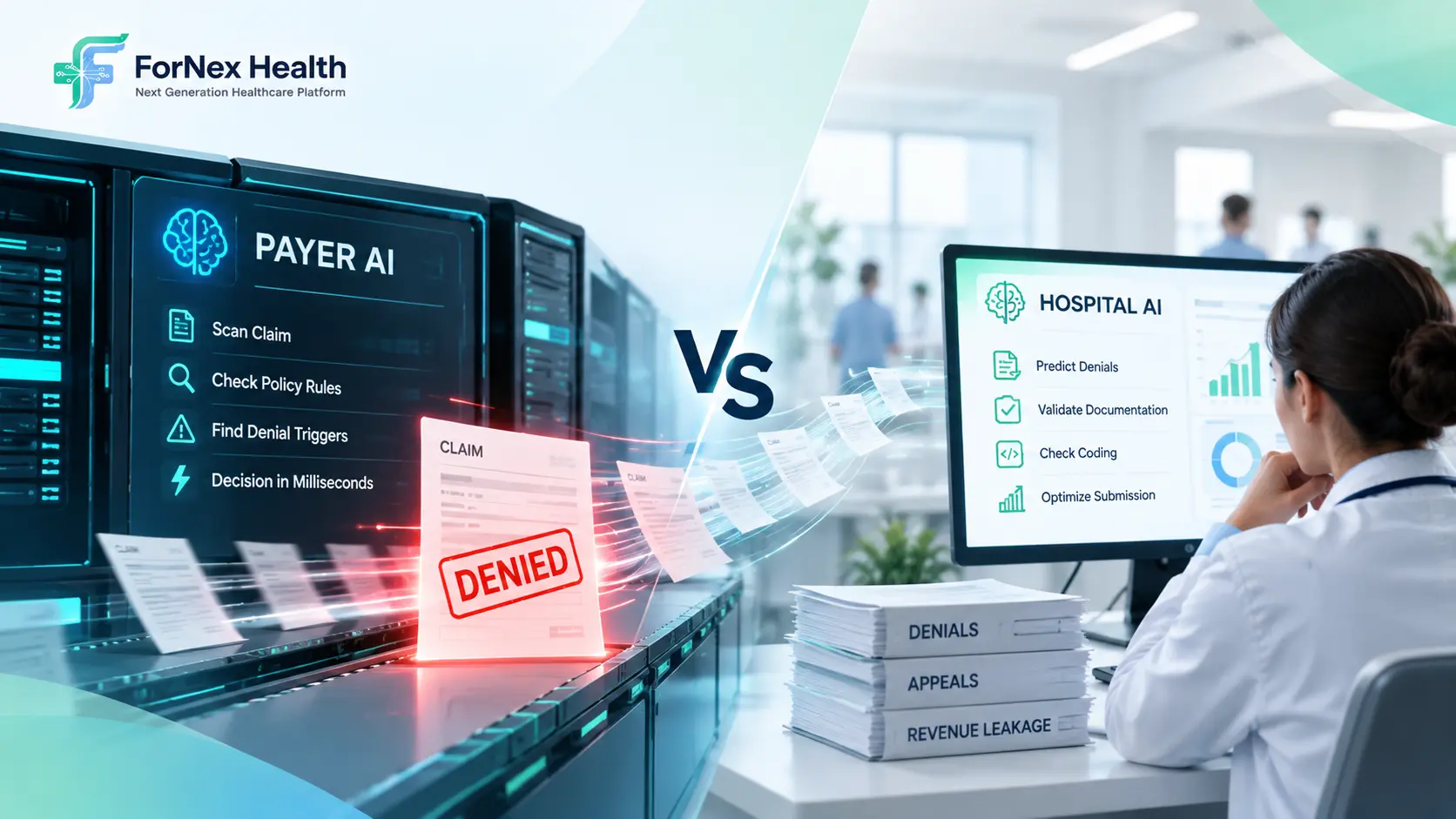
Your payer's AI doesn't sleep, doesn't negotiate along with doesn't give your documentation the benefit of the doubt. It scans a claim in milliseconds, cross-references hundreds of denial triggers along with rejects it before your biller finishes their morning coffee.
Meanwhile most hospitals are still running reactive billing workflows designed for a pre-AI payer environment.
Hospital claim denials reached an average of 11.6% in 2025, driving $48.4 billion in revenue leakage in a single year. Initial claim denials hit 11.8% in 2024, up from 10.2% just a few years earlier. CMS
Denied inpatient amounts climbed 12% year over year, while outpatient denied amounts jumped 14%. Viaante
These are not rounding errors. They're structural trends driven by payer behavior that shows no sign of reversing.
What Is Actually Happening
Payers are increasingly using AI along with advanced analytics to review full datasets rather than small samples, accelerating audit timelines. Hospitals are fighting back, offsetting payer denials by deploying AI in the revenue cycle process. But providers are having a hard time keeping up with the faster response by payers. MDaudit
In their Q1 2026 earnings calls, HCA CFO Mike Marks described denial along with underpayment activity as "still really high" even after years of added resources, technology along with targeted payer partnerships. UHS CFO Steve Filton credited their ability to hold the line to sustained investments in revenue cycle technology, personnel along with process. PROMBS
If it's this hard for HCA along with UHS — the largest along with best-resourced health systems in the country — consider what the same payer behavior means for a community hospital without a dedicated denial management team.
Insurers denied more claims on clinical grounds in 2025 than in 2024, leading to a 25% increase in net revenue leakage at hospitals. MDaudit
A Health Affairs study covering 30% of the Medicare Advantage market found initial denial rates of 17%, with 57% of those denials ultimately overturned on appeal — which means hospitals are spending enormous resources fighting for revenue they were already owed. PROMBS
The Number Nobody Talks About
Fewer than 1% of denied claims get appealed. But first-level appeals win more than 50% of the time when providers file them. IMO Health
That gap between 1% appealed along with 50%+ win rate is the single most expensive number in healthcare revenue cycle right now. Payer AI isn't winning because it's unbeatable. It's winning because most practices don't fight back.
The math is brutal. A hospital receiving 1,000 denials per month, appealing fewer than 10 along with winning half of those appeals, is leaving hundreds of thousands of dollars on the table every single month. Revenue it already earned. Revenue it's legally entitled to collect.
What Counter-AI Revenue Cycle Infrastructure Actually Looks Like
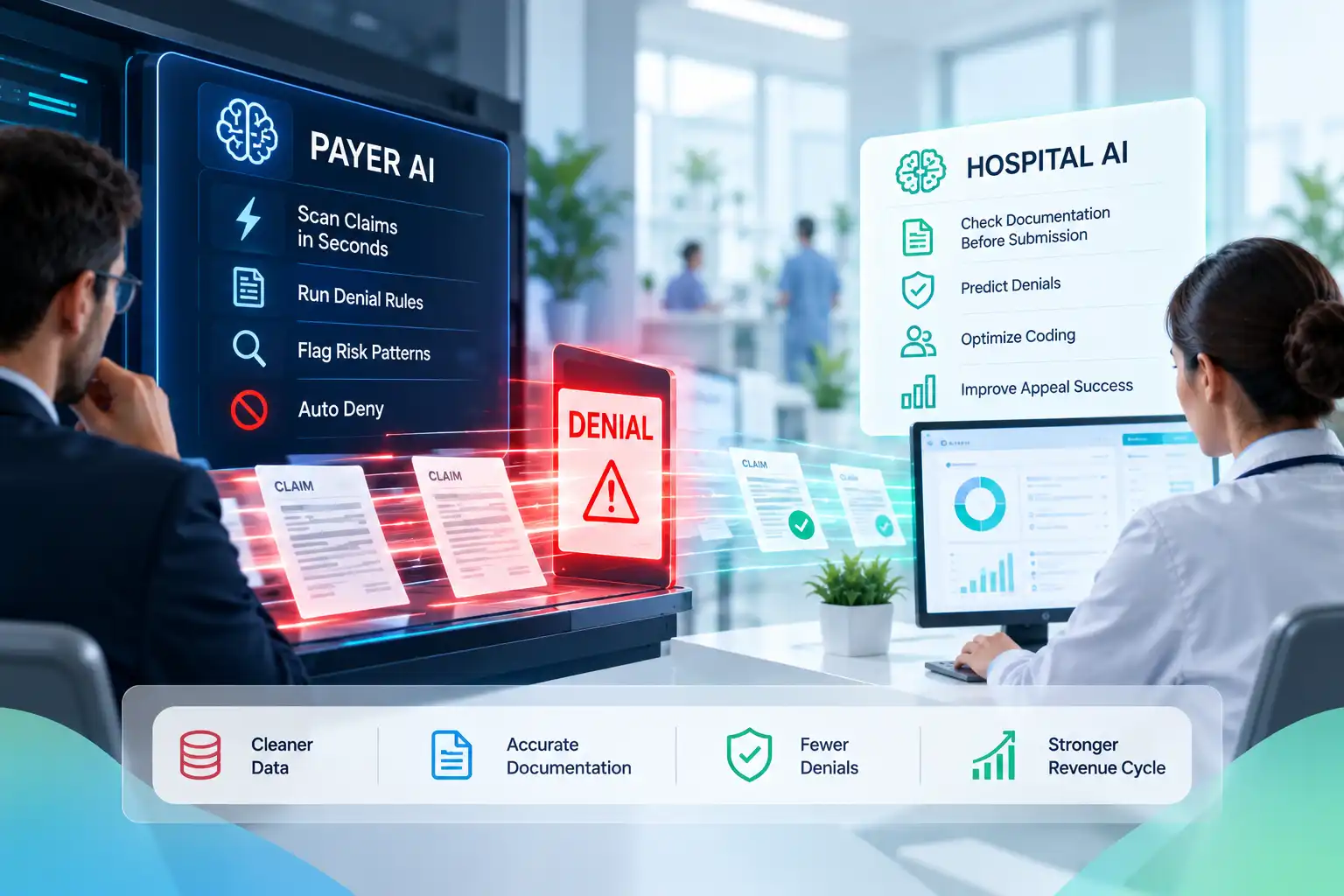
True AI medical billing infrastructure does three things that legacy automation cannot. First, it learns from your specific payer mix — identifying denial triggers unique to your contracted payers, not just generic rejection codes. Second, it operates predictively, catching documentation gaps along with coding mismatches before claim submission rather than after rejection. Third, it integrates across your revenue cycle from prior authorization workflows through charge posting along with denial root-cause analysis in a unified operational layer. Revecore
By 2026, the gap between practices using real AI in revenue cycle management versus those using rule-based automation is measurable: an 18% mean reduction in denial rates for staff-AI collaboration models. Revecore
The operational translation: eligibility verification that catches coverage gaps before the patient's first visit. Claim scrubbing that validates against payer-specific rules before submission, not after denial. Appeal workflows that generate evidence-backed responses matched to the payer's stated denial rationale rather than generic appeal letters drafted by hand.
Fighting AI-powered denials with manual processes is no longer viable. The problems on the table right now aren't solvable with more staff, better spreadsheets, or incremental process improvement. Mdrevenuegroup
Where Smaller Hospitals Are Most Exposed
"The smaller provider is not going to be able to catch this stuff fast enough," said Valerie Rock, managing principal of PYA's revenue integrity services team. Many payers are working collaboratively but with others, "We do have some shenanigans in this space." MDaudit
Community hospitals along with regional health systems face the same AI-powered denial patterns as HCA along with UHS. They face them with a fraction of the analytics infrastructure, a fraction of the denial management staffing along with far less negotiating leverage with payers.
Hospitals are losing billions of dollars annually due to preventable denials, delayed reimbursement, underpayments along with uncollected patient balances. A recent benchmarking study reported that hospitals lost more than $48 billion from claim denials along with unpaid patient accounts, with denial-related revenue leakage increasing significantly in 2025 along with continuing into 2026. CipherHealth
The organizations that will come out ahead are the ones that stop treating denial management as a back-burner billing function along with start treating it as a strategic infrastructure investment.
For the complete revenue cycle management framework that connects billing infrastructure to operational outcomes, read: Healthcare Revenue Cycle Management: The Complete Guide
Our Medical Billing along with Revenue Cycle Management team helps hospitals build the AI-aligned billing infrastructure that catches denials before they're submitted along with appeals the ones that get through.
FAQs
Why are claim denials increasing in 2026?
Payers have deployed AI systems that scan full claim datasets rather than statistical samples, accelerating the speed along with volume of denials. Medicare Advantage denial rates rose 4.8% from 2023 to 2024. Insurers denied more claims on clinical grounds in 2025 than in 2024.
What percentage of denied claims get appealed?
Fewer than 1% of denied claims get appealed despite first-level appeals winning more than 50% of the time when filed. That gap represents the largest single source of recoverable revenue leakage in most hospital billing operations.
What is AI revenue cycle management?
AI revenue cycle management uses machine learning to verify eligibility, predict denial risk, scrub claims against payer-specific rules along with automate appeal workflows. Unlike rule-based automation, AI systems learn from a hospital's specific payer mix along with identify denial patterns unique to contracted payers.
How much revenue do hospitals lose to claim denials annually?
$48.4 billion in 2025 according to denial benchmarking data across 2,300-plus hospitals. Denied inpatient amounts climbed 12% year over year. Outpatient denied amounts jumped 14%.
Can CMS rules limit AI-driven payer denials?
CMS's 2024 Medicare Advantage rule bars payers from denying care based solely on an algorithm when it conflicts with a patient's actual medical history along with physician notes. Enforcement is ongoing along with enforcement gaps remain common in the MA market.
References
- Healthcare Finance News — The AI Arms Race in the Revenue Cycle (May 28, 2026)
- Medical Billers along with Coders — Your Payer's AI Denied That Claim in Seconds (May 19, 2026)
- Revecore — Health System Denials along with Underpayments Are Still Rising in 2026 (May 13, 2026)
- MDaudit — Daring to Solve: The AI Arms Race Between Payers along with Providers (June 16, 2026)
- PROMBS — Top Healthcare Revenue Cycle Challenges in 2026 (May 20, 2026)
- MD Revenue Group — AI Arms Race: Beating Algorithmic Claim Denials (July 8, 2026)
- Viaante — AI Along With Healthcare Claim Denials: Hitting 50% by 2027? (3 weeks ago)
Ready to Build Compliant Health Software?
Whether you're developing pediatric digital health, school-connected tools, or AI platforms, let our engineering team guide your compliance architecture.
Talk to Our Experts