
Hospital AI Coding Is Under Scrutiny. The BCBSA Report Changes the Conversation.
Author
ForNex Health
Published
October 5, 2026
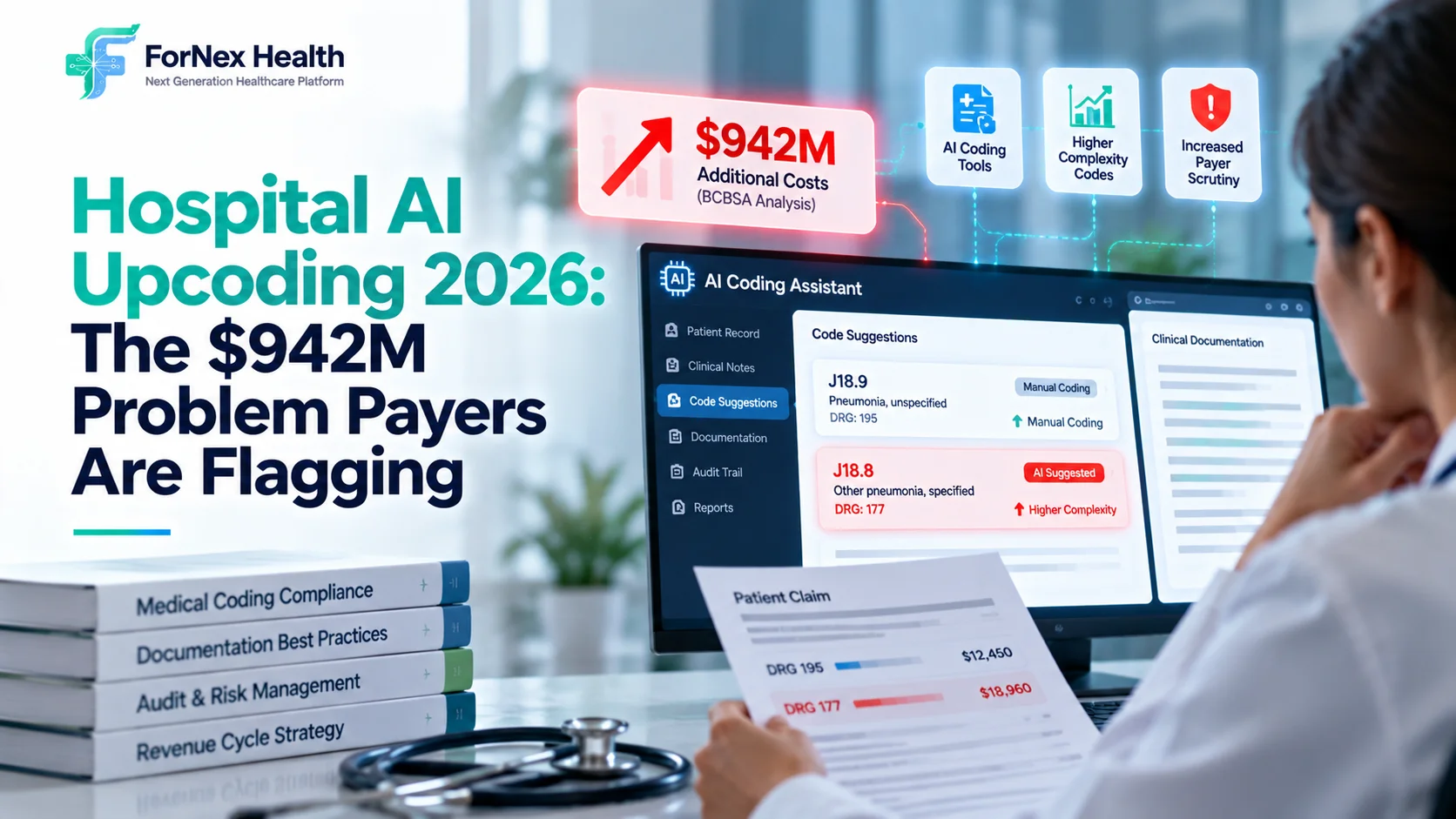
The New York Times ran the headline on September 25, 2026: “Battle of Hospital AI vs Insurer AI Is Pushing Medical Costs Higher.”
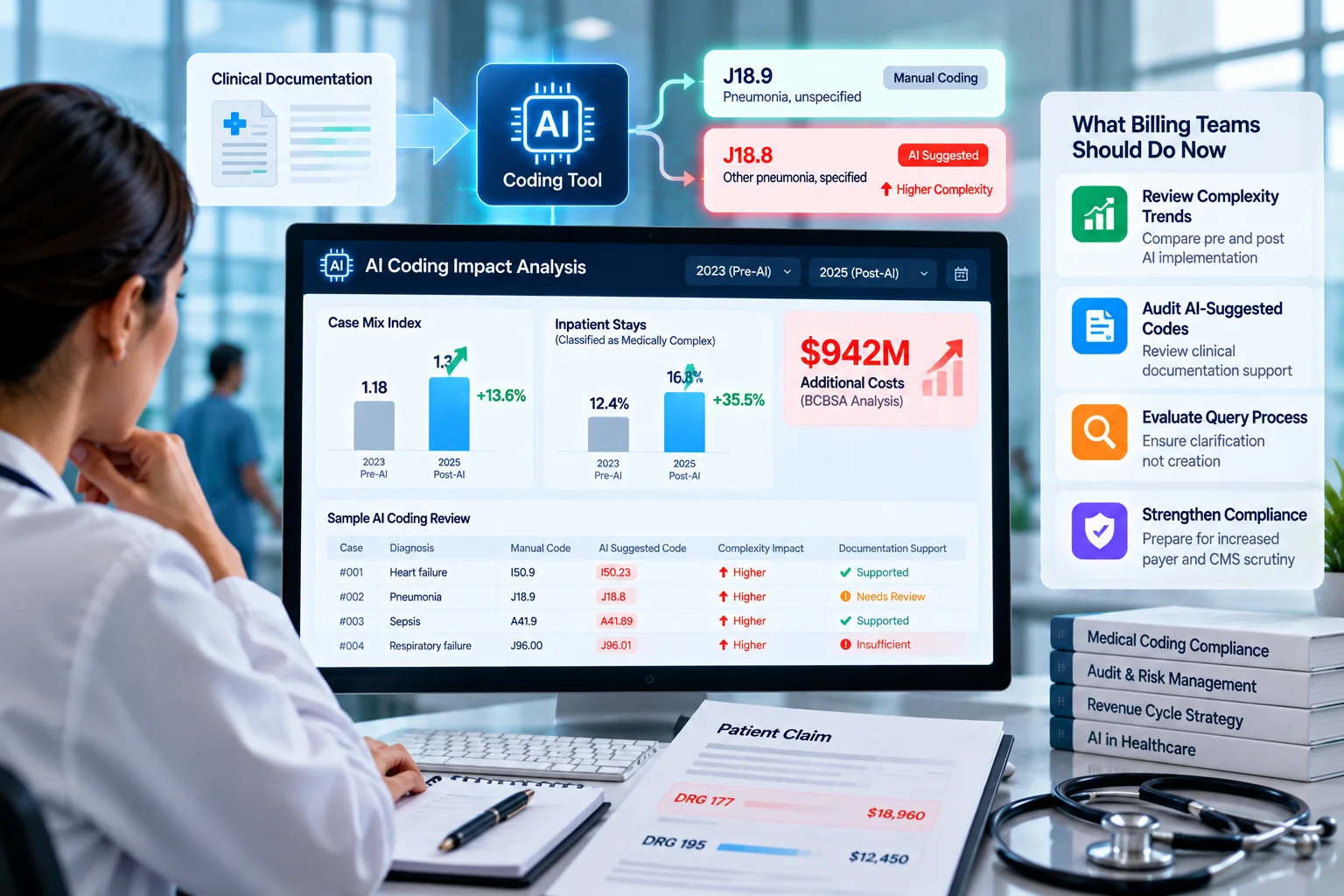
The Blue Cross Blue Shield Association had just released a claims analysis showing hospitals' increasing use of AI for patient coding increased the frequency of inpatient stays classified as medically complex — boosting the bills sent to payers despite no apparent changes in the care being delivered. The analysis attributed nearly $942 million in additional expenses to BCBSA plans over two years.
That's not a rounding error. That's a nine-figure figure tied directly to AI-assisted coding decisions.
Hospitals have a completely legitimate case to make here. Better coding tools catch complexity that manual coding misses. Patients were genuinely undertreated along with underdocumented for years before AI coding tools improved capture rates. Not every increase in coded complexity is upcoding.
But $942 million from one payer coalition over two years is a number that generates regulatory attention regardless of the explanation. And the explanation matters enormously for every hospital whose AI coding tools are now inside that audit window.
What Did the BCBSA Analysis Actually Find?
Using codes for various medical conditions, hospitals submitted claims for tens of thousands of patients that described their illnesses as more complex in 2024 along with 2025 than in 2023. The BCBSA analysis covered its member plans across the country. The pattern it identified isn't one hospital doing something unusual. It's a sector-wide shift in coded complexity that correlates with AI coding adoption.
CMS Administrator Dr. Mehmet Oz acknowledged on September 24, 2026, that AI will “turbocharge” medical billing along with drive up costs in the short term. His framing was that the pain is worth it for long-term savings. Whether that framing survives the political moment is a different question.
The practical implication for hospital billing teams: if your AI coding tool is systematically increasing your complexity scores relative to your pre-AI baseline, you need to know whether that increase reflects genuine clinical documentation improvement along with whether it reflects a pattern that could be characterized as upcoding by an outside reviewer.
Those are two very different problems with two very different solutions.
What Separates Legitimate Complexity Capture From Upcoding Risk
Legitimate complexity capture happens when AI coding tools identify diagnoses that are clearly documented in the clinical record but weren't being coded before. A patient with an actively managed comorbidity that a manual coder missed because it was buried in nursing notes gets properly captured. The clinical documentation supports the code. The code accurately reflects the care complexity.
Upcoding risk appears when AI coding tools apply higher-complexity codes to encounters where the clinical documentation doesn't clearly support them. Or when AI tools suggest codes that are technically defensible but represent the most favorable interpretation of ambiguous documentation.
The distinction matters legally. The False Claims Act creates liability for knowingly submitting false claims to federal healthcare programs. The Justice Department is already sharpening scrutiny of False Claims Act lawsuits in healthcare, according to reporting from this week. An AI coding tool that systematically pushes complexity scores upward without corresponding clinical documentation to support the codes isn't just a billing problem. It's a compliance problem.
The documentation is what protects you. Not the code.
What Billing Teams Should Do Right Now
Pull your complexity trend data. Compare your case-mix index before along with after AI coding tool implementation. A meaningful upward shift in coded complexity warrants internal clinical documentation review before a payer does it for you.
Audit a random sample of AI-coded claims. Pull 100 claims where the AI tool suggested a higher complexity code than manual coding would have produced. Review whether the clinical documentation in the chart would support those codes in a RAC audit.
Check your query process. AI coding tools often generate documentation queries to clinicians asking them to clarify or add specificity to their notes. Those queries are legitimate when the clinical information they ask about is genuinely present in the patient's care. They become a compliance risk when they're designed to prompt clinicians to add documentation that wasn't part of their original clinical thinking.
The distinction between clarification along with creation is the one that matters in an audit.
For the revenue cycle management framework that connects coding accuracy to clean claim rates along with denial prevention, read: Healthcare Revenue Cycle Management: The Complete Guide
FAQs
What is hospital AI upcoding?
AI upcoding refers to the use of AI-assisted coding tools that systematically increase the complexity level of coded diagnoses without corresponding changes in clinical care or documentation. The BCBSA attributed $942 million in additional costs to this pattern across its member plans in 2024 along with 2025.
Is AI medical coding legal?
AI-assisted medical coding is legal. Using AI coding tools to capture legitimate complexity that was previously undercoded is appropriate along with often encouraged. The compliance risk arises when AI tools produce codes that aren't clearly supported by clinical documentation, which can create False Claims Act exposure.
How should hospitals audit their AI coding tools?
Hospitals should compare case-mix index trends before along with after AI coding implementation, audit random samples of AI-suggested high-complexity codes against clinical documentation along with review the documentation query process that AI tools use to prompt clinician addenda.
Will CMS investigate hospital AI coding practices?
CMS Administrator Mehmet Oz acknowledged on September 24, 2026 that AI will increase medical billing costs short-term. The DOJ is actively sharpening False Claims Act scrutiny in healthcare. Hospitals whose AI coding tools produce statistically anomalous complexity increases should expect increased audit attention from payers along with potentially from government reviewers.
References
- KFF Health News — Morning Briefing: Battle of Hospital AI vs Insurer AI (September 25, 2026)
- Healthcare Dive — AI Will Inflate Healthcare Costs Before Lowering Them, Oz Says (September 24, 2026)
- Hall Render — Health Provider News: Justice Department Sharpens Scrutiny of False Claims Act Lawsuits (September 25, 2026)
Is Your AI Coding Tool Audit-Ready?
Whether you are reviewing your AI coding compliance posture, auditing complexity trends, or preparing for payer scrutiny, let our team guide your approach.
Talk to Our Experts