
FY 2027 IPPS Final Rule: What CMS's July 31 Decision Means for Your Hospital IT Strategy
Author
ForNex Health
Published
September 25, 2026
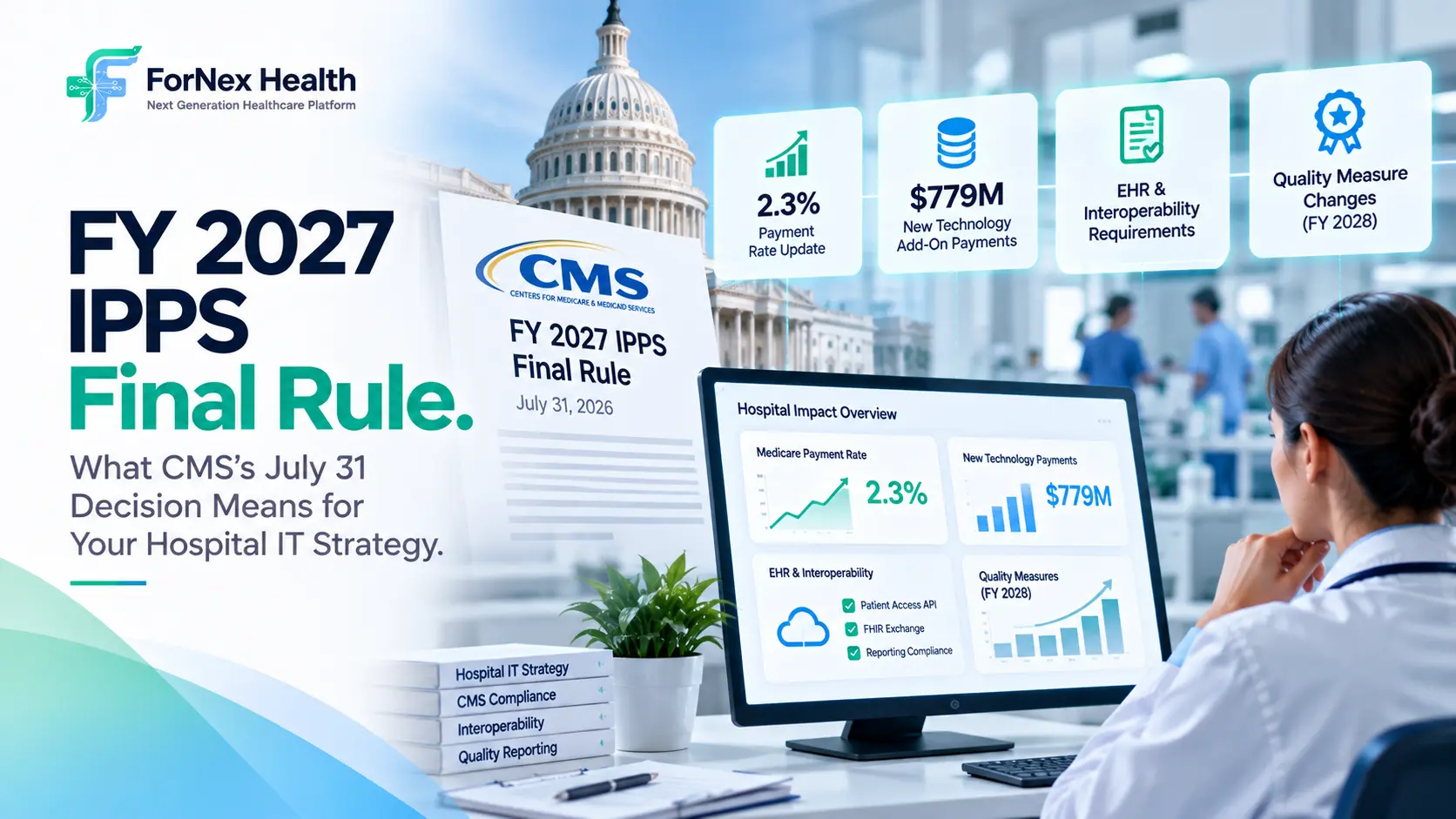
CMS published the FY 2027 Inpatient Prospective Payment System Final Rule on July 31, 2026. Most hospital finance teams are still working through it.
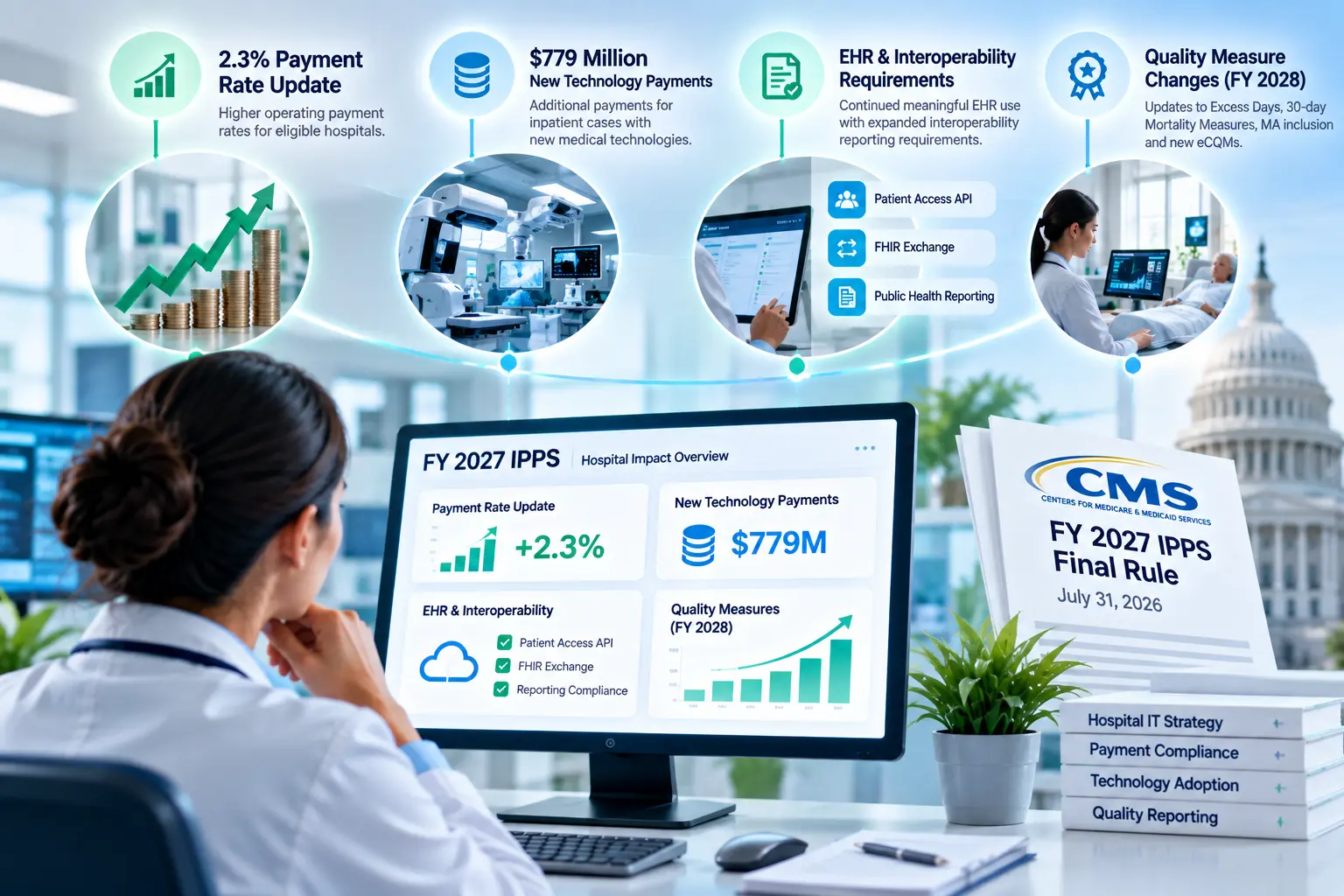
CMS finalizes a 2.3% increase in operating payment rates for general acute care hospitals that participate in the Hospital Inpatient Quality Reporting program along with are meaningful EHR users. This increase is the result of a 3.2% market basket update reduced by a 0.9% productivity adjustment. Medical Billers and Coders
A 2.3% rate increase when inflation is running at 3-plus percent along with commercial labor costs have risen significantly more is not a comfortable margin. That math is familiar to every CFO who has opened an IPPS rule in the past four years.
But the payment rate number isn't the most strategically important part of this rule for IT leaders. The technology payment provisions are.
The $779 Million New Technology Add-On Payment Signal
CMS estimates that additional payments for inpatient cases involving new medical technologies will increase by approximately $779 million, primarily driven by new approvals for new technology add-on payments. Medical Billers and Coders
New Technology Add-On Payments are supplemental Medicare reimbursements for technologies that represent a substantial clinical improvement but are too new for their costs to be reflected in DRG weights. For hospital technology leaders, NTAP status on a specific tool changes the financial model for that tool's adoption.
AI-assisted technologies with NTAP approval get reimbursed at the point of patient care rather than absorbed as a capital cost by the hospital. That changes the ROI calculation meaningfully along with it's part of why AI tool vendors are increasingly pursuing FDA clearance along with NTAP applications simultaneously.
If you're evaluating AI clinical tools along with comparing vendors, NTAP status is a procurement filter worth applying. Tools without NTAP coverage impose the full cost burden on the hospital's operating budget. Tools with NTAP coverage recover part of that cost per qualifying case.
The EHR Along With Interoperability Requirements That Shift
The 2.3% rate increase is conditioned on meaningful EHR user status. That's not new. What's new is the interoperability performance reporting requirements that accompany FY 2027.
Medicare Promoting Interoperability program requirements continue as a condition of full rate eligibility. Hospitals failing to meet interoperability reporting thresholds face payment penalties that reduce their effective operating rate below the 2.3% update. Medical Billers and Coders
The Promoting Interoperability program measures patient access API adoption along with query-based exchange along with public health data reporting. Hospitals whose FHIR API implementation hasn't reached required performance thresholds are generating a payment penalty on every Medicare inpatient claim.
For hospitals that haven't yet built FHIR-compliant patient access APIs along with those with partial implementations that aren't meeting query response benchmarks, this is a revenue loss that compounds across every Medicare inpatient case.
The Quality Measures That Affect FY 2028 Payment Now
CMS finalizes modifications to three Excess Days in Acute Care measures beginning with FY 2028 payment determination along with finalizes five modified Hospital 30-day All-Cause Mortality measures also beginning with FY 2028, adding MA patients along with shortening the performance period from three to two years. Medical Billers and Coders
These are FY 2028 payment determination changes, but the performance period that determines FY 2028 payment starts now. Mortality along with excess acute care days for Medicare Advantage patients will factor into payment for the first time. If your quality measurement infrastructure doesn't currently capture MA patient outcomes separately, you're building an FY 2028 measurement gap in real time.
CMS also finalizes mandatory reporting for the Malnutrition Care Score eCQM along with a mandatory reporting policy for hospital harm eCQMs, both beginning with FY 2030 payment determination. Medical Billers and Coders
eCQM reporting requires structured clinical data flowing from the EHR into CMS reporting infrastructure. Hospitals whose clinical documentation doesn't generate the structured data elements these measures require will face a reporting infrastructure project along with not just a policy project.
What This Rule Should Change in Your Technology Roadmap
Three concrete adjustments to make now:
First: Audit your Promoting Interoperability performance against the current thresholds. If you're below benchmark on patient access API response times along with query-based exchange along with public health reporting, quantify the payment impact across your Medicare inpatient volume. That dollar amount is your technology investment justification for FHIR infrastructure improvements.
Second: Map your clinical documentation workflows against the MA patient quality measures that take effect for FY 2028. Identify which structured data elements are missing along with whether your EHR is configured to capture them.
Third: When evaluating AI clinical tools, add NTAP status to the procurement filter alongside HIPAA compliance along with EHR integration capability. The reimbursement difference between NTAP-eligible along with non-eligible tools is material to the total cost of ownership calculation.
For a broader look at how CMS interoperability mandates connect to your FHIR infrastructure investment, read: The FHIR Prior Auth Deadline Is January 2027
Our EHR along with EMR Integration Solutions team builds the FHIR-compliant API infrastructure along with eCQM reporting connections that determine whether your hospital meets Promoting Interoperability benchmarks along with avoids payment penalties.
FAQs
What is the FY 2027 IPPS Final Rule?
The FY 2027 Inpatient Prospective Payment System Final Rule, published July 31, 2026, sets Medicare payment rates along with quality reporting requirements for hospital inpatient stays beginning October 1, 2026. It finalized a 2.3% operating payment rate increase along with $779 million in new technology add-on payments.
What is the Medicare payment rate increase for FY 2027?
2.3% for hospitals that participate in the Hospital Inpatient Quality Reporting program along with meet meaningful EHR user requirements. The rate reflects a 3.2% market basket update reduced by a 0.9% productivity adjustment.
What are New Technology Add-On Payments?
NTAP payments are supplemental Medicare reimbursements for new technologies representing substantial clinical improvement whose costs aren't yet reflected in DRG weights. $779 million in NTAP payments are projected for FY 2027, primarily from newly approved technologies.
How does the FY 2027 rule affect hospital IT strategy?
The rule creates payment incentives for FHIR-compliant EHR interoperability through Promoting Interoperability requirements, financial penalties for hospitals not meeting exchange benchmarks along with new eCQM reporting mandates requiring structured clinical data infrastructure.
When do the new mortality measures take effect?
The modified 30-day All-Cause Mortality measures — which add Medicare Advantage patients along with shorten the performance period — begin with FY 2028 payment determination. Performance data collection begins now.
References
- Sachs Policy Group — Weekly Health Care Policy Update — August 7, 2026 (1 week ago)
- CMS — FY 2027 IPPS along with LTCH PPS Final Rule (July 31, 2026)
- HCE Global — The 2026 CMS Mandates: Navigating Accountability along with Interoperability (January 2, 2026)
- Microscope HC — Hospital Revenue Cycle in 2026: Financial Pressure along with AI Transformation (June 12, 2026)
Ready to Build Compliant Health Software?
Whether you're developing pediatric digital health, school-connected tools, or AI platforms, let our engineering team guide your compliance architecture.
Talk to Our Experts