
Hospital M&A Is Closing in Fall 2026. The Technology Commitments Inside These Deals Are the Real Story.
Author
ForNex Health
Published
October 20, 2026
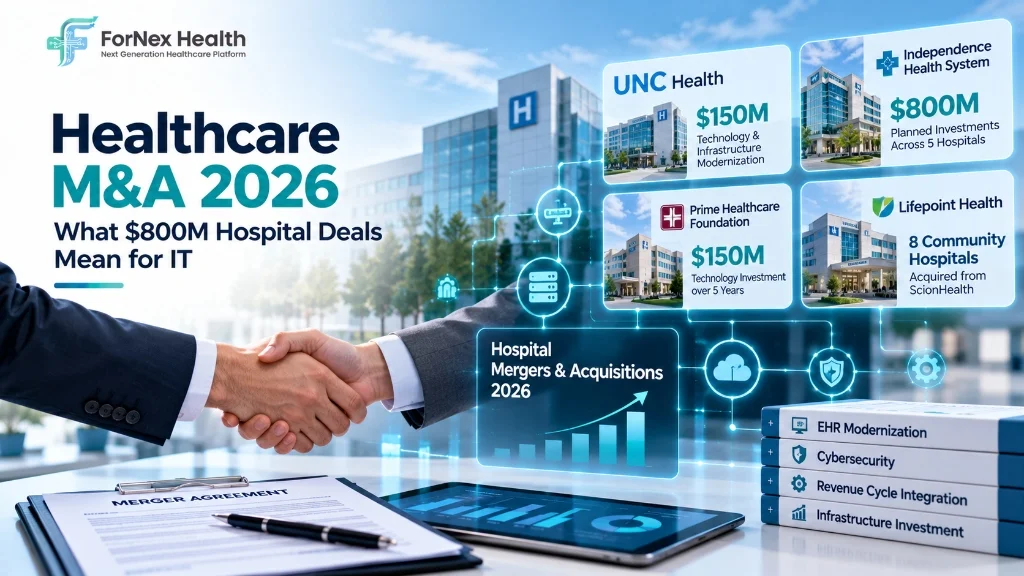
Several major hospital acquisitions are scheduled to close in September along with October 2026. Reading through the deal announcements, a pattern shows up that wasn’t as common in healthcare M&A five years ago.
Technology investment has become a standard condition of hospital merger agreements.
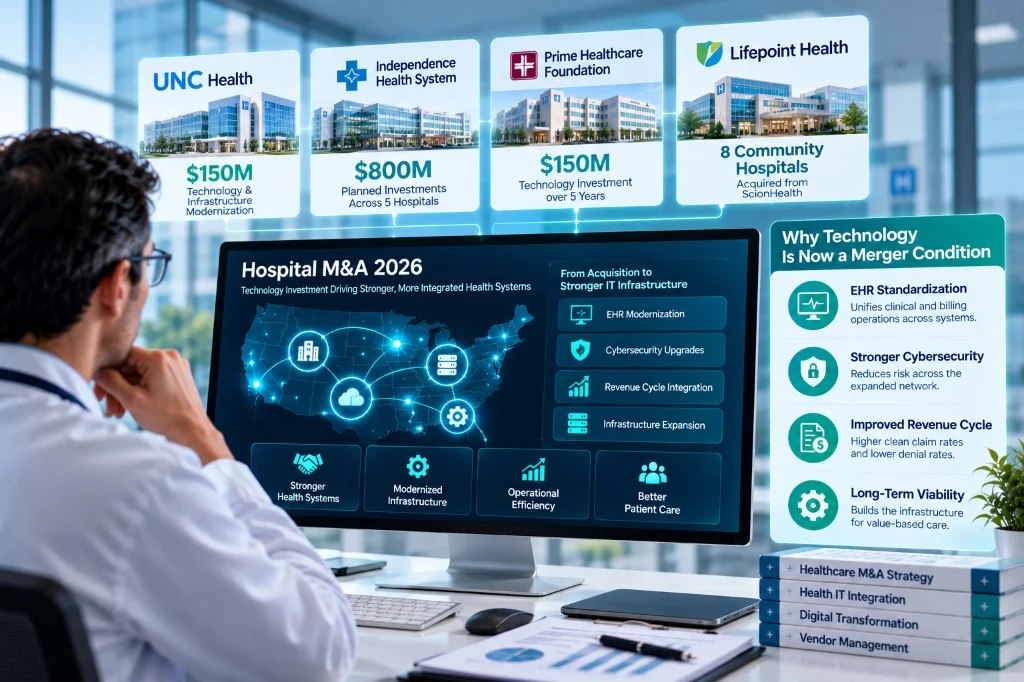
UNC Health’s acquisition includes a commitment to invest more than $150 million to modernize technology along with infrastructure. The Independence Health System deal, closing in late September along with early October, includes $800 million in planned investments across Independence’s five hospitals. Prime Healthcare Foundation’s acquisition of Central Maine Healthcare includes $150 million over five years. Lifepoint Health has acquired eight community hospitals from ScionHealth.
These aren’t deals where technology is mentioned as an afterthought. The dollar amounts committed to technology along with infrastructure modernization are part of the deal structure along with part of the regulatory approval package along with part of what makes the acquisition viable for the acquired organization’s board along with community stakeholders.
Why Technology Commitments Became a Merger Condition
Hospital board members along with community stakeholders evaluating an acquisition offer have become more sophisticated about what the deal means operationally. A commitment to keep the hospital open along with maintain service lines is no longer sufficient assurance on its own. They want to know the acquirer will invest in the infrastructure that makes the hospital competitively viable over the next decade.
That infrastructure is increasingly defined as technology. EHR modernization, cybersecurity infrastructure, AI-enabled clinical workflows along with revenue cycle systems are what determine whether a community hospital can attract physicians, maintain accreditation along with generate the operational efficiency needed to survive in the current financial environment.
For acquirers, committing to technology investment is also a signal to payers, physicians along with staff that the post-merger organization will have the infrastructure needed to participate in value-based care contracts along with deliver at the quality levels that CMS along with commercial payers increasingly require.
What the UNC Health $150 Million Technology Commitment Covers
UNC Health’s stated commitment to invest more than $150 million to modernize technology along with infrastructure is significant both in amount along with in framing.
“Modernize technology along with infrastructure” in the context of an academic health system-community hospital acquisition typically covers several categories. EHR migration to the acquiring system’s platform along with usually Epic for health system acquisitions — is generally the largest single cost along with the most operationally disruptive. It also generates the most long-term value because it puts acquired hospitals on the same clinical along with billing infrastructure as the parent system.
Cybersecurity infrastructure investment is increasingly part of the modernization package because acquiring systems know their cybersecurity posture is only as strong as the weakest-defended hospital in their network. A community hospital running on legacy systems with outdated security infrastructure is a liability for the entire system’s cyber risk profile.
Revenue cycle system integration is the financial side of the same infrastructure investment. Acquired hospitals on different billing systems, different clearinghouses along with different denial management workflows create operational complexity that reduces the combined organization’s revenue cycle efficiency until the integration is complete.
The $150 million over an integration timeline is a large commitment. It’s also, for a moderately sized community hospital system, approximately what a proper technology modernization costs when you factor in EHR migration, infrastructure security along with revenue cycle integration together.
What the Lifepoint ScionHealth Acquisition Means for Community Hospital IT
Lifepoint’s acquisition of eight community hospitals from ScionHealth is a different profile from the UNC Health deal. Lifepoint is a for-profit operator scaling through acquisition. ScionHealth had been managing those eight hospitals as a portfolio that wasn’t core to its strategy.
Community hospital acquisitions by for-profit operators follow a different technology investment pattern than academic health system acquisitions. The EHR standardization happens but on the acquirer’s existing platform along with timeline. The operational efficiency target is usually revenue cycle performance — driving clean claim rates up, denial rates down along with cost to collect down across the acquired portfolio.
For IT vendors along with technology partners, the Lifepoint-ScionHealth deal is a distribution event. Eight hospitals moving from one technology governance environment to another generates implementation projects, integration work along with platform migration contracts. Vendors who are already in Lifepoint’s ecosystem have an expansion opportunity. Vendors in ScionHealth’s ecosystem face displacement decisions.
The M&A wave in healthcare always creates technology vendor churn at acquired facilities. The 2026 wave along with with large technology investment commitments attached to multiple deals along with is generating that churn at significant scale.
What This Means for Hospitals Considering Acquisition
For community hospitals evaluating whether to pursue an acquisition conversation, the technology investment commitment is now a legitimate negotiating point along with not just a financial consideration.
What systems will you migrate us to, along with on what timeline? What cybersecurity infrastructure investment is included? What happens to our current vendor contracts along with what’s the transition plan for systems where contracts are mid-term? What does the revenue cycle integration look like along with what’s the expected performance improvement from operating on your infrastructure?
These are technical questions. They belong in the acquisition negotiation alongside the financial terms.
For hospitals on either side of an M&A conversation evaluating the technology implications of a deal, our Healthcare Software Development team helps organizations assess technology modernization scope along with cost along with timeline before commitments are made.
FAQs
What technology investments are included in 2026 hospital mergers?
Major hospital acquisitions closing in fall 2026 include substantial technology commitments: UNC Health committed $150 million to technology along with infrastructure modernization, the Independence Health System deal includes $800 million in planned investments along with Prime Healthcare Foundation committed $150 million over five years to Central Maine Healthcare.
Why are technology commitments part of hospital merger agreements?
Hospital boards along with community stakeholders now require technology investment commitments as assurance that the acquiring organization will invest in the infrastructure needed for the hospital to remain competitively viable. EHR modernization, cybersecurity along with revenue cycle integration are the primary categories.
What does a hospital technology modernization cost?
For a moderately sized community hospital system, a full technology modernization covering EHR migration, cybersecurity infrastructure along with revenue cycle integration typically runs $100 million to $200 million or more depending on the number of facilities, legacy system complexity along with the acquiring system’s infrastructure.
How does hospital M&A affect healthcare IT vendors?
Acquisitions create vendor churn at acquired hospitals as technology governance shifts to the acquiring organization’s platform. Vendors in the acquirer’s ecosystem gain distribution. Vendors in the acquired system’s ecosystem face potential displacement. Large M&A activity in 2026 is generating this churn at significant scale.
What should community hospitals negotiate on technology in an acquisition?
Target system migration timeline, cybersecurity investment scope, handling of existing vendor contracts along with mid-term commitments along with revenue cycle integration plan are the technology-specific negotiating points that belong alongside financial terms in an acquisition discussion.
References
Navigating Healthcare M&A or IT Modernization?
Whether you are planning an EHR migration across acquired facilities, evaluating cybersecurity posture, or consolidating revenue cycle systems post-merger, let our team guide your approach.
Talk to Our ExpertsRelated Insights
Hospital Margins
Hospital Margins in 2026 Are Slim. The Strata Data Makes That Specific.
Healthcare AI
Big Tech Is Betting $700 Billion on AI. Hospitals Are Where the Return Gets Proven — But the Window Is Narrowing.
Hospital Operations