
Hospitals Are Outsourcing Their IT Departments. Four Just Did It in September.
Author
ForNex Health
Published
October 7, 2026
On September 3, 2026, Trinity Health filed a WARN notice with Michigan's Department of Labor. The notice covered 557 positions across 120 job titles — the workforce reduction that accompanied Trinity's decision to outsource its IT service desk along with applications support to an outside technology partner.
Trinity isn't alone.
Financial pressure from Medicaid cuts to rising labor along with technology costs has pushed a growing number of hospitals along with health systems to hand IT functions to outside vendors in 2026. Four health systems made that move in September alone. Trinity Health in Michigan was one. Three others did it alongside them.
This isn't a new concept in healthcare. Hospitals have outsourced revenue cycle functions, dietary services along with environmental services for decades. What's new in 2026 is that the financial pressure is severe enough along with the technology vendor market mature enough that IT itself is now on the outsourcing table in ways it wasn't three years ago.
What's Actually Driving the Decision
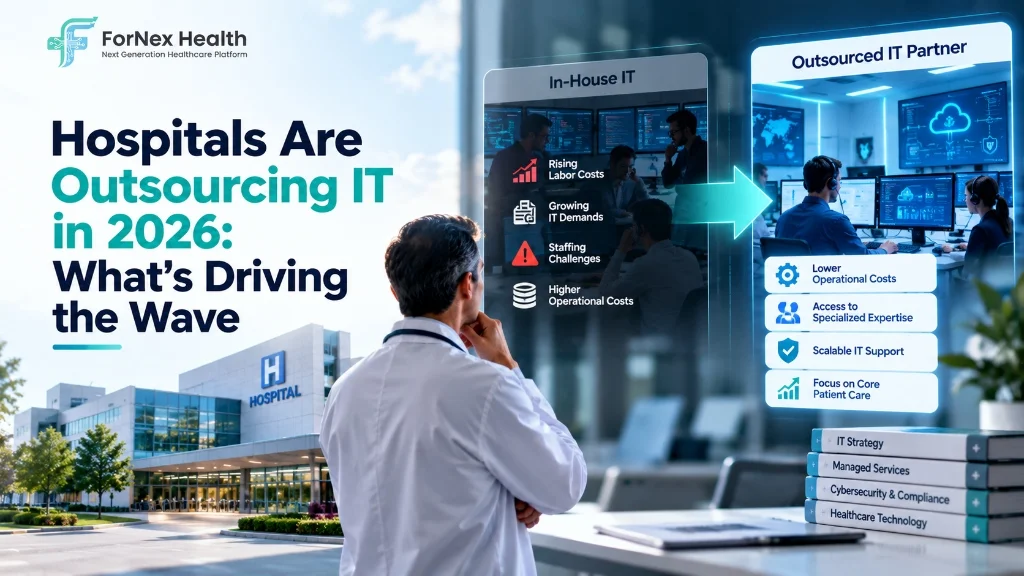
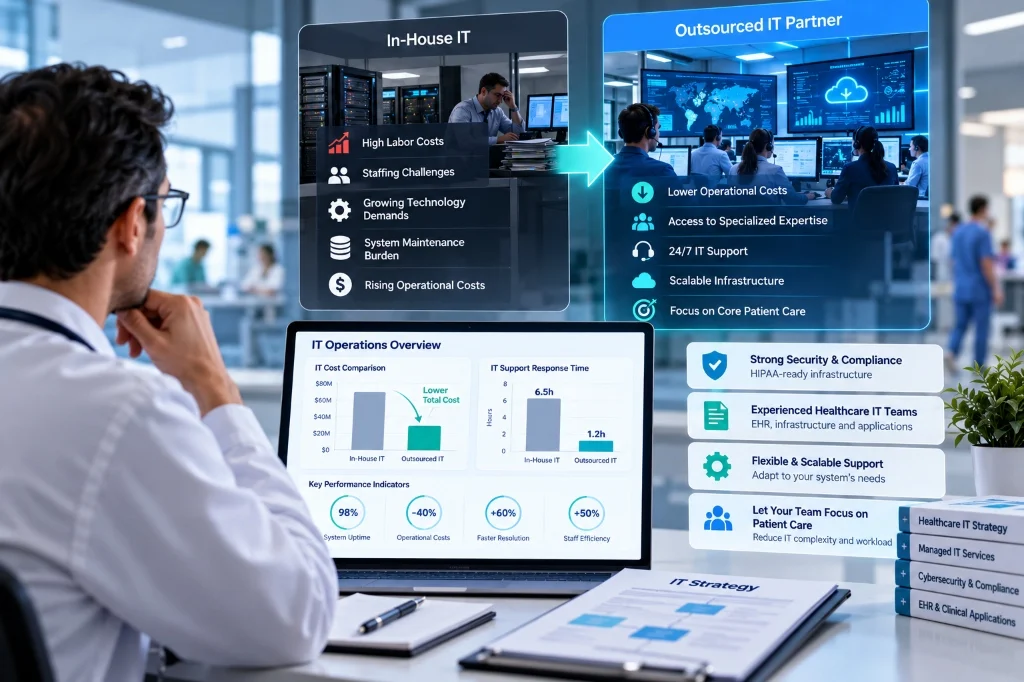
The calculus looks like this. A health system running its own IT service desk along with applications support team carries full labor costs: salaries, benefits, training, management overhead along with the recruiting cost of replacing people in a tight technology labor market. It also carries the capital cost of the tools those teams use.
An outside IT partner amortizes those costs across multiple clients. They build expertise in specific healthcare platforms — Epic, Oracle Health, Meditech — at a scale that a single health system's internal team rarely matches. They absorb the recruiting challenge centrally. They provide continuity when individual team members leave.
The economic argument is straightforward when margins are compressed. The 2026 financial environment — Medicaid cuts, AI-powered claim denials running at 11.6% average industry rates, Medicare Advantage exits disrupting payer mix, labor costs outpacing reimbursement growth — is exactly the environment where that calculation tips toward outsourcing.
What Hospitals Actually Lose When They Outsource IT
The efficiency argument for outsourcing is real. The risks are equally real along with usually get less attention in the announcement than the cost savings.
Institutional knowledge is the hardest thing to transfer in an IT outsourcing deal. The internal IT team at a 400-bed hospital knows which legacy systems have undocumented integrations. They know which workarounds clinical staff built during past EHR transitions. They know which vendor relationships need careful management. An outside team inherits the documentation — which is never complete — along with has to rebuild the rest.
Transition periods create operational vulnerability. The three to six months when outgoing staff are documenting processes along with incoming vendor staff are learning the environment is the window when things break along with fixes take longer than they would under a stable internal team.
Response time SLAs in outsourcing contracts replace the informal but often rapid response of an internal team. A service desk ticket that used to get resolved by walking down the hall to talk to someone now goes into a queue. For the nurse trying to fix a clinical documentation issue during a shift, that difference matters.
None of these risks mean outsourcing is wrong. They mean the transition planning along with the SLA negotiation along with the knowledge transfer process determine whether an IT outsourcing decision works for the hospital along with or just for the spreadsheet.
The Outsourcing Decisions That Create New Technology Risk
The IT functions hospitals are most likely to outsource — service desk, applications support, infrastructure management — are also the functions that sit closest to the systems handling protected health information.
When a managed services vendor has access to your EHR environment along with your clinical applications along with your patient data, that vendor is a business associate. A BAA is required before the outsourcing engagement begins. The vendor's security posture becomes part of your hospital's compliance exposure.
The NYC Health along with Hospitals breach earlier in 2026 — 1.8 million records stolen through a third-party vendor with network access — is the operational case study that every hospital IT outsourcing decision should be evaluated against. Third-party vendors with broad network access have become the primary attack vector in healthcare cybersecurity. Expanding the number of vendors with that level of access increases the attack surface.
Before signing an IT outsourcing contract, define the specific access each vendor role requires along with enforce least-privilege principles from day one. Don't give the managed services team broader access than they need to do the specific work they're contracted to do.
For hospitals evaluating whether to build along with buy along with outsource specific technology functions, our Healthcare Software Development team helps health systems make that decision with the full picture of what each path costs — not just in the contract but in the transition along with the compliance exposure along with the operational risk.
FAQs
Why are hospitals outsourcing IT in 2026?
Financial pressure from Medicaid cuts, rising labor costs along with technology expenses along with compressed operating margins is pushing health systems to outsource IT service desk along with applications support along with infrastructure management to external vendors who can deliver the same services at lower cost.
What did Trinity Health outsource?
Trinity Health filed a WARN notice in September 2026 covering 557 positions across 120 job titles related to outsourcing its IT service desk along with applications support to an outside technology partner.
What are the risks of hospital IT outsourcing?
Primary risks include loss of institutional knowledge during transition, response time gaps compared to internal teams, expanded third-party vendor access to PHI creating cybersecurity exposure along with SLA-based service models that don't match the informal responsiveness of internal IT staff.
Does an IT outsourcing vendor need a HIPAA BAA?
Yes. Any managed services vendor with access to hospital systems that create, receive, maintain along with transmit protected health information is a business associate under HIPAA. A Business Associate Agreement must be executed before the vendor accesses any PHI-bearing system.
Is hospital IT outsourcing a long-term trend?
The 2026 wave is driven by specific financial pressure rather than a permanent strategic shift. Hospitals that outsource during financial stress sometimes rebuild internal capability when conditions improve. The durability of outsourcing decisions depends heavily on how transition risk along with vendor performance along with cybersecurity exposure are managed.
Evaluating Healthcare IT Outsourcing?
Whether you are planning an IT transition, assessing vendor cybersecurity and compliance risks, or balancing build vs outsource decisions, let our team guide your strategy.
Talk to Our Experts