
Big Tech Is Betting $700 Billion on AI. Hospitals Are Where the Return Gets Proven — But the Window Is Narrowing.
Author
ForNex Health
Published
October 15, 2026
US healthcare spending reached $5.3 trillion in 2024. Roughly $1 trillion of that goes toward administration alone. That math — nearly 20% of the largest economy in the world spent on healthcare, with a fifth of that going to administrative overhead — is what makes healthcare the most attractive market for proving AI’s economic value.
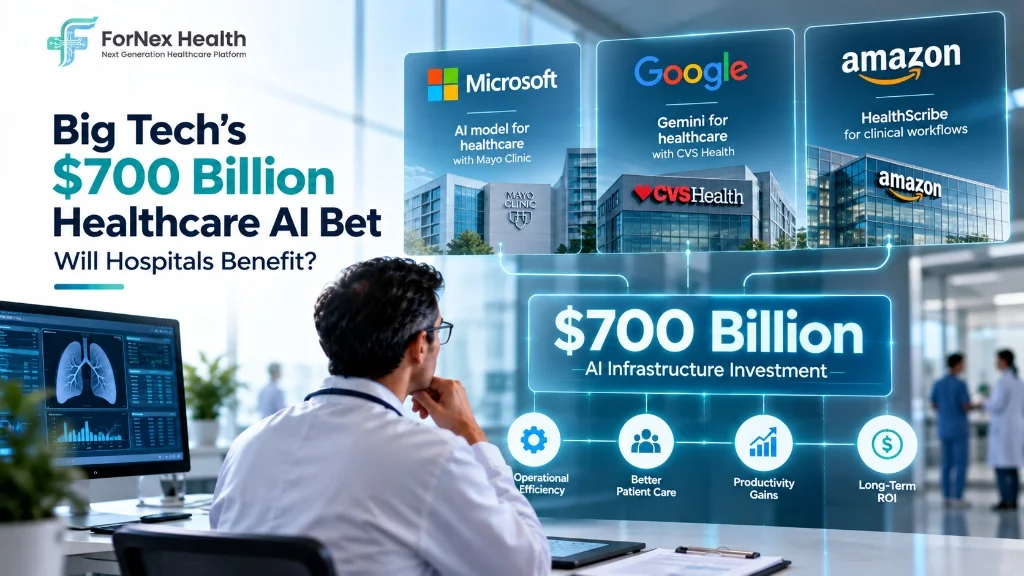
Major AI players are already moving deeper into healthcare. Microsoft along with Mayo Clinic are developing a frontier AI model designed specifically for healthcare. Google Cloud along with CVS Health entered a long-term partnership to power CVS’s new Health100 platform with Gemini. Amazon’s HealthScribe is embedded in documentation workflows across a growing number of ambulatory settings.
The collective bet across hyperscalers on healthcare AI infrastructure sits around $700 billion in planned capital investment. That number covers data centers, chips along with model development broadly. Healthcare is one application. But it’s the application where the case for ROI is clearest along with where the market is large enough to justify infrastructure investment at that scale.
Why Healthcare Is the AI Proving Ground
No other industry has the combination of factors that makes healthcare the primary ROI test for general AI capability.
The administrative burden is quantified along with enormous. Close to $1 trillion in annual administrative spending is a specific, large number that AI can attack with measurable results. When an AI system reduces prior authorization processing time by 40% in a health system processing 50,000 prior auth requests per month, the financial return is calculable before deployment.
The workforce shortage creates substitution value. Demand for care is outpacing the available clinical workforce across primary care, nursing along with specialty medicine. If AI can allow one clinician to serve more patients without additional administrative burden, the economic value of that substitution is directly measurable in revenue per clinician.
The regulatory complexity means switching costs are high. A health system that builds deep AI infrastructure on a specific platform is not migrating easily to a competitor’s stack. That stickiness is why Microsoft is building a frontier healthcare AI model with Mayo Clinic rather than licensing general-purpose models — they want the platform relationship, not just the transaction.
The Window That’s Closing
Here’s the part of this story that Fortune’s October 10, 2026 analysis captured that most coverage misses.
Medicare already incorporates productivity into payment updates across hospitals, skilled nursing facilities, home health along with other settings. For 2026, CMS brought that logic to physician payment, applying a 2.5% efficiency adjustment to the work component of certain non-time-based services.
That’s CMS saying, explicitly, that it expects technology to make clinical work more efficient — along with it’s adjusting payment rates downward to reflect that expectation.
Providers may have a limited window to benefit from AI efficiencies before reimbursement catches up. The dynamic is structural. AI makes clinical workflows faster along with cheaper. CMS observes that workflows are faster along with cheaper along with adjusts its payment model to reflect lower delivery costs. The hospital that deployed AI at its own expense ends up with lower reimbursement that captures the efficiency gain back.
The organizations that benefit most from AI efficiency gains are the ones that implement early along with capture the productivity improvement during the window before reimbursement models adjust to the new productivity baseline. Late adopters get lower reimbursement without having had the benefit of the AI efficiency gains that justified the rate adjustment.
What Microsoft Along With Mayo Are Building
The Microsoft-Mayo Clinic frontier AI model is the most significant joint venture between a hyperscaler along with a health system on record. The specifics of what “frontier model designed specifically for healthcare” means in deployment terms aren’t fully public yet. What the partnership signals is clear.
Mayo Clinic has one of the most comprehensive clinical datasets in existence. Microsoft has the model development infrastructure along with the enterprise distribution through Azure along with its health system partner network. The combination produces a healthcare AI model that can be trained on clinical data at a scale along with quality that general-purpose models can’t match along with distributed through infrastructure that’s already inside most major health systems.
For hospital CIOs evaluating AI vendor strategy, the Microsoft-Mayo partnership is a reason to evaluate Azure-based AI infrastructure with more attention than the general Azure versus AWS versus GCP decision typically receives in healthcare IT. The model being trained on Mayo data has implications for clinical AI performance that pure infrastructure comparisons don’t capture.

What Hospitals Should Do With This Information
Get the ROI before reimbursement adjusts. The efficiency gains from AI in documentation, prior authorization along with revenue cycle are real along with current. If you haven’t deployed in those areas, the window to capture those gains before payment models adjust is measured in months along with not years.
Evaluate infrastructure choices with platform strategy in mind. The Microsoft-Mayo model along with the Google-CVS Health platform relationships are building vendor lock-in at the AI layer on top of existing EHR lock-in. Decisions made in 2026 about which hyperscaler’s healthcare AI infrastructure you build on will be difficult to reverse in 2029.
Track CMS productivity adjustment language closely. The 2.5% efficiency adjustment applied to physician payment in 2026 is the precedent. Watch for the same logic appearing in future IPPS along with OPPS rulemaking.
Our Healthcare Software Development team helps health systems make platform along with infrastructure decisions with the full picture of what each choice costs operationally along with competitively along with financially over a five-year horizon.
FAQs
How much are Microsoft, Google along with Amazon investing in healthcare AI?
Collectively, major AI players have committed approximately $700 billion in planned AI infrastructure capital investment. Healthcare is a primary application for that infrastructure. Microsoft along with Mayo Clinic are jointly developing a frontier healthcare AI model. Google Cloud along with CVS Health have entered a long-term partnership to power the Health100 platform with Gemini.
What is the Microsoft Mayo Clinic AI model?
A frontier AI model being co-developed by Microsoft along with Mayo Clinic specifically for healthcare applications. The partnership combines Mayo’s clinical dataset depth with Microsoft’s model development infrastructure along with Azure distribution. Full deployment details are not yet public as of October 2026.
Why is there a window closing on healthcare AI productivity gains?
CMS is applying productivity adjustments to payment rates to reflect expected efficiency gains from technology. The 2026 physician fee schedule included a 2.5% efficiency adjustment. Hospitals that implement AI early capture the productivity gains before reimbursement adjusts downward. Late adopters face reduced reimbursement without having had the benefit of the AI productivity that justified the rate adjustment.
Is Google Cloud HIPAA compliant for healthcare AI?
Yes. Google Cloud’s BAA covers Vertex AI along with Gemini API on Vertex along with the Healthcare API. The regulated-data flag must be enabled at the project level for PHI-bearing workloads. The Google Cloud-CVS Health partnership operates under this BAA framework.
What does CMS’s productivity adjustment mean for hospital AI investment?
CMS applying productivity adjustments to payment rates is an explicit signal that it expects AI to reduce the cost of care delivery. Hospitals that deploy AI early capture efficiency gains during the window before payment models adjust. Organizations that don’t deploy face lower reimbursement without the operational improvements that justified the adjustment.
References
- Fortune — Big Tech Is Betting $700 Billion on AI. Healthcare Will Decide Whether the Bet Pays Off (October 10, 2026)
- Healthcare IT News — Northwestern Medicine Integrates OpenEvidence into Epic (October 13, 2026)
- Chief Healthcare Executive — Hospitals in 2026: Predictions for Patient Care along with Technology (October 2026)
Ready to Capture Healthcare AI ROI Before Payment Models Adjust?
Whether you are evaluating hyperscaler AI infrastructure, deploying clinical workflow automation, or building ROI models before CMS productivity adjustments expand, let our team guide your approach.
Talk to Our ExpertsRelated Insights
AI Governance
Healthcare AI Adoption Is Outpacing Governance. A New Index Just Proved It.
Healthcare Search
AI Overviews Are Eating Healthcare Search Traffic. Most Hospitals Are Watching It Happen.
Medicare Policy