
Dragon Copilot vs Every Other Ambient Scribe in 2026: The NEJM Trial Data Nobody Leads With
Author
ForNex Health
Published
September 28, 2026
Most ambient scribe marketing leads with documentation time savings. The headline is always some version of "reduce documentation by 50%" along with "save 2 hours per physician per day."
The strongest independent trial data on Dragon Copilot specifically tells a more complicated story. And it is worth understanding before your health system commits to a six-figure enterprise contract.
A randomized controlled trial published in NEJM AI in 2025 enrolled 238 physicians across 14 specialties at UCLA Health. Physicians were randomized to Dragon Copilot (DAX), Nabla, along with usual care from November 2024 through January 2025. No vendor funded the trial.
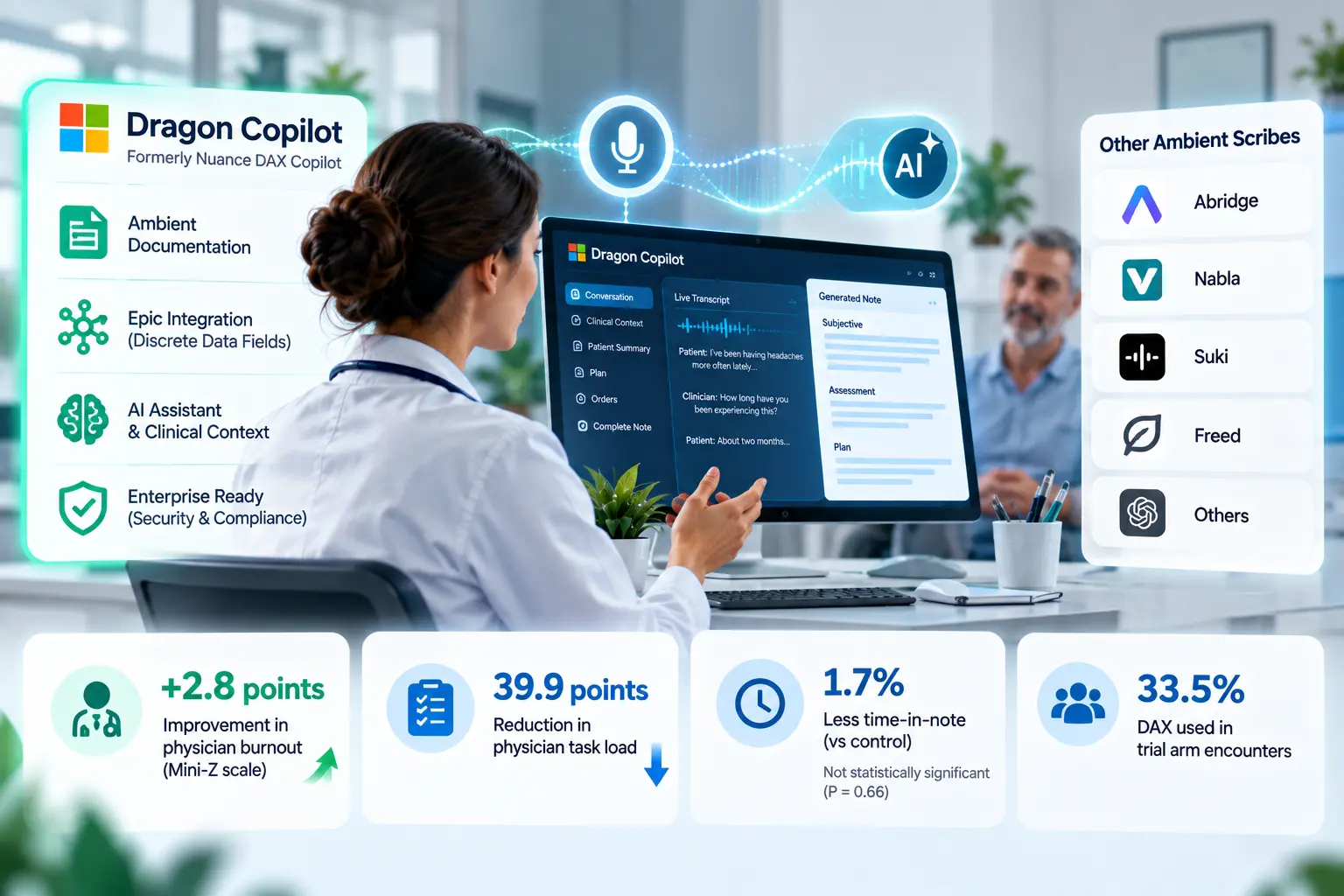
The burnout result: The DAX arm showed a +2.8 point improvement on the Mini-Z burnout scale. Physician task load dropped by 39.9 points. Those are meaningful clinical findings.
The documentation time result: DAX showed 1.7% less time-in-note versus control. That result was not statistically significant with a P value of 0.66.
DAX was used in 33.5% of encounters in the trial arm. That partial adoption rate is itself a signal worth unpacking.
What the Trial Actually Means
A technology that improves burnout along with cognitive load is genuinely valuable, even if documentation time reduction did not reach significance in this specific trial design. Physician burnout costs the US healthcare system an estimated $4.6 billion annually through turnover, reduced productivity along with early retirement. A tool that meaningfully reduces cognitive burden justifies serious consideration on that basis alone.
The documentation time result does not mean the tool does not save time. It means in this trial population, with 33.5% adoption, statistical significance was not reached. A different adoption rate along with a different trial duration along with a different specialty mix could produce a different result.
What it does mean: when evaluating ambient scribes, ask vendors for documentation time data from independent trials along with not just their own pre/post studies. The pre/post study methodology is inherently susceptible to observer effect along with workflow novelty. An RCT removes those confounders.
Dragon Copilot's HIMSS 2026 Pivot: From Scribe to Agentic Platform
Microsoft's pitch at HIMSS 2026 moved the conversation significantly. Microsoft turned what started as an ambient documentation tool into a deliberate platform play: Dragon Copilot is no longer just a speech-to-text assistant for clinicians. It is being positioned as a unified clinical AI platform that embeds Microsoft 365 context, opens a partner app ecosystem through the Microsoft Marketplace along with promises to scale across roles, settings along with geographies.
The new pitch reframes Dragon Copilot as a context-aware agent. Clinicians can query lab values, cross-check organizational policies, consult calendar along with messaging context along with invoke third-party clinical apps, all without leaving the clinical interface.
That is a meaningfully different product claim than ambient documentation. It is also a claim that will be tested against real clinical adoption over the next 12 months.
For organizations already on Microsoft Azure along with Epic infrastructure, the platform play is coherent. Dragon Copilot is embedded directly inside Epic Hyperspace via the Microsoft PAL partnership, enabling auto-population of Epic discrete data fields rather than free-text dumps. That is the deepest Epic integration of any major AI scribe alongside Abridge's Epic PAL-tier integration.
What It Costs Along With Who It Actually Fits
Dragon Copilot runs $369 to $830-plus per provider per month depending on configuration. That is the enterprise tier. Nuance does not publish pricing for smaller practices. The deployment base is concentrated in large health systems.
For organizations already invested in the Microsoft stack, Dragon Medical One, Azure, Microsoft 365, Dragon Copilot is the logical choice. The governance posture along with security model are consistent with what large enterprise IT teams already manage.
For solo practitioners, small group practices, non-Epic environments along with organizations prioritizing budget along with specialty breadth, the picture is different. Microsoft reports 600-plus healthcare organizations have deployed Dragon Copilot. The deployment base is large health systems. That is both a feature along with a limitation depending on your organization.
As of 2025 to 2026, Microsoft has been unifying Dragon Copilot under broader "Dragon Copilot" branding integrating Microsoft 365 Copilot capabilities. The exact feature boundaries between DAX Copilot along with Dragon Copilot as a combined product are still evolving in public documentation. Validate current product packaging directly with your Microsoft account team before signing.
The broader ambient scribe market along with how to evaluate any tool regardless of vendor is covered in our guide: Ambient AI Scribes Are Everywhere — Here's How to Actually Choose One
FAQs
What is Microsoft Dragon Copilot?
Dragon Copilot is Microsoft's ambient AI clinical documentation system, formerly called Nuance DAX Copilot. It records patient-clinician conversations, generates structured notes along with integrates directly into Epic EHR. At HIMSS 2026, Microsoft expanded its positioning from documentation tool to agentic clinical AI platform.
What did the NEJM AI trial find about Dragon Copilot?
The UCLA Health RCT found Dragon Copilot significantly improved physician burnout scores (+2.8 Mini-Z points) along with reduced task load by 39.9 points. Documentation time reduction of 1.7% was not statistically significant at P=0.66. DAX was used in 33.5% of trial arm encounters.
How much does Dragon Copilot cost?
$369 to $830-plus per provider per month for enterprise deployments. Nuance does not offer transparent pricing for smaller practices along with requires sales engagement. Cost is prohibitive for solo practitioners along with small group practices.
Does Dragon Copilot work with non-Epic EHRs?
Dragon Copilot's deepest integration is with Epic. It supports other major EHRs but without the same native discrete field population that Epic users get. Organizations on non-Epic systems should validate integration depth directly with Microsoft before contracting.
Is Dragon Copilot FDA cleared?
Per FDA guidance issued mid-2025, ambient AI scribes used purely for clinical documentation are not subject to FDA device clearance requirements. The physician reviews along with edits every note before it becomes part of the official medical record.
References
- Commure - DAX AI Scribe: Honest Review (August 13, 2026)
- AI Health Guide - Nuance DAX Copilot Review 2026 (April 8, 2026)
- RevCycle AI - Nuance DAX Deep Dive (July 14, 2026)
- Windows Forum - Dragon Copilot at HIMSS 2026: From Ambient Scribe to Agentic Clinical Assistant (March 6, 2026)
- Vero Scribe - Nuance DAX Copilot Review 2026 (June 3, 2026)
- Twofold - DAX Copilot Review 2026: Features and Limitations (June 11, 2026)
Ready to Build Compliant Health Software?
Whether you are developing ambient AI integrations, EHR workflows, or clinical AI platforms, let our engineering team guide your architecture.
Talk to Our Experts