
Ambient AI Scribes Are Everywhere. Here's How to Actually Choose One
Author
Fornex Health Team
Published
May 18, 2026

Every major health system has an ambient AI scribe vendor in their inbox right now. Most have three. Some have more.
The market has exploded. A recent JAMA study found that AI-powered ambient scribes decreased total EHR time by 13.4 minutes and documentation time by 16.0 minutes across five academic medical centers. Numbers like that travel fast. Every CMO is getting questions about it. Every physician group wants a pilot.
The problem is that the vendor landscape is genuinely crowded. The marketing all sounds the same. The demos all look impressive. Choosing wrong means you spend six months rolling out a tool your physicians quietly stop using by month seven.
This is how to actually evaluate one.
The Market Right Now
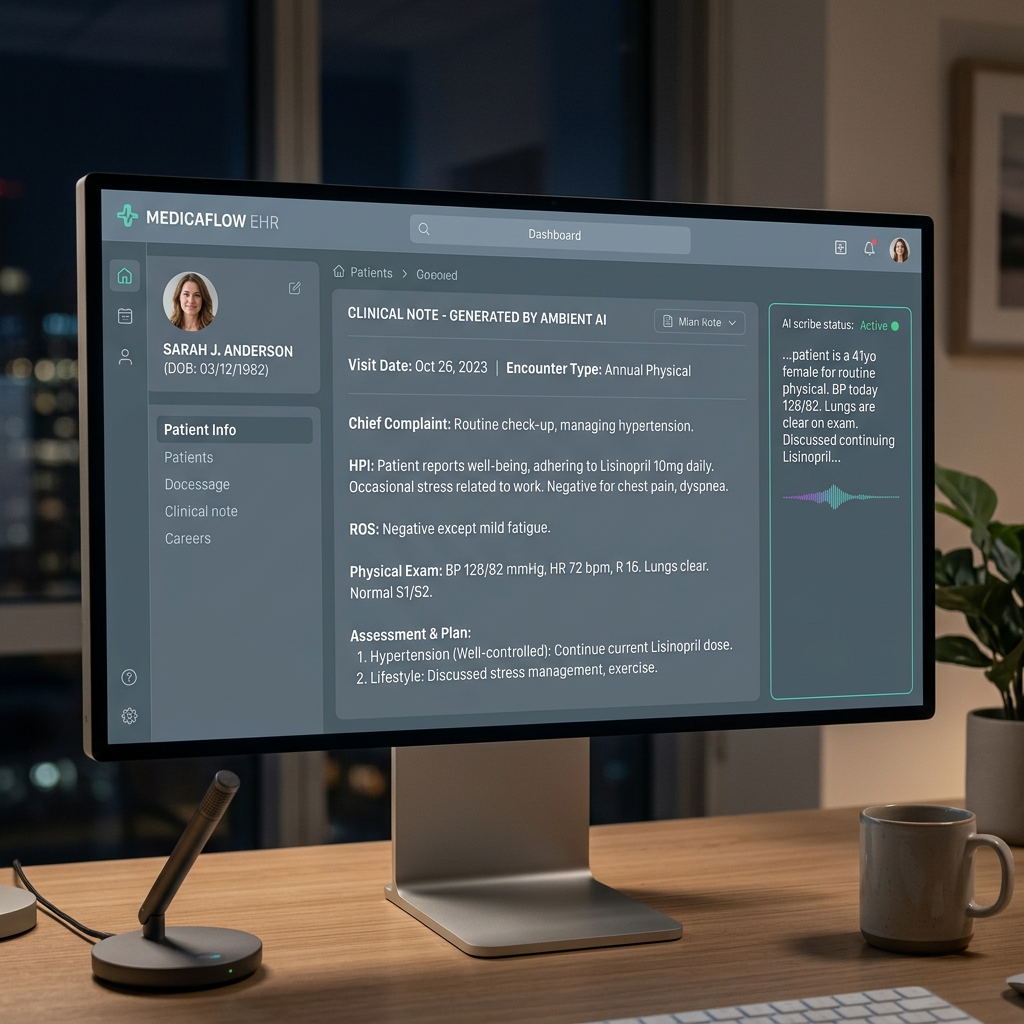
Ambient scribes are the most competitive category of AI in healthcare right now, with consolidation expected through 2027. The major players in 2026 include Nuance DAX Copilot, Abridge, Suki, Freed, DeepScribe, Augmedix, Heidi Health, Nabla. Each targets a different buyer.
For 100-plus provider health systems on Epic, Nuance DAX Copilot offers the deepest enterprise integration. For practices prioritizing patient-centered care, Abridge leads on patient engagement features. For voice-first workflow beyond documentation, Suki is the strongest option. For budget-constrained practices, Freed starts at $99 per month.
Ambient AI documentation costs range from $99 to $600-plus per physician per month. ROI is typically 50 to 600 percent depending on time saved.
That range tells you something important: this is not a commodity market. The right tool for a 500-bed hospital system is completely different from the right tool for a 12-provider specialty practice. Comparing them on price alone is a mistake.
The Four Questions That Actually Matter
1. What does your EHR relationship look like?
This is the first filter. Everything else comes second.
If your organization runs Epic at scale, the conversation narrows quickly. Nuance DAX specializes in deep Epic integration. Abridge offers one-tap activation within Epic's mobile apps Haiku and Canto, inserting finished notes directly into the encounter documentation.
If your EHR is something other than Epic, the picture changes. Nuance DAX integrates with 40-plus EHRs but requires enterprise procurement. DeepCura offers bidirectional write-back with nine-plus EHR systems. Heidi, Twofold, Freed rely primarily on browser-based workflows.
Browser-based copy-paste works until the EHR UI changes. Then it breaks. For a large deployment, that is a support nightmare. Get specific commitments about integration depth before signing anything.
2. What happens when the AI is wrong?
This question makes vendors uncomfortable. Ask it anyway.
Every ambient scribe generates errors. The question is not whether errors happen. It is whether your organization can prove what was actually said in the room when an audit comes.
In an audit situation, "the AI said so" is not a defense. You need to prove that documented information was actually discussed with the patient. Only systems that maintain audio recordings with timestamp links can provide this proof. Abridge stores audio for 90 days. Most other platforms including Nuance DAX, Suki, Freed, DeepScribe do not retain audio, leaving transcript-only documentation that cannot be verified years later when medical-legal cases emerge.
For high-acuity specialties, for organizations with significant litigation exposure, for any setting where documentation accuracy is a compliance requirement, this is not a minor consideration. It is a deciding factor.
3. How does your IT team feel about the deployment?
There is a real gap in this market between tools that work well in a demo and tools that survive enterprise deployment.
Consumer-friendly options like Freed can be running in under 10 minutes. Enterprise solutions like Nuance DAX require IT involvement and can take weeks to deploy.
Neither of those is inherently better. It depends on your organization's IT capacity, your security review process, your change management bandwidth. A tool that requires a three-month IT deployment in an organization with limited technical resources is a tool that gets delayed indefinitely.
Be realistic about your implementation capacity before you evaluate features.
4. What is the actual patient consent workflow?
This one gets skipped in vendor conversations. It should not.
Patients must provide informed consent before ambient listening technology records their conversations. Consent should explain what is being recorded, how the data will be used, who has access, how long recordings are retained, and the patient's right to decline.
Some states have specific legal requirements around this. Some specialties have stronger consent expectations than others. Behavioral health is a good example. A patient discussing mental health in a therapy session has different expectations about recording than a patient in a routine physical.
Your vendor should have a clear, tested consent workflow. If they hand you a generic consent form template and say "your legal team can handle it," that is not a complete answer.
The Burnout Argument Is Real. Do Not Let It Rush You.
A 2025 study of 263 physicians across six health systems found burnout decreased from 51.9 percent to 38.8 percent after just 30 days using an AI scribe. Physicians report saving two to three hours daily on documentation while seeing 15 percent more patients per hour.
Those numbers are compelling. They are also the numbers vendors will lead with in every sales conversation. The pressure to move fast because of burnout is real. The decision still deserves the same rigor as any other clinical technology procurement.
A bad scribe implementation adds friction. It generates note quality complaints. It creates consent confusion. It produces liability exposure if the governance around it is thin.
Speaking of governance: the questions around how AI agents are authorized, audited, then shut down when something goes wrong apply to ambient scribes just as much as they apply to agentic AI platforms. Our blog on “AI governance in healthcare and what your vendor should be able to prove” covers exactly what a governance framework for clinical AI tools looks like in practice.

What a Smart Pilot Looks Like
Pick one department. One specialty. Ideally one with high documentation volume where time savings will be immediately visible.
Run it for 60 days minimum. Collect three data points: time to note completion before vs. after, physician satisfaction via a simple survey, note quality review from your coding team.
Do not scale based on physician enthusiasm alone. Enthusiasm is high in month one for almost every new tool. The real signal is retention at month three.
Talk to your coding team before you go live. They review the notes downstream. They will tell you faster than anyone whether the AI is generating documentation that holds up.
The Bottom Line
The ambient scribe market in 2026 has genuinely good options at every price point. The tools work. The ROI is real. The burnout reduction is measurable.
The organizations that get the most out of them are the ones that picked based on EHR fit, governance posture, deployment capacity. Not the ones that picked based on which demo looked best.
Pick for your organization. Not for the demo room.
Fornex Health helps healthcare organizations evaluate, implement, then govern clinical AI tools. If your team is working through an ambient scribe selection, reach out to our team.
Need a Scribe Pilot?
Get an expert evaluation guide and choose the right ambient AI scribe for your health system's specific needs.
Request a Free Scribe Evaluation Guide