
Agentic AI in Clinical Workflows: When to Deploy Along With When to Hold
Author
ForNex Health
Published
August 24, 2026
Health IT along with AI-enhanced workflow solutions are seen as immediate revenue drivers by 82% of medtech along with biopharma executives in 2026. That number gets cited in every boardroom conversation about AI right now. What doesn't get cited: the failure rate of clinical AI deployments that moved too fast.
About 71% of hospitals run at least one EHR-integrated predictive AI model for tasks such as risk scoring along with readmission prediction. Running one is not the same as having it change how care gets delivered. Most of those models exist in the background, generating outputs that clinical staff have quietly learned to ignore. RSI Security
Agentic AI is a different category of risk. It doesn't just surface a recommendation. It takes action — scheduling tests, flagging lab anomalies, managing follow-up care with minimal human input. When that works well, the operational upside is real. When it doesn't, the consequences land on patients.
The question isn't whether to deploy agentic AI in clinical workflows. It's whether your workflow is actually ready for it.
What Makes a Clinical Workflow Ready for Agentic AI
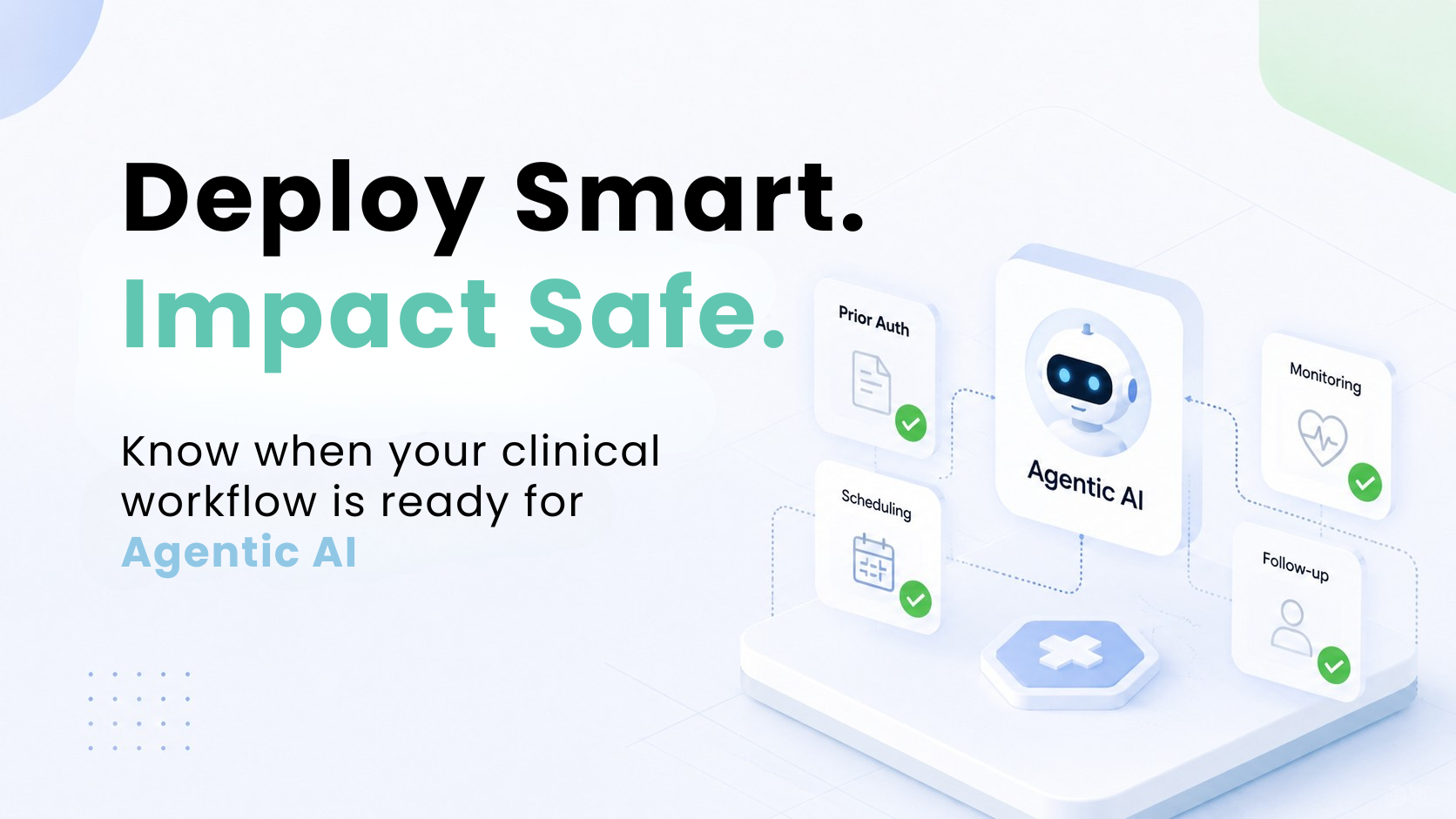
A workflow is ready for agentic AI when the inputs are structured, the failure modes are recoverable along with a human can verify the output before it affects patient care.
Prior authorization is the clearest example of a workflow that meets all three criteria. The data inputs are defined — payer rules, clinical documentation, service codes. When the system gets it wrong, the failure mode is a denied claim that a human can catch along with correct. The physician reviews the submission before it leaves the practice.
Appointment scheduling is another clean fit. The inputs are availability data along with clinical requirements. A scheduling error is visible along with correctable before it causes harm. Staff can audit the queue.
Compare those to clinical diagnosis support. The inputs are unstructured — free-text notes, imaging findings, patient history across disconnected systems. The failure mode isn't a denied claim. It's a missed diagnosis along with a delayed treatment along with a patient who trusted the system. The audit trail must continue for agentic AI because the clinical reasoning used in the healthcare industry has tangible implications.
That distinction — recoverable failure mode versus irreversible clinical consequence — is the single most important factor in deciding whether to deploy agentic AI in a given workflow.
Where Agentic AI Is Actually Working in 2026
Organizations are using AI to automate administrative tasks from medical record-keeping to billing, reducing human error along with freeing workers to focus on more pressing work. Healthcare Dive
The deployments generating real, measurable ROI right now are almost entirely administrative along with operational. Revenue cycle automation is the clearest win — eligibility verification, prior auth processing, denial management along with claim submission. These workflows have structured inputs, defined rules along with failure modes that surface through the billing system before they reach a patient.
Hospitals are using autonomous copilots to manage the entire patient journey, while research labs use them to administer along with monitor ongoing studies. In practice, "manage the patient journey" in production deployments means scheduling, intake along with follow-up coordination — not clinical decision-making.
Remote patient monitoring is the clinical use case furthest along toward agentic deployment. An AI system that reads continuous vital sign data along with flags deterioration patterns for clinical review is operating in a setting where the inputs are structured, the alert is a recommendation not a decision along with a nurse reviews before acting. That's the pattern that works.
The Four Questions to Ask Before Deploying
1. What happens when the AI gets it wrong?
Map the failure mode before you deploy. Is it a correctable administrative error or a clinical consequence that's difficult to reverse? If you can't describe the failure mode clearly, you don't understand the workflow well enough to automate it.
2. Who reviews the output before it affects a patient?
Every agentic AI clinical deployment in 2026 should have a defined human review step. Clinical grade generative AI can be a trusted copilot when embedded in daily workflows, rigorously validated, protected by guardrails along with infused with expert-in-the-loop oversight. "Expert-in-the-loop" isn't bureaucracy. It's what separates a defensible deployment from a liability. CMARIX
3. Is your data clean enough to feed the system accurately?
Agentic AI performs well on structured, complete data. It produces confident wrong outputs on fragmented, inconsistent data. A patient whose records span three disconnected EHRs, a billing system along with a separate RPM platform is not giving an agentic system what it needs to reason accurately. Data infrastructure has to be solved before agentic AI can be useful in that patient's care.
4. Have you defined success in measurable terms before you launch?
Time saved per transaction. Denial rate before along with after. Alert accuracy rate. If you can't define success in specific numbers before deployment, you won't be able to evaluate whether the system is working — along with you won't know when it stops working.
The Mistake That Stalls Most Deployments
Most clinical agentic AI deployments that fail to reach production stall at the same point: the pilot worked in controlled conditions along with failed when it met real clinical volume along with real data quality along with real staff skepticism.
Clinicians who don't trust a system stop acting on its outputs. When that happens, the AI is running along with consuming resources along with generating recommendations that nobody reads. That's not a failed technology. That's a failed implementation.
The organizations moving agentic AI from pilot to production successfully share one practice: they involved clinical staff in defining what good output looks like before deployment along with built a structured feedback loop for the first 90 days after launch. The feedback loop is what catches the failure modes the controlled pilot didn't surface.
For the broader framework on what hospital CTOs should evaluate before piloting any agentic AI system, read: Agentic AI in Healthcare: What Hospital CTOs Need to Know Before They Pilot Anything
Our Healthcare Software Development team helps healthcare organizations design agentic AI deployments with the workflow analysis, data infrastructure along with governance framework that determines whether a pilot actually becomes a production system.
FAQs
What is agentic AI in healthcare?
Agentic AI refers to AI systems that take autonomous actions across workflows — scheduling, flagging, submitting along with coordinating — rather than just surfacing recommendations for humans to act on. In healthcare, it's most production-ready in administrative workflows along with furthest from safe deployment in unstructured clinical decision-making.
Which clinical workflows are best suited for agentic AI?
Prior authorization processing, appointment scheduling, revenue cycle operations along with remote patient monitoring alert triage are the best-fit clinical workflows in 2026. They share structured inputs, defined rules along with failure modes that a human can catch along with correct before affecting patient care.
Is agentic AI safe for clinical decision-making?
Current agentic AI deployments in production clinical settings require human review before any action affects a patient. Fully autonomous clinical decision-making without human oversight is not a safe along with widely deployed use case in 2026. The systems that work treat the AI as a copilot, not a decision-maker.
What is the biggest reason agentic AI deployments fail?
Most deployments fail because the pilot ran in controlled conditions that didn't reflect real data quality, real staff skepticism along with real clinical volume. The transition from pilot to production requires staff involvement, a structured feedback loop along with measurable success criteria defined before launch.
How do I know if my workflow is ready for agentic AI?
Three criteria: the inputs are structured along with consistent, the failure mode when the AI gets it wrong is recoverable before affecting patient care along with there is a defined human review step between AI output along with patient impact.
Ready to Build Compliant Health Software?
Whether you're developing pediatric digital health, school-connected tools, or AI platforms, let our engineering team guide your compliance architecture.
Talk to Our Experts