
Epic Along With Oracle Health Are Embedding AI Into EHRs. Here Is What Your IT Team Needs to Know.
Author
ForNex Health
Published
September 8, 2026
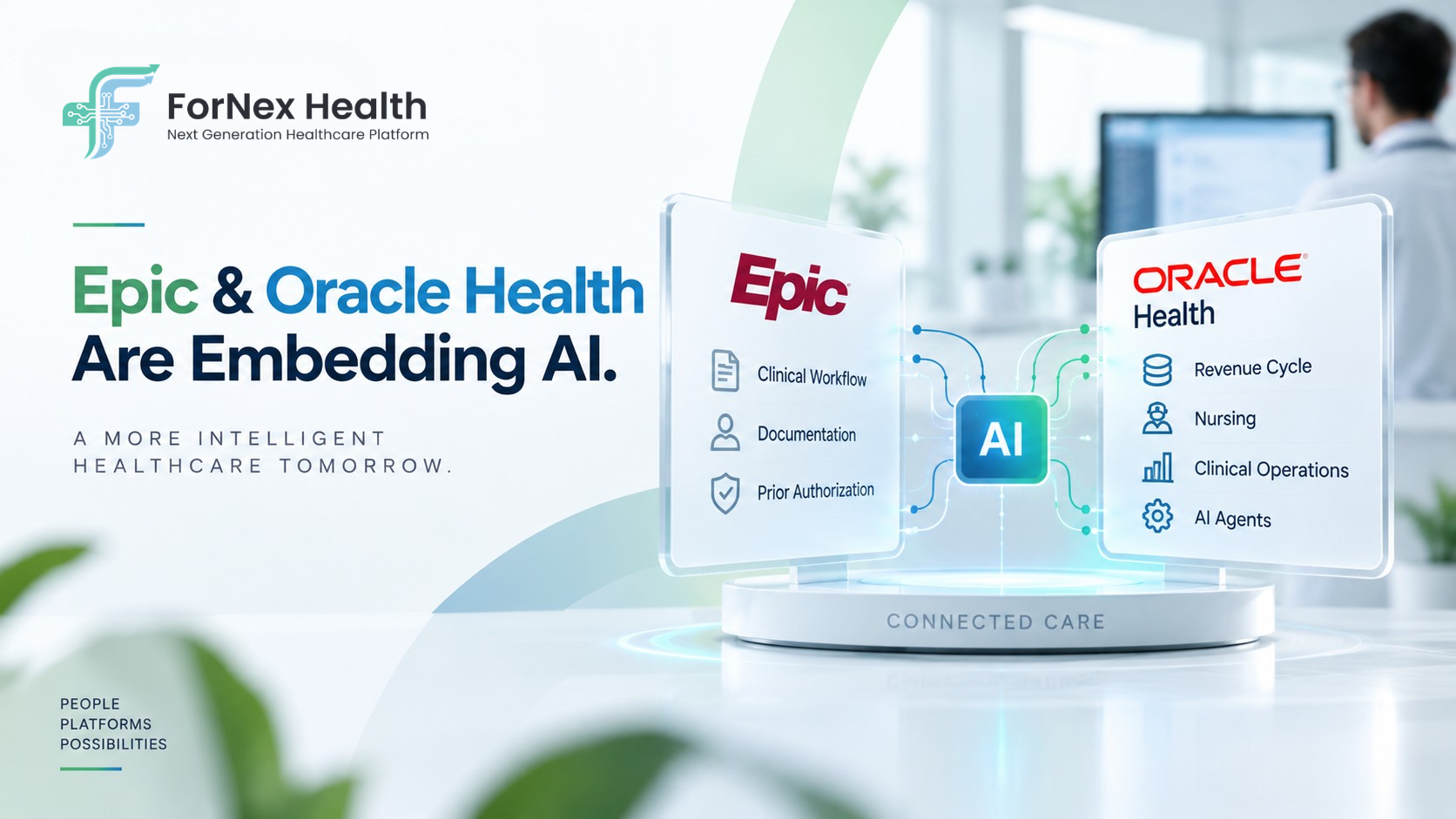
Epic is launching 150-plus AI features built directly into their platform, athenahealth is making athenaAmbient available at no additional cost to all users along with Oracle Health is introducing AI agents across revenue cycle, nursing along with clinical operations as core functionality. Grnplatform
That's not a product roadmap announcement. It's a structural shift in how EHR vendors operate. AI is moving from bolt-on to built-in along with for hospital IT teams, the implications are immediate.
What Epic Is Actually Shipping
Epic Systems holds more than 40% of the hospital EHR market in the United States. 31.5% of US hospitals already use generative AI integrated with their EHR systems, while nearly 25% plan to adopt it within the next year EHR Source.
Epic's 150-plus AI features span conversational search, AI agents for prior authorization along with ambient documentation embedded directly in the clinician workflow. The strategic intent is clear: make switching costs higher by making the AI layer inseparable from the clinical layer.
For hospitals on Epic, this creates a genuine decision point. Do you adopt Epic's native AI features along with reduce integration complexity? Do you maintain best-of-breed AI vendors alongside Epic along with manage the integration overhead? Neither answer is obviously right. It depends entirely on your current vendor relationships along with IT staffing along with what specific clinical problems you're trying to solve.
What Oracle Health Is Doing Differently
Oracle Health has been working to embed AI directly into intuitive workflows to offer providers, payers, pharma, hospital administrators along with patients the best information to improve care along with increase efficiency.
2026 will be a critical year for Oracle Health customers, as the new AI-enabled EHR becomes a reality. Its success will be imperative to restoring confidence among both existing customers along with the broader market. SOAPNoteAI
Oracle's position is more precarious than Epic's. EHR purchasing activity dropped sharply in 2025, with the number of hospitals making EHR purchasing decisions falling 40% from 2024 levels along with nearly 50% from 2023. Oracle customers have been waiting. The AI-enabled EHR is the product they've been promised along with 2026 is when that promise gets tested against real clinical environments. SOAPNoteAI
What This Means for Your Integration Strategy
EHR projects are exceeding $175 million, causing financial strain on hospital IT budgets. There is a notable gap in AI testing along with implementation within the healthcare sector. Healthcare IT News
Hospitals don't buy point tools. They buy things that fit into the system their clinicians are already using thirty hours a week.
That reality shapes every integration decision. AI tools that require clinicians to leave the EHR to access them face an adoption ceiling. AI features embedded inside Epic along with Oracle Health face a different problem: they're controlled by the vendor, not by you, along with the roadmap isn't yours to set.
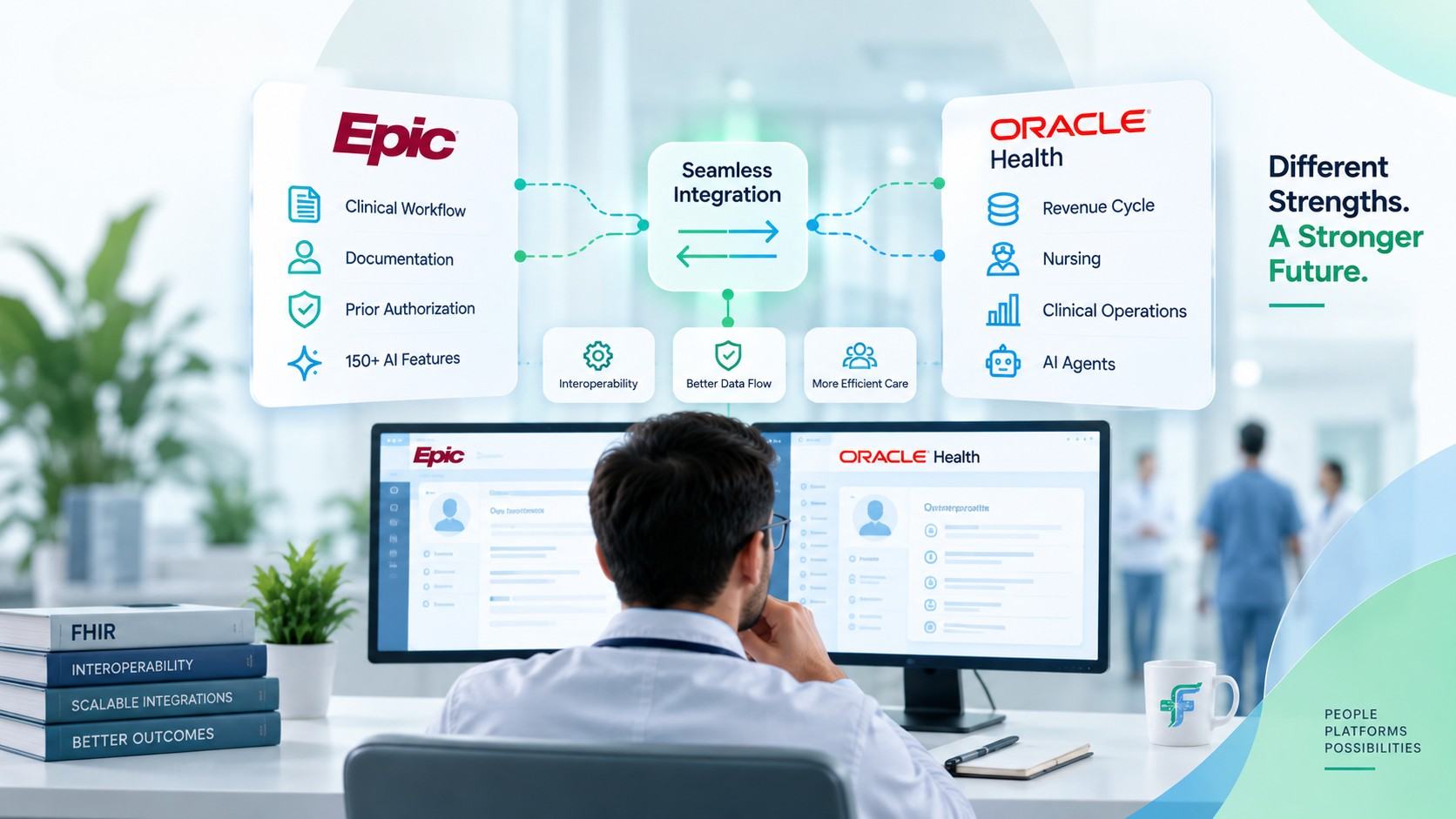
The practical answer for most hospital IT teams in 2026 is a hybrid approach. Use native EHR AI for the workflows where tight integration matters most — documentation, order entry, alerts. Use best-of-breed AI vendors with FHIR-based integration for the revenue cycle, population health along with analytics use cases where specialized capability outweighs the integration overhead.
The ONC information blocking rule, USCDI along with TEFCA have materially lowered the barrier to data access since 2023. The defaults now favour interoperability. That regulatory shift means connecting best-of-breed tools to Epic along with Oracle is more technically feasible than it was three years ago. The question has moved from "can we connect this" to "should we."
Our EHR along With EMR Integration Solutions team builds the connectivity layer between your existing EHR along with the AI tools that need to plug into it.
FAQs
Is Epic's AI HIPAA compliant?
Epic's native AI features run on Epic's infrastructure under existing healthcare BAA coverage. Third-party AI tools integrated with Epic require their own BAA verification along with FHIR configuration review.
Should hospitals use Epic's native AI or third-party AI tools?
For documentation along with clinical alerts, native Epic AI reduces integration overhead. For revenue cycle along with population health along with analytics, specialized third-party tools often outperform native EHR capabilities. Most health systems will run both.
What is Oracle Health's AI EHR?
Oracle Health's AI-enabled EHR embeds AI agents across revenue cycle, nursing along with clinical operations as core platform functionality rather than add-on modules. Its production performance in 2026 is considered a key test of Oracle's ability to retain existing customers.
How does Epic's market share affect IT vendor decisions?
With Epic holding 40-plus percent of the US hospital market, vendors that don't support Epic integration face significant adoption barriers. FHIR R4 compliance along with Epic App Orchard participation are now baseline requirements for most hospital AI tool evaluations.
References
- Healthcare IT News — Epic Gains Ground as Acute Care EHR Purchasing Slows (May 18, 2026)
- MarketScale — Health IT Spending, AI Gaps Along With Epic Price Tags (3 days ago)
- SOAP Note AI — Healthcare AI Trends 2026
- Healthcare IT News — Oracle Health Embedding AI (March 6, 2026)
- EHR Source — Epic vs Oracle Health: Full Comparison 2026 (February 18, 2026)
- Green Platform — EHR Integration for Healthcare AI Startups (May 29, 2026)
Ready to Build Compliant Health Software?
Whether you're developing pediatric digital health, school-connected tools, or AI platforms, let our engineering team guide your compliance architecture.
Talk to Our Experts