
Google AI Overviews Are Eating Healthcare Search Traffic. Most Hospitals Are Watching It Happen.
Author
ForNex Health
Published
October 1, 2026
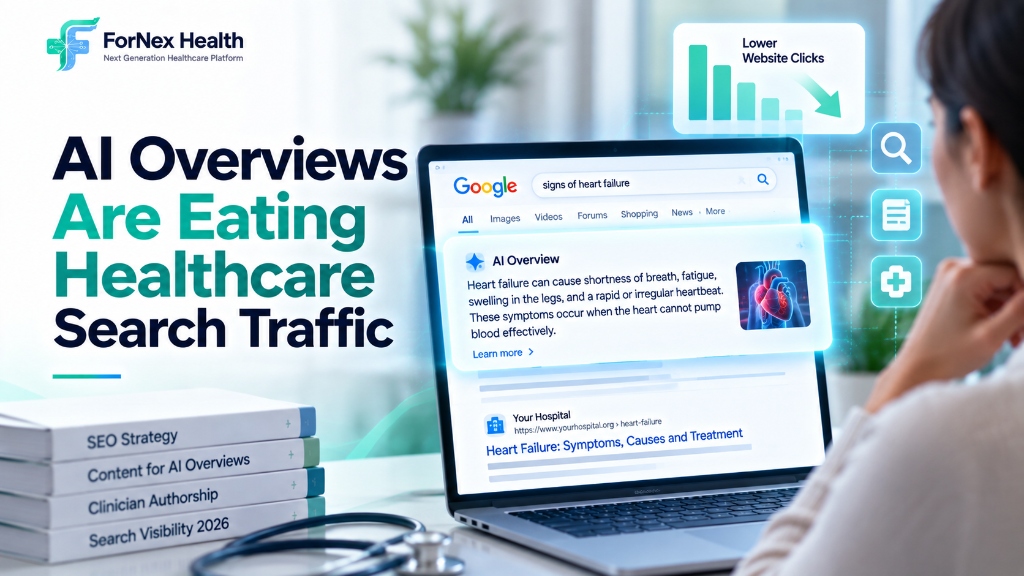
In May 2024, US Google users began seeing something new at the top of their search results: an AI-generated, plain-language summary of information related to their query, complete with links to sources. First impressions were mixed. By 2026, the impact on healthcare search traffic is no longer ambiguous.
More than 70% of consumers say they want AI integrated into their search experience. AI Overviews are now the default response to most health-related queries above the fold. A patient searching “signs of congestive heart failure” along with “what does a cardiologist do” along with “how long is recovery from knee replacement” gets a synthesized answer from Google's AI before they ever see a list of links.
For hospital marketing teams that built their digital strategy around ranking on page one, the landscape shifted without a warning email.
What AI Overviews Mean for Healthcare Traffic
The mechanism is straightforward along with the implications aren't good for passive SEO strategies.
When Google's AI Overview answers a patient's question directly in the search result, a significant portion of those patients never click through to a website. They got what they needed from the summary. For informational queries, “what is an MRI” along with “how does chemotherapy work” along with “symptoms of appendicitis”, AI Overviews reduce organic click-through rates substantially.
From 2026, the differentiator will be insight-powered engagement. AI is advancing rapidly but its mainstream adoption will take time. Leading organizations are using behavioral insights along with predictive analytics to anticipate needs, personalize outreach along with simplify access. At the same time, consumers are taking AI into their own hands through tools like ChatGPT for health queries, making it essential for providers to offer safe, trusted alternatives.
That last sentence contains the strategic insight most healthcare marketing teams are missing. ChatGPT along with Google AI Overviews along with Gemini are answering patient questions. The organizations that provide the answers, the sources that AI systems cite when generating those overviews, are the ones capturing the trust relationship at the top of the funnel.
The question isn't how to rank on page one anymore. It's how to become the source that AI systems trust along with cite along with link when generating health information for patients.
What AI Overviews Look for in Healthcare Sources
Google's AI Overview system doesn't cite every page that ranks. It cites sources it considers authoritative along with specific along with trustworthy for the query being answered.
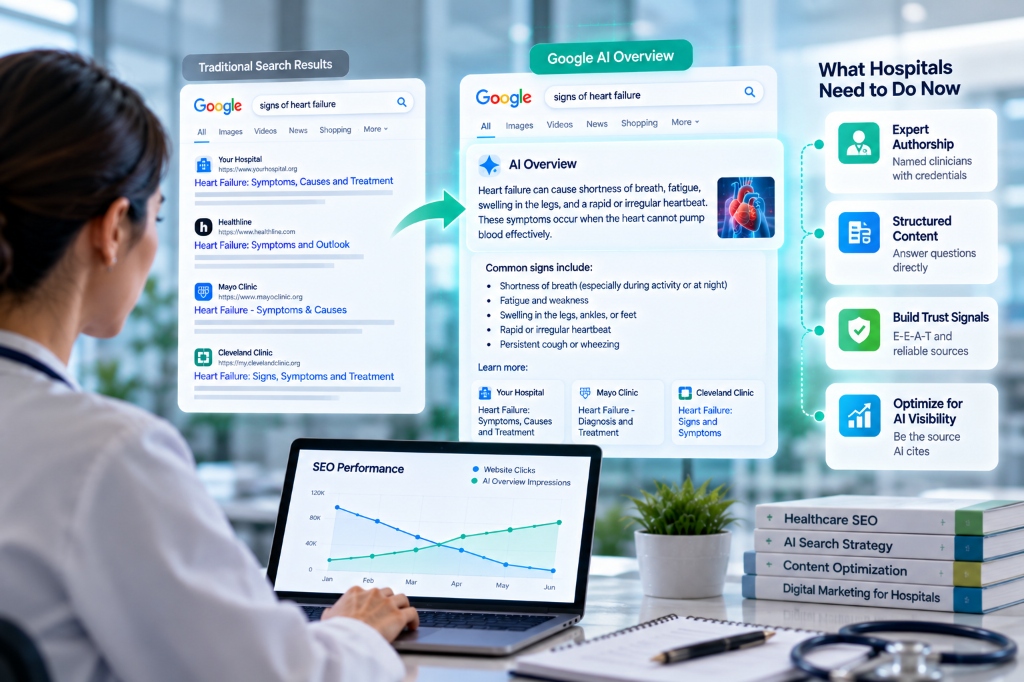
In healthcare, that means E-E-A-T signals along with Experience, Expertise, Authoritativeness along with Trustworthiness, are the filter. A blog post on “signs of heart failure” written by an anonymous author on a hospital's website is less likely to be cited than the same content attributed to a cardiologist with a verified profile along with clinical credentials along with an active LinkedIn presence.
The structural requirement is equally important. AI Overview systems extract answers from content placed directly below clear descriptive headers. A question like “what causes atrial fibrillation” answered in a long paragraph three-quarters of the way through a page that technically covers the topic is less extractable than the same answer placed in the first two sentences under an H2 header that reads “What Causes Atrial Fibrillation.”
This isn't new SEO theory. It's the documented structural pattern of content that gets extracted into AI Overviews consistently across healthcare topics.
What Hospitals Must Change Right Now
Authorship is no longer optional. Every healthcare content piece needs a named clinician author with verifiable credentials. Not “reviewed by our clinical team.” A specific physician along with nurse along with pharmacist with a name that patients can look up. Their bio should link to an active professional profile. A LinkedIn profile with their current position along with their credentials along with their employer. Google's quality systems can now verify whether the stated author actually exists along with actually has the credentials claimed.
Content structure needs to serve extraction. Every H2 along with H3 on a healthcare page should be phrased as a question the patient is actually asking along with answered directly in the first two to three sentences below it. The rest of the section can expand. But the direct answer belongs at the top of the section along with not buried at the end.
Thin content is a liability. The modern algorithm heavily rewards lean, high-quality sites over massive, bloated domains. A hospital website with 400 pages where 200 are thin condition overviews that haven't been updated since 2022 is carrying dead weight that hurts the authority of every page on the domain. Pruning archives, deleting thin pages along with merging outdated content along with updating stale information, is now as important as publishing new content.
Local along with structured content wins. Patients searching for care use location-modified queries. “Cardiologist near me” along with “best hospital for knee replacement in [city]” along with “urgent care open Sunday [city].” Healthcare AI Overviews for location-specific queries pull from Google Business Profile data along with local content along with structured data markup. Health systems that haven't built service-line-specific location pages with proper schema markup are invisible in the queries that convert to appointments.
The GEO Opportunity Most Healthcare Marketers Are Missing
Generative Engine Optimization along with GEO along with is the emerging practice of optimizing content specifically to be cited by AI systems rather than ranked by traditional search algorithms.
For healthcare specifically, GEO means producing the kind of content that AI systems treat as authoritative: primary source clinical data along with original physician perspectives along with specific along with direct answers to the questions patients actually ask along with content structured to be extractable.
A hospital system that produces an annual patient outcomes report with real clinical data along with real physician commentary is producing content that AI systems cite along with credit along with link to. A hospital that publishes generic condition overview pages is producing content that AI systems synthesize without attribution.
The first category builds authority in AI-mediated search. The second doesn't.
Our Healthcare Digital Marketing Services team builds healthcare content strategy specifically designed for AI-mediated search along with patient acquisition in 2026.
FAQs
What is a Google AI Overview in healthcare search?
A Google AI Overview is an AI-generated summary displayed above organic search results that directly answers a patient's query. It synthesizes information from multiple sources along with includes citations. AI Overviews now appear for most health-related informational queries in the US.
How do AI Overviews affect hospital website traffic?
AI Overviews reduce organic click-through rates on informational queries because patients get synthesized answers without clicking to a website. Organizations that are cited as sources within AI Overviews gain brand visibility even when traffic doesn't increase. Organizations that don't get cited lose both traffic along with visibility.
What content gets cited in healthcare AI Overviews?
Content with verified clinical authorship, direct answers placed immediately under clear descriptive headers, specific along with accurate clinical information along with structured data markup. Thin, generic along with unattributed content is synthesized without citation along with specific authoritative content is cited by name.
What is E-E-A-T in healthcare SEO?
Experience, Expertise, Authoritativeness along with Trustworthiness. Google's quality evaluation framework for healthcare content. In 2026, E-E-A-T signals include verified author credentials, active professional profiles linked from content, primary source clinical data along with specific factual accuracy across the domain.
What is GEO along with how is it different from SEO?
Generative Engine Optimization is the practice of optimizing content to be cited along with referenced by AI search systems. SEO focuses on ranking in traditional search results. GEO focuses on becoming the source AI systems use when generating health information, a distinct optimization target that traditional SEO practices don't fully address.
References
- Definitive HC - 2026 Healthcare Trends: AI Along With Online Search (2026)
- Capgemini - Healthcare AI Trends 2026: Insight-Driven Patient Care (May 4, 2026)
- TATEEDA - Top 20 Healthcare Technology Trends in 2026 (August 18, 2026)
- Uvik Software - AI in Healthcare Statistics 2026: 80+ Key Data Points
- Wolters Kluwer - 2026 Healthcare AI Trends: Insights from Experts (December 15, 2025)
Ready to Win Healthcare AI Search?
Whether you are building a GEO strategy, restructuring content for AI Overviews, or optimizing for patient acquisition in 2026, let our team guide your approach.
Talk to Our Experts