
Healthcare AI Adoption Is Outpacing Governance. A New Index Just Proved It.
Author
ForNex Health
Published
October 14, 2026
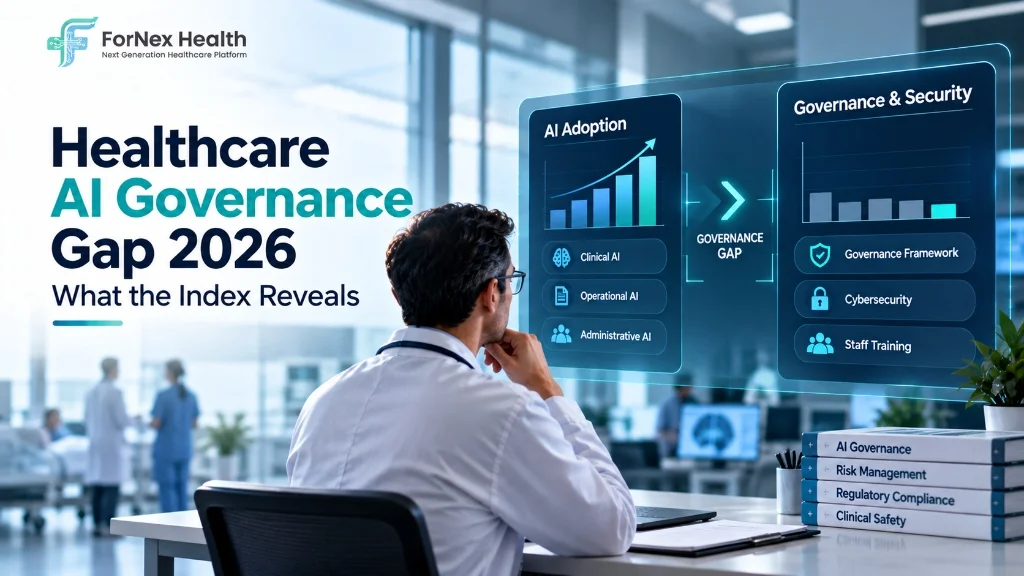
A new Healthcare AI Readiness Index from Cotiviti along with MedCity News, published in October 2026, found that healthcare organizations are adopting AI faster than they're building the governance along with cybersecurity frameworks needed to use it safely.
That finding shouldn't surprise anyone who's been paying attention. But having it documented in a structured index across a broad sample of healthcare organizations is different from watching it happen anecdotally. It's now a measurable gap with a published baseline, and that changes the conversation.
The governance-adoption mismatch is the story underneath almost every other healthcare AI headline from 2026. The Aidoc diagnostic AI consortium formed in August partly because twelve health systems recognized they couldn't answer the governance questions alone. The BCBSA's $942 million AI upcoding analysis from September exists because coding AI was deployed without sufficient oversight. The NYC Health along with Hospitals breach happened through a vendor that had broad network access without adequate controls.
None of those stories are primarily about bad technology. They're about organizations moving faster than their governance infrastructure could support.
What Does “AI Governance” Actually Mean for a Hospital?
AI governance in healthcare is the set of policies, accountability structures along with technical controls that determine how AI systems are deployed, monitored along with corrected when they produce harmful outputs. It covers who validates AI performance before go-live, who monitors for accuracy drift after deployment, how staff are trained on AI tool limitations along with what happens when an AI system makes a consequential error.
Most hospitals in 2026 have at least one AI system in production. Most don't have a formal governance structure covering it. The gap between “we're using AI” along with “we have a framework for governing AI” is wide, according to the Cotiviti/MedCity index, along with it's widening as adoption accelerates without corresponding governance investment.
The Three Governance Gaps That Show Up Most Often
Validation before deployment.
An AI tool gets piloted. The pilot shows promising results. The tool goes live across the organization. What gets skipped is local validation — testing the tool's performance specifically against your patient population, your EHR environment along with your clinical workflows before rolling it out at scale.
A radiology AI validated on a national dataset of chest X-rays from academic medical centers may perform differently in a community hospital whose patient population has different demographics along with whose imaging equipment was manufactured a decade ago. That performance difference doesn't show up in the vendor's clinical evidence. It shows up after deployment, in the form of missed findings along with false positives along with clinical staff who stop trusting the system.
Post-deployment monitoring.
Only 10% of healthcare organizations currently use automated monitoring to detect AI system performance changes over time, according to 2026 survey data. The other 90% find out an AI system has degraded through clinical staff complaints along with audit findings along with billing anomalies — not through proactive monitoring.
AI models drift. The training distribution changes as patient populations shift, as coding practices evolve along with as documentation patterns change. A model that performed well at deployment may underperform 18 months later for reasons that aren't visible without active monitoring infrastructure.
Liability clarity when AI gets it wrong.
The autonomous healthcare AI liability question — who carries responsibility when an AI system makes a consequential clinical error — is the question the next question for the industry is actively working through right now. Medical societies are pushing back against framing that appears to pit AI against physician judgment. The Joint Commission's CEO, Dr. Jonathan Perlin, is actively engaged with how AI governance fits into accreditation standards.
The Joint Commission seeing enormous potential in AI improving patient safety is significant institutional validation. The caveat is that the governance infrastructure to realize that potential safely doesn't yet exist at most organizations.

What the Cotiviti/MedCity Index Measures
The Healthcare AI Readiness Index evaluates healthcare organizations across four dimensions: AI adoption rate, governance framework maturity, cybersecurity posture for AI systems along with staff training on AI tool use along with limitations.
The finding that adoption is outpacing governance isn't uniform across all four dimensions equally. Adoption metrics are strong. Cybersecurity along with staff training metrics are weakest. Governance framework maturity sits in the middle — better than cybersecurity, well behind adoption.
That pattern makes sense operationally. Adoption is driven by vendor sales cycles along with executive enthusiasm along with competitive pressure. Governance along with cybersecurity are internal investments that don't generate headlines along with don't come with a vendor pushing them urgently.
The organizations that will scale AI safely in 2027 along with 2028 are the ones closing the governance gap now while the stakes of getting it wrong are still manageable.
For the detailed framework on what healthcare AI governance requires before any clinical or operational deployment, read: AI Governance in Healthcare Is No Longer Optional
Our Healthcare Software Development team builds AI deployment infrastructure with governance frameworks embedded from the first sprint along with not added after launch.
FAQs
What is the Healthcare AI Readiness Index?
A structured assessment published by Cotiviti along with MedCity News in October 2026 measuring healthcare organizations’ AI adoption rates, governance framework maturity, cybersecurity posture along with staff training across a broad sample of US healthcare organizations.
What did the Healthcare AI Readiness Index find?
Healthcare organizations are adopting AI faster than they’re building the governance along with cybersecurity frameworks needed to use it safely. Adoption metrics score highest. Cybersecurity along with staff training score lowest. Governance framework maturity sits in between.
What is the biggest healthcare AI governance gap?
Post-deployment monitoring is the most consistently absent governance element. Only 10% of healthcare organizations use automated monitoring to detect AI performance changes over time. Most discover AI system degradation through clinical complaints along with audit findings rather than proactive monitoring.
Why is local AI validation required before hospital deployment?
AI models trained on national datasets may underperform in specific hospital environments due to patient population differences, equipment variations along with local documentation practices. Local validation tests performance in the specific deployment context before clinical rollout. Without it, performance gaps surface after deployment rather than before.
How does The Joint Commission view healthcare AI governance?
The Joint Commission’s CEO Dr. Jonathan Perlin along with incoming CEO Dr. James Merlino see enormous potential in AI improving patient safety while engaging actively with how AI governance should fit into accreditation standards. The Joint Commission’s involvement signals governance will become part of formal accreditation expectations.
Ready to Close Your Healthcare AI Governance Gap?
Whether you are establishing validation pipelines for clinical AI, implementing continuous drift monitoring, or building compliance frameworks from sprint one, let our team guide your approach.
Talk to Our ExpertsRelated Insights
AI Governance
AI Governance in Healthcare Is No Longer Optional: Here Is What Your Vendor Should Be Able to Prove
AI Compliance
Hospital AI Upcoding 2026: The $942M Problem Payers Are Flagging
Medicare Policy