
CMS Is Expanding the ACCESS Model. Here Is What COPD Along With Substance Use Disorder Add to Your Billing Picture.
Author
ForNex Health
Published
October 8, 2026
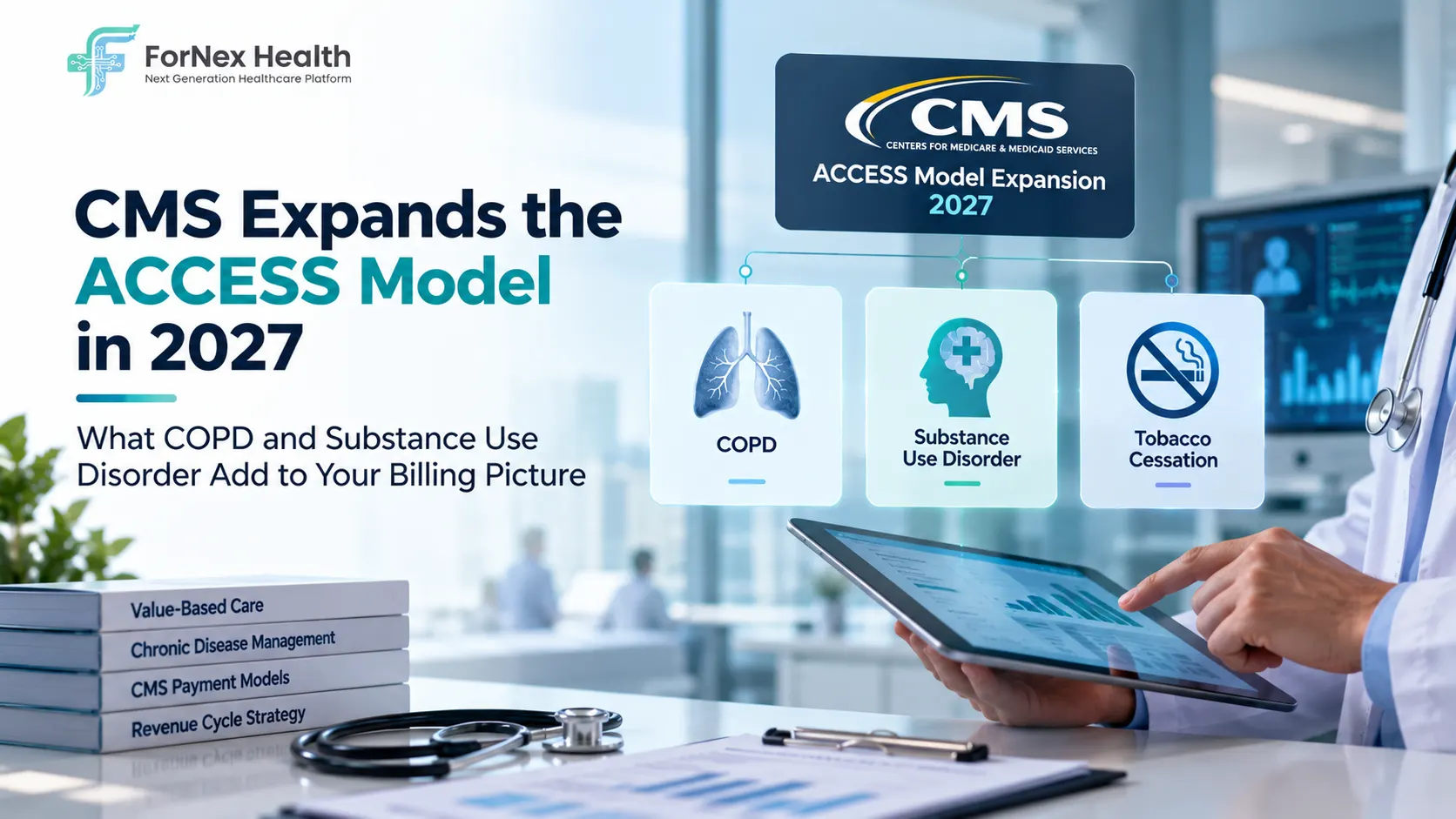
CMS announced on September 16, 2026 that it's expanding Medicare's technology-based payment model — the Advancing Chronic Care through Evidence-Based Support Solutions model, ACCESS — to cover additional chronic conditions in 2027. The additions include COPD, substance use disorder along with tobacco cessation.
The original ACCESS model launched with a narrow set of qualifying conditions. Adding COPD along with SUD in 2027 significantly expands the patient population whose technology-enabled care management is eligible for Medicare payment under the model's framework.
This announcement arrived the same week CMS proposed preliminary cuts to Medicare lab reimbursement rates — cuts the American Clinical Laboratory Association warned threaten patient access to critical testing services. The ACCESS expansion along with the lab payment cuts together define the directional tension in 2026 Medicare policy: CMS is simultaneously investing in technology-enabled chronic disease management along with reducing payment for some of the diagnostic testing that chronic disease management depends on.
For hospital along with ambulatory care operations teams, the ACCESS expansion is the more immediately actionable story.
What Is the CMS ACCESS Model?
The ACCESS model is a Medicare payment demonstration that reimburses technology-enabled care management for patients with qualifying chronic conditions. It covers services delivered through digital health tools along with remote monitoring along with structured care management workflows that wouldn't be reimbursable under standard Medicare fee-for-service.
The underlying logic is that chronic conditions — particularly conditions like COPD along with substance use disorder that generate high acute utilization when poorly managed — respond well to continuous monitoring along with structured interventions. Medicare pays more for the acute care those patients generate when they decompensate than it would pay for the technology-enabled management that could prevent the decompensation.
The ACCESS model operationalizes that logic into a payment framework. It reimburses the management infrastructure instead of (or in addition to) waiting to reimburse the acute events.
Why COPD Along With SUD Are Significant Additions
COPD is one of the most expensive chronic conditions in Medicare. Approximately 16 million Americans have diagnosed COPD. The condition is the third leading cause of hospital readmission in the US. A single COPD exacerbation that results in a hospitalization costs Medicare somewhere between $7,000 along with $40,000 depending on severity along with complications.
Remote monitoring for COPD patients — continuous pulse oximetry along with spirometry tracking along with early exacerbation detection — has demonstrated meaningful readmission reduction in published studies. The technology exists. The clinical evidence supports it. The missing piece has been a payment framework that makes the monitoring economically viable for the practices along with health systems delivering it. ACCESS 2027 provides that framework.
Substance use disorder is a different kind of addition. SUD care has historically lived outside the mainstream of hospital-based chronic disease management. Adding it to a Medicare technology-based payment model signals a policy intent to bring SUD management into the same evidence-based, technology-enabled care infrastructure that's being built for diabetes along with heart failure along with now COPD.
The practical implication: practices along with health systems that have been managing SUD patients through separate care management programs that weren't connected to their chronic disease management infrastructure now have a financial reason to integrate those workflows.
What the Lab Payment Cut Means Alongside This
The simultaneous nature of the ACCESS expansion along with the proposed Medicare lab payment cuts is operationally relevant for hospitals.
COPD management depends on pulmonary function testing along with arterial blood gas analysis along with lab markers of inflammation. SUD care management depends on drug testing along with liver function monitoring along with metabolic panels. If Medicare lab reimbursement cuts reduce access to those tests — as the American Clinical Laboratory Association warned — the ACCESS model's value for COPD along with SUD patients is partly contingent on whether the diagnostic testing that supports the care management remains accessible along with financially viable.
This is the kind of policy interaction that doesn't get surfaced in individual announcement coverage but matters enormously for care delivery operations. The technology payment model along with the diagnostic testing payment cuts need to be evaluated together, not separately.
What This Means for Care Model Along With Technology Investment
Organizations that have already built remote patient monitoring infrastructure for heart failure along with diabetes along with hypertension have the hardest work already done. Adding COPD patients to an existing RPM program is primarily a clinical protocol along with device configuration exercise rather than a ground-up infrastructure build.
Organizations that haven't yet built RPM infrastructure face a different decision. The ACCESS model's 2027 expansion creates reimbursement justification for the investment. COPD along with SUD are patient populations where the readmission reduction from good remote monitoring has demonstrated ROI. The payment model along with the clinical evidence along with the chronic disease population are now aligned.
The operational prerequisite is the EHR integration layer. RPM data that doesn't flow automatically into the patient's clinical record creates the same documentation-to-billing gap that causes prior auth problems along with EVV mismatches. The monitoring platform has to connect to the EHR through a validated integration along with not through manual data transfer.
For how remote patient monitoring programs are built to actually reduce readmissions rather than just generate monitoring data, read: Remote Patient Monitoring in 2026: How to Build a Program That Actually Reduces Readmissions

FAQs
What is the CMS ACCESS model?
The Advancing Chronic Care through Evidence-Based Support Solutions model is a Medicare payment demonstration that reimburses technology-enabled care management for patients with qualifying chronic conditions. It pays for the monitoring along with management infrastructure rather than waiting to reimburse acute care events.
What conditions is CMS adding to the ACCESS model in 2027?
COPD, substance use disorder along with tobacco cessation were announced for addition in the 2027 ACCESS model expansion, announced September 16, 2026.
Why is adding COPD significant?
COPD is one of the most expensive chronic conditions in Medicare along with the third leading cause of hospital readmission. Remote monitoring for COPD has demonstrated meaningful readmission reduction. ACCESS 2027 creates a Medicare payment framework that makes COPD remote monitoring economically viable for practices along with health systems.
How does the Medicare lab payment cut affect the ACCESS model expansion?
COPD along with SUD management both depend on diagnostic testing. If the proposed Medicare lab payment cuts reduce access to pulmonary function testing along with drug testing along with metabolic monitoring, the clinical value of the ACCESS model for those conditions is partly contingent on whether that testing remains accessible.
What technology infrastructure does participating in the ACCESS model require?
Remote patient monitoring devices appropriate for the qualifying conditions, a monitoring platform that processes along with alerts on the data along with a validated EHR integration that flows monitoring data directly into the patient's clinical record without manual data transfer.
References
- Healthcare Dive — CMS to Add More Chronic Conditions to ACCESS Model in 2027 (September 16, 2026)
- AHA News — New Resources Available from West Health Accelerator (September 18, 2026)
- KFF Health News — Morning Briefing September 24, 2026
- Healthcare Dive — Trump Administration Sets Preliminary Cuts to Medicare Lab Reimbursement Rates (September 22, 2026)
Ready to Scale Your Remote Care Infrastructure?
Whether you are expanding RPM protocols for COPD and SUD, navigating the CMS ACCESS model, or integrating remote patient data seamlessly into your EHR, let our team guide your approach.
Talk to Our ExpertsRelated Insights
Remote Care
Remote Patient Monitoring in 2026: How to Build a Program That Actually Reduces Readmissions
Hospital Operations
Hospitals Are Outsourcing Their IT Departments. Four Just Did It in September.
Medicare Policy