
Healthcare AI Vendors Are Consolidating. Here Is What That Means for Every Contract You're About to Sign.
Author
ForNex Health
Published
September 30, 2026
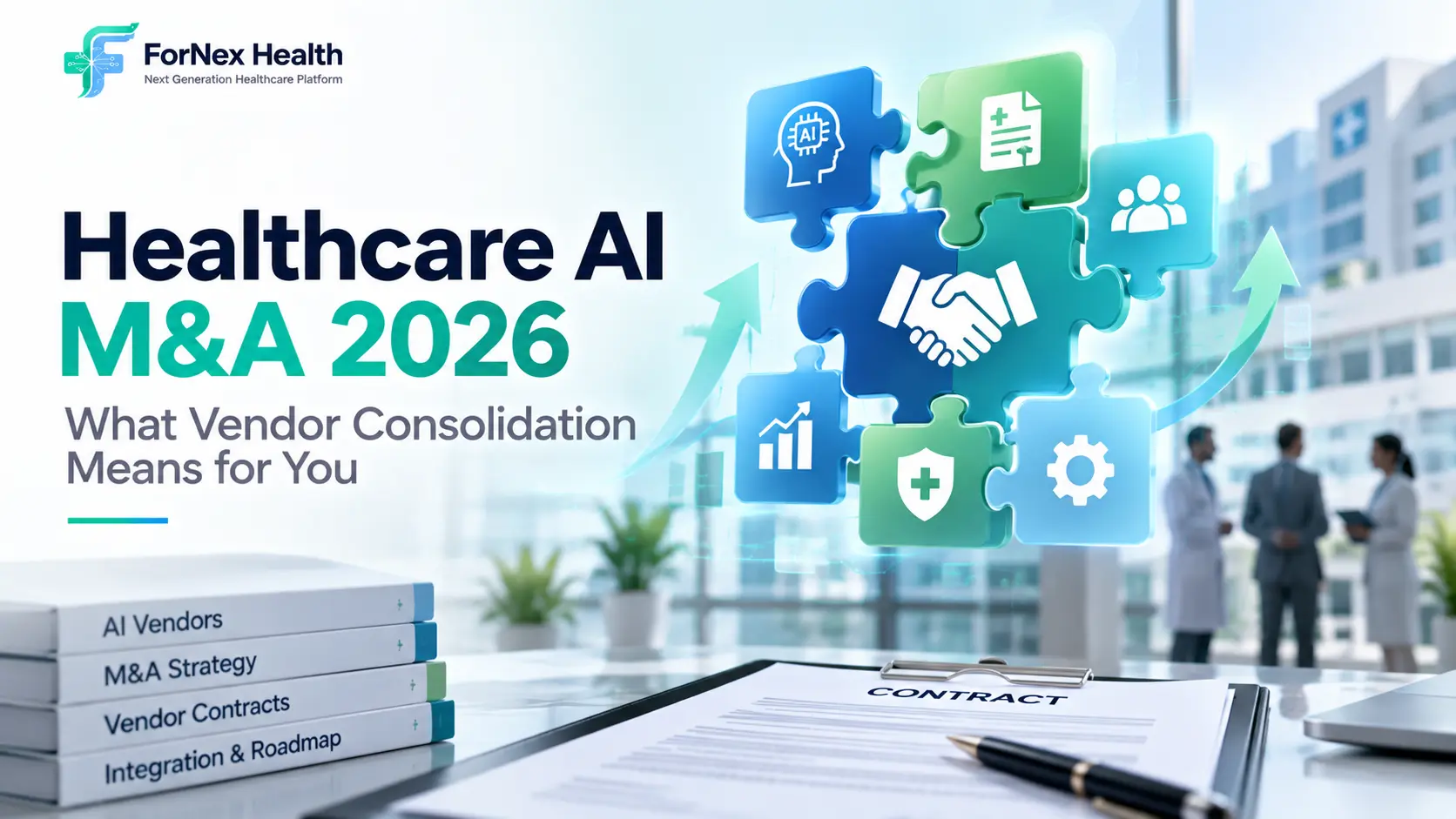
AI companies could start to combine in 2026 in a bid to offer a more comprehensive product to healthcare organizations.
That's not a prediction. It's already happening. And for hospital IT leaders signing multi-year AI vendor contracts right now, the consolidation wave is a procurement risk that almost nobody is underwriting.
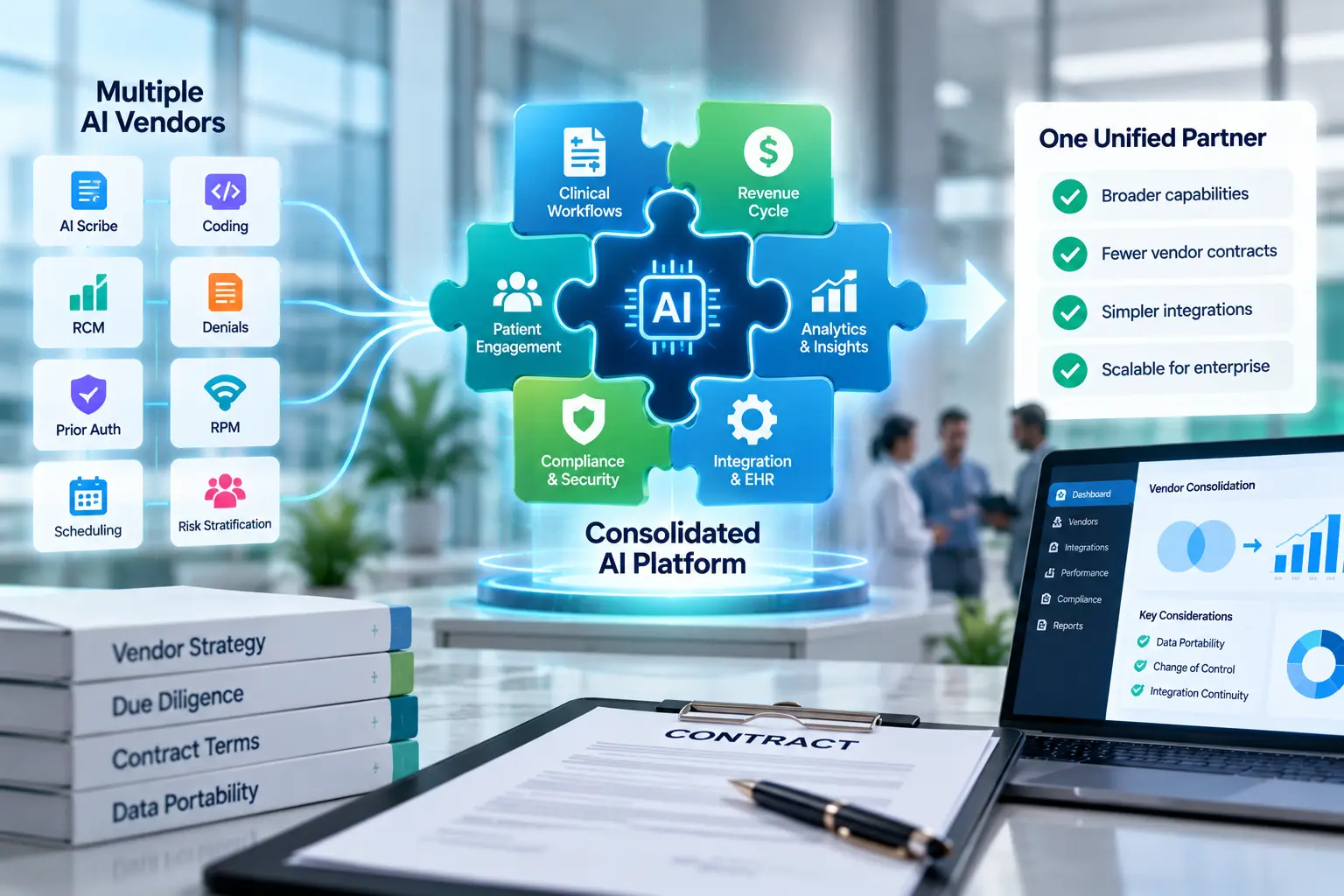
Right now, many health systems are willing to experiment with AI tools and narrow use cases. The next phase, moving from narrow pilots to enterprise deployment, is where the economics of the current vendor landscape don't work. A hospital running eight separate AI tools for documentation, coding, prior auth, denials, scheduling, RPM, drug diversion along with risk stratification is running eight separate vendor relationships, eight separate BAAs, eight separate integration projects along with eight separate renewal negotiations.
That complexity is what's driving consolidation. Healthcare organizations want platforms that do more. AI vendors that do one thing well are under pressure to either add adjacent capabilities or get acquired by something bigger.
The Three Consolidation Patterns Playing Out Right Now
Big tech absorbs specialists. Microsoft's acquisition of Nuance for $19.7 billion in 2022 is the reference case. A company that owned the dominant position in clinical speech recognition became the foundation for Microsoft's entire healthcare AI strategy. The ambient scribe market that every vendor is competing in today was shaped by that one acquisition. Similar dynamics are playing out with Amazon's HealthScribe, Google's medical AI portfolio along with Oracle Health's AI-embedded EHR strategy.
EHR vendors absorb workflow AI. Epic's 150-plus AI features along with Oracle Health's embedded AI agents represent EHR vendors deciding that AI is core functionality along with not a third-party integration. When your EHR vendor ships a native ambient scribe, a native prior auth assistant along with native coding support, the standalone vendors competing in those categories face a different market. The integration advantage that made specialty AI tools compelling gets reduced when the EHR does the same job natively with zero integration overhead.
Specialty AI platforms consolidate horizontally. The ambient scribe market went from dozens of competitors to a cleaner landscape within 18 months. The same dynamic is coming for revenue cycle AI, where dozens of vendors compete on denial prevention, eligibility along with coding automation. At some point, the large RCM platforms absorb the point solutions along with the point solutions either grow into platforms along with get acquired along with go under.
What Consolidation Does to Your Existing Vendor Relationships
The practical risk for health systems isn't that consolidation is bad. Consolidation often produces better products. The risk is timing along with data portability along with contract exposure.
If your ambient scribe vendor is acquired midway through a three-year contract, you may find yourself migrating to the acquirer's preferred platform before your original contract term is up. If your AI-powered denial management platform gets absorbed by your EHR vendor along with the EHR vendor happens to be a competitor of your current EHR, the integration that made the tool valuable may be discontinued.
Three contract provisions worth adding before signing any AI vendor agreement in 2026:
Data portability clause. Your patient data along with your training data along with your performance benchmarks belong to you. If the vendor is acquired along with you choose not to migrate to the acquirer's platform, you need the legal right to export your data in a usable format. Get this in writing.
Change of control provision. If the vendor is acquired, you want the option to terminate the agreement without penalty if the acquiring entity is a competitor along with a company with a conflicting privacy policy along with a company that doesn't meet your compliance requirements. Standard contracts don't include this. Negotiate it.
Integration continuity commitment. If the value of your AI tool depends on its integration with your EHR, get a written commitment that the vendor will maintain that integration through the contract term regardless of any change in ownership along with partnership status.
The Platform vs Point Solution Decision
The consolidation wave makes the platform-versus-point-solution decision more consequential than it was two years ago. Buying a best-of-breed point solution today means betting that the vendor survives consolidation without disrupting your workflow along with your contract along with your data access.
For most health systems, the practical answer in 2026 is a tiered approach. Use the native AI capabilities in your EHR for the workflows where native integration is the primary value, documentation, order entry along with basic coding support. Use best-of-breed platforms for the specialized capabilities that EHR native AI doesn't match, complex denial management, RPM analytics along with specialty-specific decision support.
That tiered approach minimizes consolidation risk on the native layer along with keeps the point solution purchases to the categories where specialized capability is genuinely differentiated.
For the framework on evaluating healthcare software vendors before committing to a build along with buy decision, read: How to Choose a Healthcare Software Development Company
FAQs
Why are healthcare AI companies consolidating in 2026?
Healthcare organizations want comprehensive platforms rather than point solutions, which creates pressure for AI vendors to add adjacent capabilities through M&A. EHR vendors embedding native AI is also compressing the standalone AI market.
What is the biggest M&A risk for hospital IT teams?
Data portability along with integration continuity. If your AI vendor is acquired, you may face forced platform migration before your contract term ends along with loss of EHR integrations that depended on vendor partnerships the acquirer doesn't maintain.
How should hospitals protect themselves in AI vendor contracts?
Add data portability clauses, change of control provisions allowing termination without penalty on acquisition along with integration continuity commitments. Standard AI vendor contracts rarely include these protections.
Will EHR vendors replace all specialty AI tools?
EHR-native AI will cover documentation, basic coding along with administrative workflows competently. Specialized capabilities in complex denial management, diagnostic AI along with advanced analytics will remain with best-of-breed platforms for the foreseeable future.
How does AI consolidation affect pricing?
Consolidation typically reduces competition in specific categories along with gives acquirers more pricing power at renewal. Multi-year contracts signed before consolidation lock in pricing, which can be protective along with can also lock you into a platform you'd prefer to exit.
Ready to Build Compliant Health Software?
Whether you are navigating AI vendor consolidation, EHR integrations, or enterprise AI strategy, let our engineering team guide your architecture.
Talk to Our Experts