
Medicaid Work Requirements Start January 1. CMS Just Offered States a Soft Landing.
Author
ForNex Health
Published
November 24, 2026
Last reviewed: November 2026. Fornex Health.
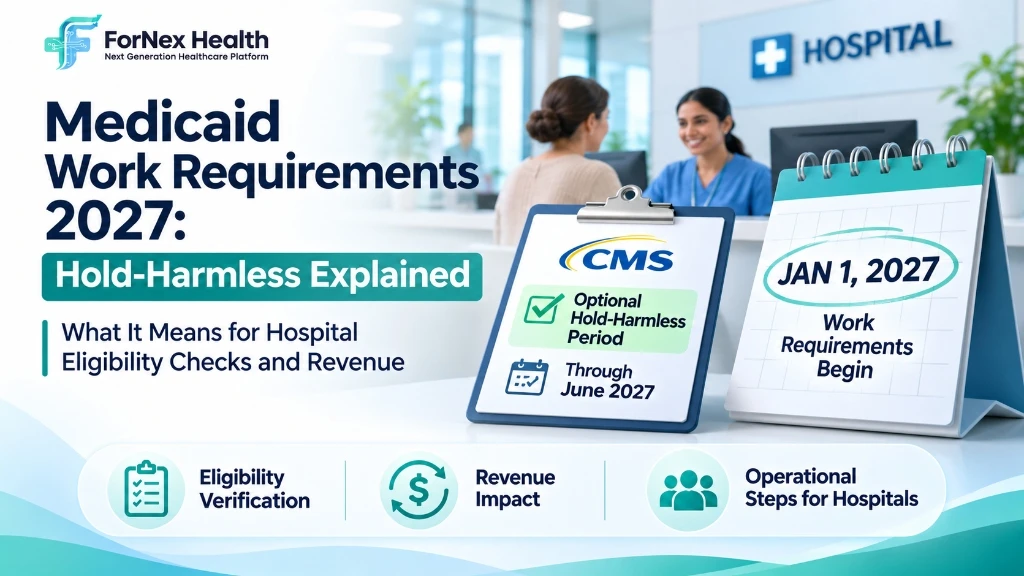
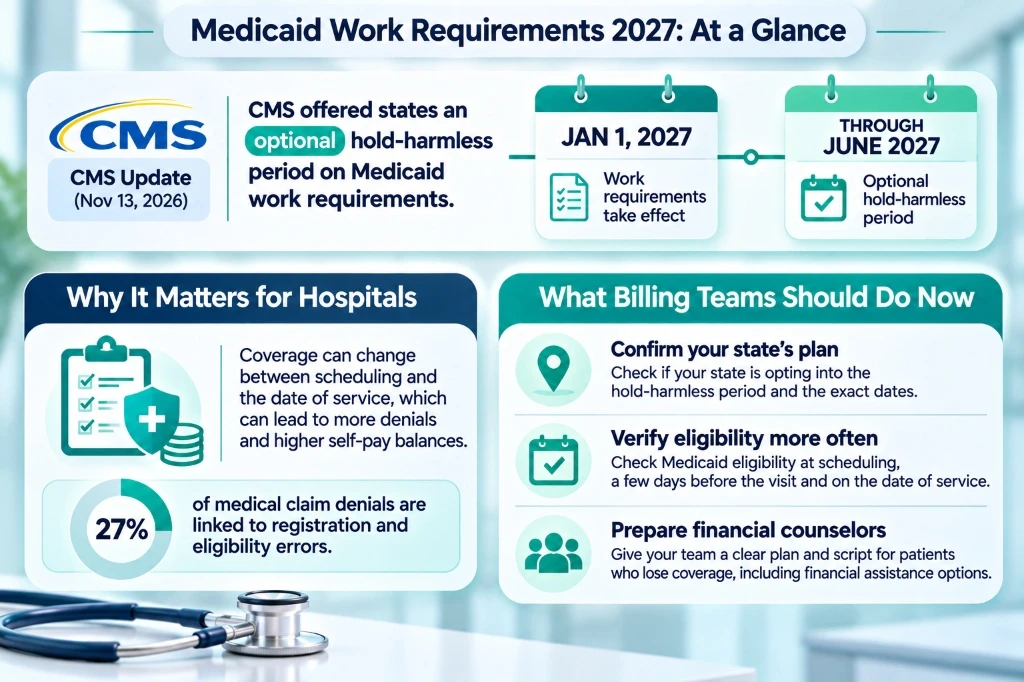
On November 13, CMS sent a letter to state Medicaid directors offering an optional hold-harmless period through the end of June 2027. It relates to the Medicaid work requirements scheduled to take effect on January 1, 2027.
Circle the word “optional.” States decide whether to use the offer, so what your hospital sees in January depends on where you operate. If you work across several states, you may be dealing with different timelines at the same time.
What Did CMS Announce About Medicaid Work Requirements?
CMS told state Medicaid directors on November 13, 2026 that states may opt into a hold-harmless period lasting until the end of June 2027. The underlying work requirements are still scheduled to begin January 1, 2027.
The reporting we found doesn’t spell out every term of the hold-harmless arrangement. Read the letter itself, or ask your state Medicaid agency, before you build a plan around it. What follows is an operational view, not a legal reading.
Why Does This Matter for Hospital Revenue?
Because coverage status will change faster than most registration workflows can track. A patient who was covered at scheduling may not be covered on the date of service, and the hospital finds out when the claim comes back.
Eligibility problems were already a leading source of denials before any of this. One industry analysis puts registration and eligibility errors behind roughly 27% of all medical claim denials (CertifyHealth). Add a population whose coverage is being reviewed against new requirements and that number has nowhere to go but up.
The hold-harmless option may soften the first six months in states that take it. It also postpones the problem. A hospital that uses the extra time to rebuild its eligibility process comes out ahead. A hospital that treats it as a reprieve will face the same January in July.
What Should Billing Teams Do Before January 1?
Check eligibility more often than you do today, track failures separately and give financial counselors a script. Specifically:
Ask your state Medicaid agency whether it is opting into the hold-harmless period and what the dates are. Don’t assume. Write the answer down for each state you serve.
Verify Medicaid eligibility at scheduling, again a couple of days before the visit and again on the date of service. Many registration teams verify once and move on. That worked when coverage was stable.
Give your financial counselors a plan for patients who lose coverage. Charity care and financial assistance applications take time, and the patient is in front of you at the worst possible moment to start one.
Build two simple weekly numbers. The first is Medicaid eligibility failures per 1,000 registrations. The second is how many of those patients end up with financial assistance on file. Together they show whether coverage loss is turning into bad debt or being caught early. This is our recommendation, not a CMS requirement, and it takes a few hours to set up.
Our earlier piece on the broader policy picture is still relevant: Medicaid Cuts 2026: What Hospitals Must Do Now. If your registration and billing workflows need a second pair of eyes, that is what our Medical Billing and Revenue Cycle Management team does.
About the Author
Written by the Fornex Health content team. Fornex builds billing infrastructure and healthcare software for US hospitals and health systems. See our work at fornexhealth.com/blogs.
Frequently Asked Questions
When do Medicaid work requirements take effect?
January 1, 2027, according to the schedule CMS referenced in its November 13, 2026 letter to state Medicaid directors.
What is the Medicaid hold-harmless period?
An optional period, offered by CMS to states, that runs until the end of June 2027 and relates to the work requirements. States choose whether to use it.
Does every state get the hold-harmless period?
No. It is optional and state-level. Check with your state Medicaid agency.
How could work requirements affect hospital billing?
Patients may lose Medicaid coverage between scheduling and the date of service, which raises eligibility denials and self-pay balances.
What should registration teams change first?
Verify Medicaid eligibility more than once per encounter and train financial counselors to start assistance applications early.
Facing Medicaid Work Requirements & Eligibility Challenges?
Whether you need to rebuild eligibility verification workflows, reduce claim denial rates, or train financial counselors for coverage transitions, let our team optimize your revenue cycle.
Talk to Our Experts