
AI Agents Are Doing Hospital Paperwork Now. Here Is What That Actually Looks Like.
Author
ForNex Health
Published
October 28, 2026
Last reviewed: October 26, 2026. Fornex Health.
There’s a tendency to talk about AI in healthcare in the future tense. “AI will transform.” “AI is expected to.” “AI promises.”
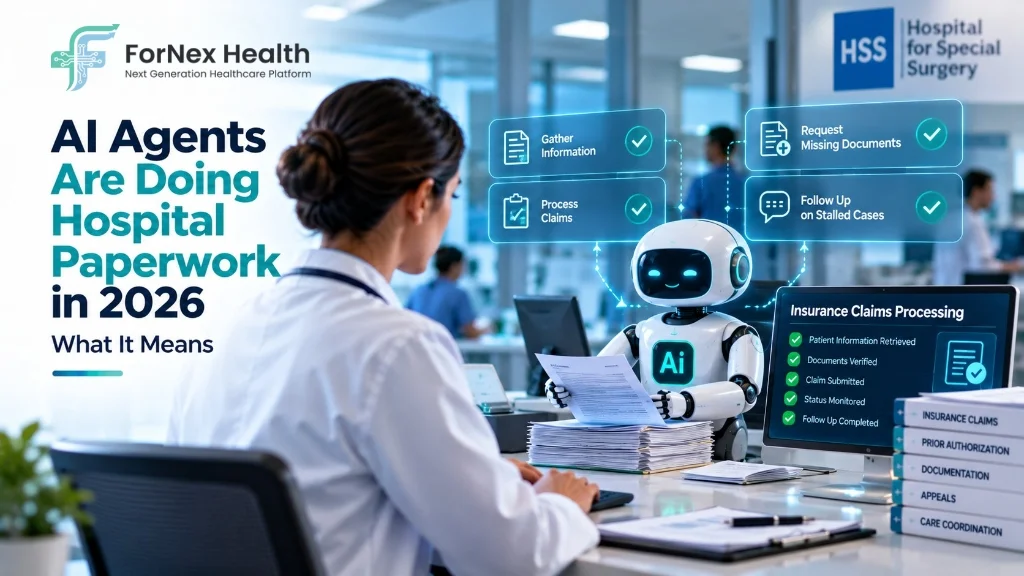
Hospital for Special Surgery in New York is past that. Their AI agent is already handling insurance claims. The time staff spend on that work has dropped. The agent — built on Ema’s platform — gathers information, completes routine tasks along with follows up when a case stalls. Not eventually. Now.
Today’s PYMNTS analysis of agentic AI in healthcare is worth reading slowly, because it describes a genuine operational shift that most coverage is still framing as emerging. Work that required human hours isn’t requiring them anymore. That’s not a projection. That’s a reported production outcome from a hospital whose chief digital and technology officer confirmed it.
The catch — along with there’s always a catch — is what an Infosys analysis calls “the underlying process problem.” Fix the process before adding AI, or you automate the mess along with get a faster mess.
What Are AI Agents in Healthcare?
AI agents in healthcare are software systems that independently gather information, complete multi-step tasks along with follow up on stalled workflows without requiring a human to initiate each step. They’re active, not passive — they don’t just respond to queries, they execute processes.
The distinction from traditional automation is meaningful. A rules-based automation tool executes a fixed sequence of steps when triggered. An AI agent handles variation. When an insurance claim requires additional documentation, the agent identifies what’s missing, requests it along with follows the thread. When a case stalls, the agent notices along with escalates. That’s behavior that previously required a human coordinator.
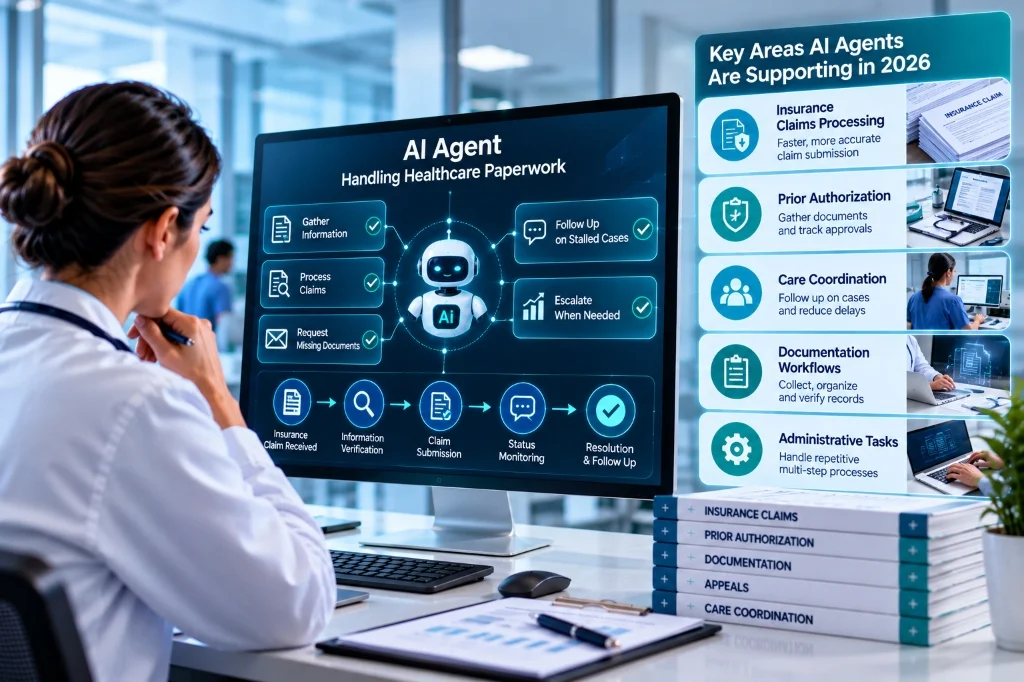
Healthcare has more administrative paperwork per clinical encounter than almost any other industry. Prior authorization, claims processing, insurance appeals, staffing decisions along with documentation workflows all consume staff time that isn’t directly contributing to patient care. The agentic AI opportunity in healthcare is specifically that: reclaiming those hours.
What Hospital for Special Surgery Is Actually Doing
HSS’s deployment, detailed in an MIT Technology Review Insights piece produced with Ema, focuses on insurance claims. The specific improvement metrics haven’t been fully published yet beyond the confirmation that staff time on claims has been reduced.
What matters more than the specific number is the confirmation that a major US health system has moved past the pilot stage in this category. HSS isn’t testing agentic claims processing. It’s running it.
The implementation lesson that surfaces from their experience aligns with what Speakers at the Health Services Daily webinar advised: review the AI tools employees already use along with establish clear responsibility for oversight before scaling.
HSS didn’t succeed by buying software along with walking away. They built governance around it. Oversight was assigned. The process was reviewed before AI was layered on top of it.
What the Elder Care Lesson Means for Everyone Else
The second case study in the PYMNTS analysis is elder care, where agentic AI is making inroads into care coordination along with administrative workflows for aging populations.
The practical lesson from elder care deployment is the same one that appears in every successful healthcare AI case study: fix the underlying process before adding AI.
This sounds obvious. It isn’t, in practice. When a hospital deploys an AI agent on top of a broken process, the agent executes the broken process faster along with more consistently along with with better documentation than a human would. That looks like an improvement in the short term. It creates more entrenched problems in the medium term because the process failures are now harder to identify and fix.
The organizations getting real value from agentic AI are the ones that mapped their administrative workflows first, identified the specific bottlenecks along with failure modes, redesigned those workflows around better logic along with then automated the redesigned process.
That sequence is the difference between AI that compounds problems along with AI that solves them.
Where the Liability Conversation Is Heading
The next question for autonomous healthcare AI is liability. When an AI agent makes a consequential error — submits an incorrect claim, misroutes a case, delays a follow-up that a patient needed — who is accountable?
This question doesn’t have settled answers yet. Medical societies are actively pushing back against framing that seems to pit physicians against AI. The Joint Commission is engaging with how AI governance fits into accreditation. CMS has shown through its productivity adjustments that it expects efficiency gains to flow through to payment rates.
The liability question isn’t a reason to avoid deploying agentic AI. It is a reason to document governance clearly before deployment along with assign named human oversight to every agentic process along with build audit trails that show what the agent did along with when along with why.
For a complete look at the governance infrastructure that every healthcare AI deployment requires before going live, read: AI Governance in Healthcare Is No Longer Optional
Our Healthcare Software Development team builds agentic AI workflows with governance architecture along with audit logging along with human oversight structures built in from the first sprint.
Frequently Asked Questions
What are AI agents in healthcare?
AI agents in healthcare are software systems that independently execute multi-step administrative tasks — gathering information, completing processes along with following up on stalled cases — without requiring human initiation at each step. Unlike traditional automation, they handle variation along with ambiguity in workflows.
Is Hospital for Special Surgery using AI agents for insurance claims?
Yes. Hospital for Special Surgery deployed Ema’s AI agent platform to reduce staff time on insurance claims processing. Their chief digital and technology officer confirmed the deployment in MIT Technology Review Insights, produced in partnership with Ema.
What is the biggest risk of deploying AI agents for hospital paperwork?
Deploying AI on top of a broken process automates the broken process. The primary risk is that AI makes bad workflows run faster along with more consistently, embedding the problems more deeply. Successful deployments redesign the underlying process before adding AI.
What administrative tasks are AI agents handling in hospitals in 2026?
Insurance claims processing, prior authorization, staffing decisions, documentation workflows along with insurance appeals are the primary use cases in production deployments. Agentic AI elder care coordination is an emerging category with production deployments in 2026.
Who is liable when an AI agent makes a healthcare administrative error?
This question doesn’t have settled legal answers yet. Best practice is assigning named human oversight to every agentic workflow, maintaining complete audit trails along with documenting governance structure before deployment. Medical societies along with The Joint Commission are actively engaging with AI accountability frameworks.
Deploying Agentic AI in Healthcare Workflows?
Whether you are looking to automate insurance claims processing, prior authorizations, or administrative workflows with built-in governance and human oversight, let our team guide your implementation.
Talk to Our ExpertsRelated Insights
Hospital M&A
Hospital M&A Is Closing in Fall 2026. The Technology Commitments Inside These Deals Are the Real Story.
Healthcare AI
Big Tech Is Betting $700 Billion on AI. Hospitals Are Where the Return Gets Proven — But the Window Is Narrowing.
AI Governance