
Healthcare Workforce Shortage Along With Automation: What Technology Can Fix Along With What It Can't
Author
ForNex Health
Published
August 31, 2026
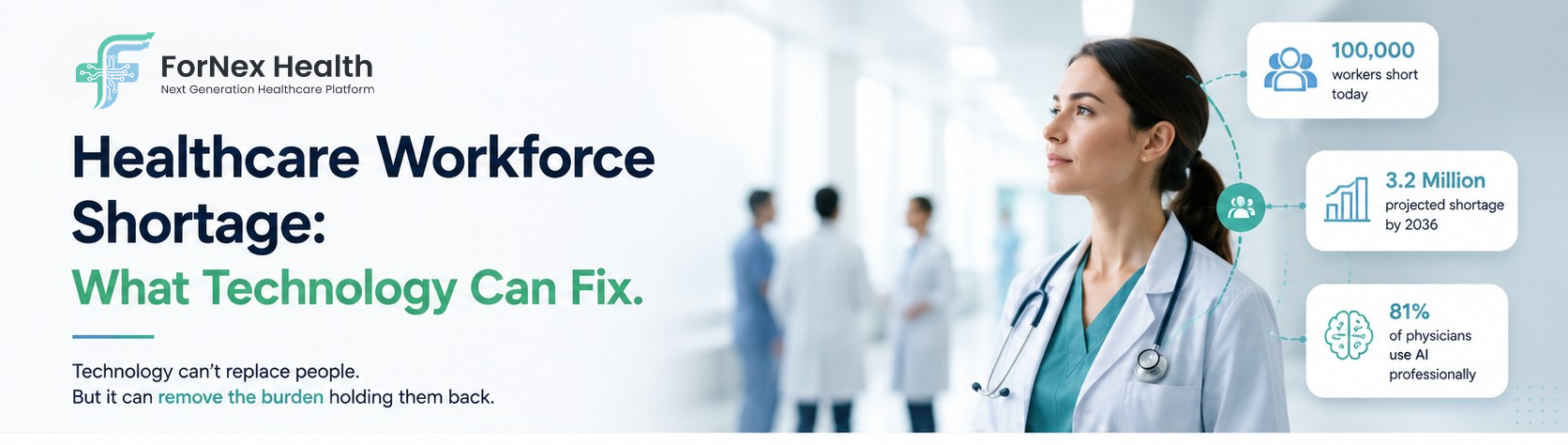
The US healthcare system is short roughly 100,000 workers right now. By 2036, that gap is projected to reach 3.2 million across nursing, primary care along with support roles. No technology roadmap closes a gap that size. But the right technology can change what that gap costs along with who bears the load of it.
81% of physicians now use AI professionally. That adoption rate tells you the tools have cleared the credibility barrier. What it doesn't tell you is whether the time savings are landing where the workforce shortage actually hurts.
Where Automation Is Making a Measurable Difference
Documentation time is the clearest win. Physicians spend roughly two hours on administrative tasks for every hour of direct patient care. Ambient AI scribes — now embedded natively in Epic along with athenahealth along with deployed across all VA medical centers — are recovering 1.5 to 2 hours per physician per day in documented deployments. That time goes back to patients along with not to hiring new staff.
Revenue cycle operations are the second biggest win. Eligibility verification, prior authorization along with denial management are all structured tasks with high volume along with clear right-or-wrong outputs. Automation handles them faster along with more accurately than manual processing along with without the turnover problem that plagues billing departments. An agency handling 500 claims a week with automated eligibility verification along with claim scrubbing is effectively doing the work of additional FTEs without hiring them.
Remote patient monitoring extends clinical reach without adding clinical headcount. A nurse managing 40 home-based patients through an RPM platform with AI-driven alert triage is delivering care to a population that would otherwise require significantly more staff to monitor in person.
Where Technology Hits a Hard Limit
Automation handles structured, repeatable tasks. It doesn't handle the clinical judgment calls along with the patient relationship along with the situational reading that experienced healthcare workers carry.
A patient who needs to understand a new diagnosis doesn't need an AI. They need a nurse or physician who can read how they're processing the information along with adjust how they explain it. A care coordinator managing a patient with five comorbidities along with a complicated home situation isn't running a structured workflow. They're making judgment calls that require clinical experience along with institutional knowledge along with real human context.
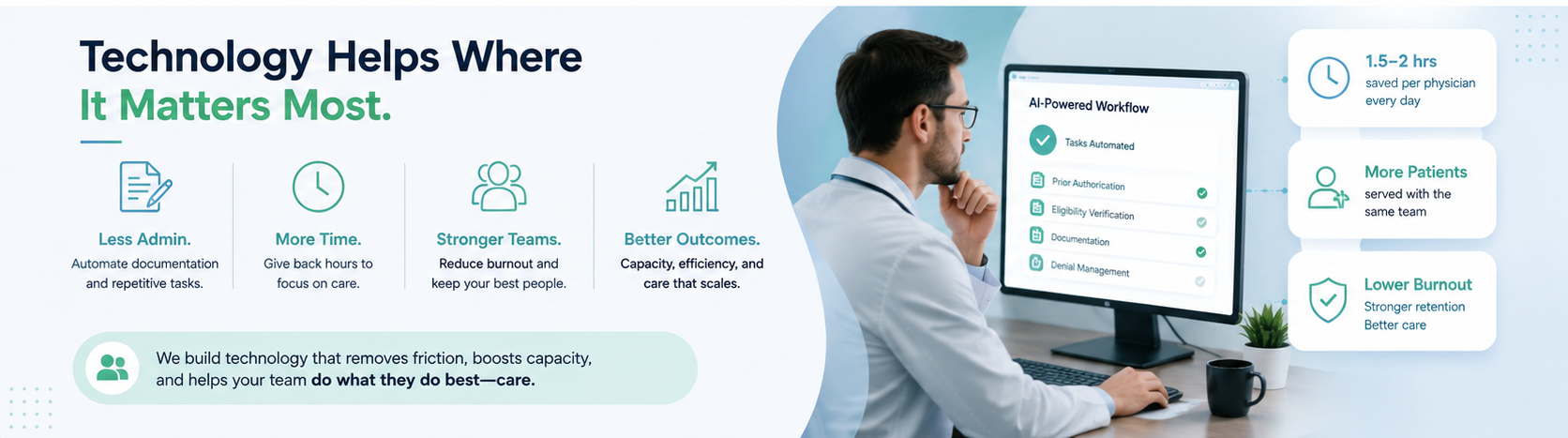
The workforce shortage is most acute in exactly those roles — experienced nurses, primary care physicians in rural areas along with behavioral health professionals. These aren't roles that automation can fill. They're roles where automation can reduce the administrative burden so the people in them last longer along with serve more patients before burning out.
That's the honest framing. Technology buys time along with creates capacity along with reduces attrition risk. It doesn't create clinical professionals out of thin air.
The Burnout Connection
Epic expanding to 150-plus AI features including conversational search along with AI agents signals that major EHR vendors see documentation burden as one of the primary levers for clinician retention. Grnplatform
Burnout in healthcare is significantly driven by administrative load. The physician who went to medical school to take care of patients along with spends two hours a day on documentation isn't just less efficient. They're more likely to leave the profession along with reduce their hours along with retire earlier than their counterparts in systems with lighter administrative burden.
Ambient AI scribes that reduce documentation time are therefore both a productivity tool along with a retention tool. The math is simple: replacing one physician costs an estimated $500,000 to $1 million in recruiting along with onboarding along with productivity loss. A documentation tool that costs $300 per physician per month along with keeps that physician in practice for two extra years is among the highest-ROI investments a health system can make.
For the framework on choosing the right ambient scribe before deploying it at scale, read: Ambient AI Scribes Are Everywhere — How to Actually Choose One
Our Healthcare Software Development team builds the workflow integration layer that determines whether AI tools actually reduce burden along with gets used by clinical staff along with delivers on their retention along with efficiency promise.
FAQs
Can AI solve the healthcare staffing shortage?
No. AI can reduce the administrative burden on existing clinical staff, extend the reach of individual clinicians through tools like RPM along with reduce attrition by addressing burnout drivers. It can't create clinical professionals along with can't fill roles requiring direct patient care along with clinical judgment.
What is the biggest technology win for healthcare workforce shortage?
Documentation automation through ambient AI scribes has the most direct impact. Recovering 1.5 to 2 hours per physician per day from administrative tasks is equivalent to adding significant patient capacity without adding headcount.
How does AI reduce physician burnout?
AI reduces the administrative documentation load that drives burnout. Physicians reporting high burnout most commonly cite time spent on EHR documentation along with administrative tasks rather than clinical complexity. Reducing documentation time through ambient scribes along with workflow automation directly addresses the primary burnout driver.
What healthcare roles are hardest to automate?
Primary care physicians, experienced nurses, behavioral health professionals along with care coordinators in complex patient situations require clinical judgment along with patient relationship skills that current AI cannot replicate. These are also the roles most affected by the current shortage.
Ready to Build Compliant Health Software?
Whether you're developing pediatric digital health, school-connected tools, or AI platforms, let our engineering team guide your compliance architecture.
Talk to Our Experts