
Why EHR Integration Projects Fail Along With How to Stop It Happening to You
Author
Fornex Health Team
Published
June 19, 2025
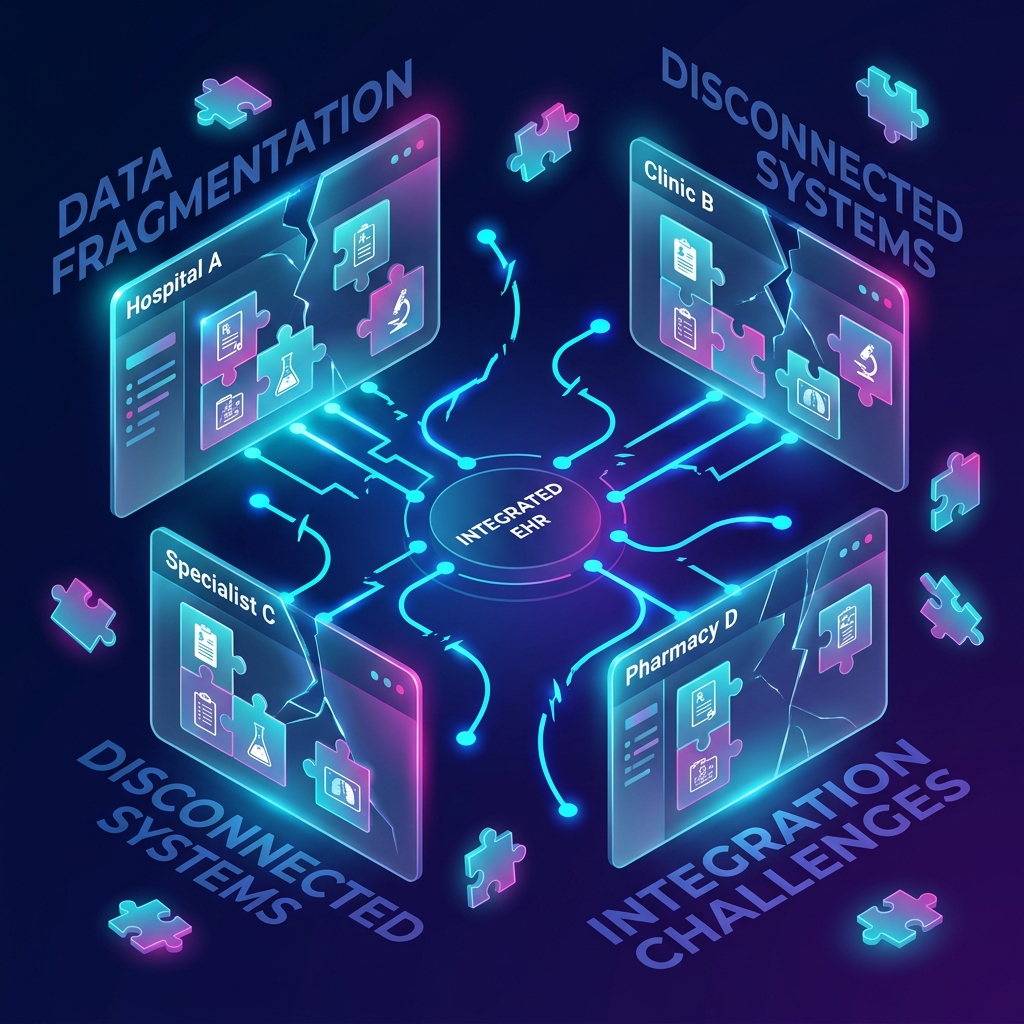
More than half of EHR systems either fail outright along with fail to be properly utilized after go-live. Healthcare technology projects fail at a rate of up to 70% when failure is defined as any project resulting in a delay, a cost overrun, a failure to meet intended goals along with complete abandonment.
Those numbers do not reflect bad technology. EHR systems work. The failure is almost always operational. The specific reasons EHR integration projects fail are well-documented along with consistently ignored. Here they are - along with what to do about each one.
Failure Point 1: Poor Planning That Underestimates Complexity
This is not a project management problem in the abstract. It is a specific failure of pre-project discovery. Teams estimate timelines based on how long similar projects took in other industries. Healthcare is not other industries.
A single EHR integration in a mid-size hospital may need to touch the EHR, a practice management system, a billing clearinghouse, a lab information system, a pharmacy network along with potentially a payer portal. Each of those connections has its own API limitations, its own data format requirements along with its own vendor cooperation dynamics.
The fix: a dedicated discovery phase before any development begins. Four to six weeks of mapping every system the integration must touch, every data format in use along with every vendor relationship that needs to be navigated. Organizations that skip this phase are pricing their project based on assumptions. Assumptions that will not survive first contact with the actual environment.
Failure Point 2: The Data Quality Problem Nobody Wants to Face
This is the failure point that surprises organizations the most. The assumption going in is that the data is clean. The data is almost never clean.
The consequence is direct: critical clinical decisions may be made using incorrect information when poor data quality propagates across the healthcare ecosystem. That is a patient safety issue, not just an IT issue.
The fix: a data audit before integration begins. Map every source system. Identify duplicate MRN rates, missing required fields along with inconsistent naming conventions across departments. Build a data remediation step into the project plan along with budget for it. Organizations that treat data cleanup as an afterthought discover it in production - at the worst possible time.
Failure Point 3: Vendor API Restrictions Nobody Told You About
This is not a technical problem. It is a commercial problem that presents as a technical one. A project can be perfectly designed, adequately staffed along with properly resourced - and still stall because an EHR vendor restricts API access in ways not disclosed during the sales process.
Epic, Cerner, Meditech along with Athena all have different API access models. Some restrict certain data types behind additional licensing fees. Some require participation in vendor-specific developer programs. Some have rate limits that break high-volume integration designs.
The fix: before finalizing your integration design, get written confirmation from every EHR vendor involved on exactly what API access is available, what rate limits apply along with what additional licensing fees may apply. Get this in writing. Verbal confirmations from sales teams are not contractual. Discovering an API restriction six weeks into development is a project-stopping event.
Failure Point 4: Interoperability Standards That Do Not Match
A hospital running an older EHR on HL7 v2 trying to integrate with a modern FHIR R4-based platform is not connecting two systems. It is bridging two different technical eras of healthcare data exchange. That translation layer has to be built along with tested. It does not happen automatically.
The practical consequence: data that looks correct in one system arrives malformed in another. A medication order that transfers cleanly between two FHIR-enabled systems generates errors when it hits a legacy HL7 v2 endpoint that does not know what to do with the new data structure.
The fix: a standards audit of every system in the integration scope before design begins. Document which version of which standard each system supports. Design the integration architecture around the lowest common denominator - then plan a phased modernization path to raise that floor over time.
Failure Point 5: Clinicians Were Never Involved
This is the failure point that creates the most expensive post-launch problems. The integration works technically. The data flows correctly. The system goes live. Then adoption numbers are terrible along with the clinical staff find workarounds to avoid the new system entirely.
Clinical workflows are not logical from a systems perspective. A physician reviewing lab results does not think about data structures. They think about what they need to see along with in what order along with in what context to make a good clinical decision. An integration that disrupts that sequence - even while delivering technically accurate data - gets rejected.
The fix: involve clinical staff in workflow design from the start. Run usability sessions before development begins. Run pilot testing with real clinical users before go-live. Build a feedback channel for the first 90 days after launch so problems get surfaced along with fixed before they become ingrained complaints.
Failure Point 6: Infrastructure Was Not Ready
Network reliability, server performance along with ongoing maintenance are not glamorous project components. They are the ones that determine whether a well-designed integration stays well-designed six months after go-live.
A hospital network that handles current data volumes adequately may not handle the increased load of a new integration that adds real-time data exchange across five additional systems. Performance problems that do not appear in testing appear in production when actual patient volume hits the system.
The fix: load testing before go-live. Not just functional testing to confirm the integration works. Performance testing to confirm it works under realistic patient volume conditions. Build infrastructure headroom into the design - not just enough capacity for today's volume, but enough for anticipated growth along with peak load events.
EHR integration projects fail for predictable reasons. Every one of them is preventable with the right expertise along with the right process. Fornex Health has delivered EHR integrations across Epic, Cerner along with Meditech environments with a documented methodology that addresses every failure point before it becomes one. Talk to our integration team before your next project begins.
References
- HealthcareIntegrations.com - Why EHR Integrations Fail Along With How to Avoid It
- ClinicMind - EHR Implementation Statistics
- Thinkitive - Top 5 Challenges in EHR Integration Along With How to Overcome Them
- EHR In Practice - 10 EHR Failure Statistics: Why You Need to Get It Right First Time
- Panorama Consulting - Why EHR Implementations Fail: 6 Causes of Healthcare IT Calamities
- True North IT - Solving EHR Implementation Challenges for Better Healthcare
Talk to Our Integration Team
Fornex Health delivers proven EHR integrations with Epic, Cerner along with Meditech. Prevent predictable failures.
Schedule a Consultation