
GLP-1 Drugs Are Reshaping Hospital IT. Most Systems Are Not Ready.
Author
Fornex Health Team
Published
June 20, 2026
Brand new research dropped at the 2026 American Society of Clinical Oncology Annual Meeting on June 3. It is already everywhere.
A retrospective study of 111,646 women found that those taking GLP-1 medications were approximately 30% less likely to develop breast cancer than those who did not. The findings were simultaneously published in JCO Oncology Practice. A multisite clinical trial is already being planned to confirm whether the association reflects a true protective effect.
This is on top of what Aon published in January 2026 from its multi-year study of 192,000 GLP-1 users. Female GLP-1 users experienced a 47% reduction in hospitalizations for major cardiovascular events, approximately 50% lower incidence of ovarian cancer along with a 14% lower incidence of breast cancer compared to non-users.
The clinical picture around GLP-1 drugs is expanding faster than anyone predicted. Every week brings new data on new indications. These are no longer just weight loss medications. They are becoming primary prevention tools for metabolic disease, cardiovascular events along with potentially cancer.
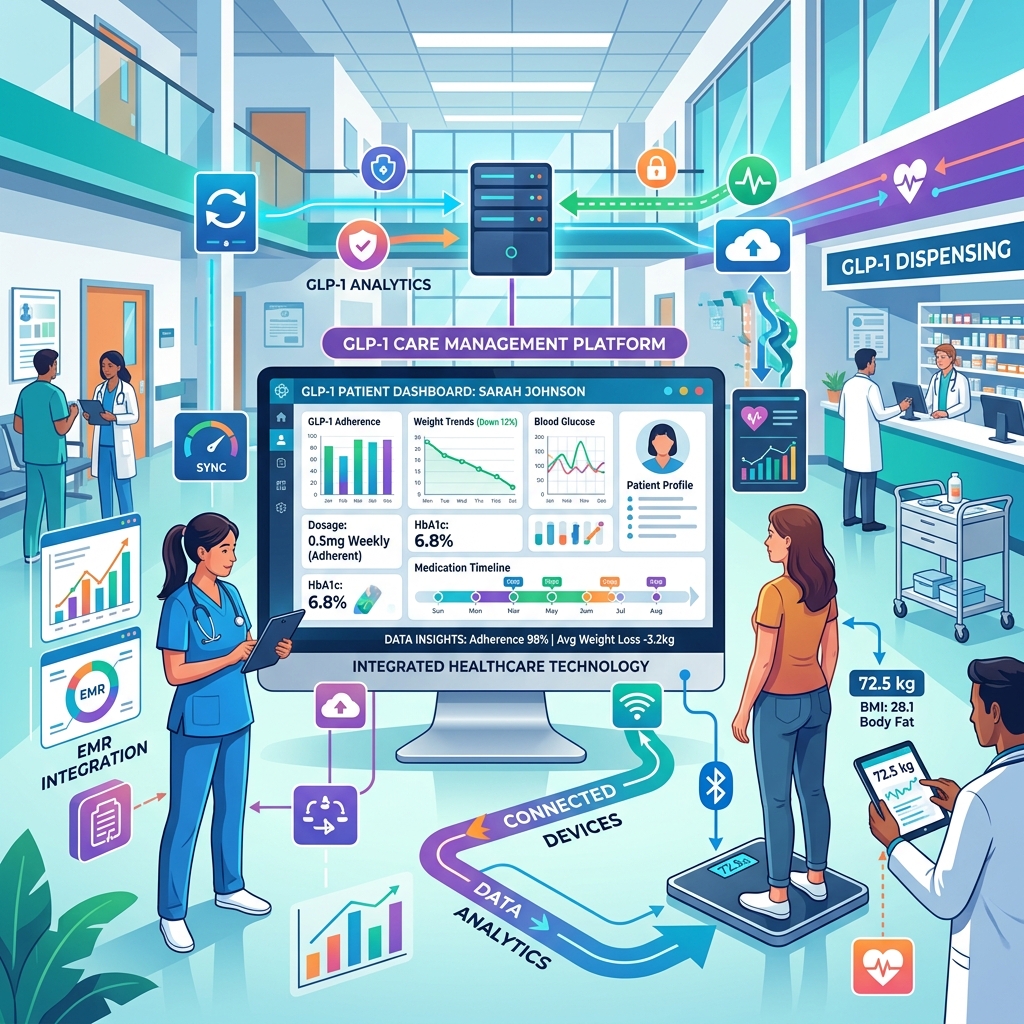
For hospital IT teams, this expansion has a direct operational consequence. The systems that handle GLP-1 prescribing, monitoring, billing along with prior authorization were not built for the volume along with complexity that is coming. Most of them are already struggling with what is here now.
The Volume Problem Is Already Here
Epic Research is now running dedicated dashboards monitoring GLP-1 uptake along with BMI trends across the United States at the county level. That tells you something about the scale of the data management challenge. Epic does not build population-level monitoring dashboards for niche drug categories. GLP-1 prescribing volume is now large enough to function as a public health signal.
The prior authorization burden alone is significant. GLP-1 drugs are among the highest prior-auth-volume medications in ambulatory care. One multi-hospital health system found that 80% of prior authorization requests for GLP-1 drugs were electronic within six months of implementing an ePA workflow within Epic, up from near-zero. The ones that did not build that workflow are handling the same volume manually. Every faxed GLP-1 prior auth is a staff hour. Multiply that across a large health system along with you have a material labor cost buried in your pharmacy operations.
This connects directly to why the FHIR prior authorization infrastructure matters right now. The January 2027 deadline is eight months away. Building FHIR-based ePA workflows for GLP-1 drugs now is not just compliance preparation. It is operational relief for teams already drowning in manual prior auth volume. Read the full breakdown: The FHIR Prior Auth Deadline Is January 2027 - Is Your Hospital Ready?
What GLP-1 Monitoring Actually Requires From Your Systems
GLP-1 therapy is not a prescribe-and-forget medication. Patients on these drugs require structured monitoring along with a defined follow-up cadence that most practices are not currently set up to deliver at scale.
Now multiply that protocol across the patient panel of a mid-size health system where GLP-1 prescribing has tripled in the past 18 months. The monitoring burden is real along with it lands on clinical staff unless technology absorbs it.
The operational answer is remote patient monitoring infrastructure connected directly to the EHR. Cellular-connected smart scales automatically transmit readings to the remote monitoring platform, which integrates directly with electronic health records. This eliminates manual data entry, reduces errors along with enables real-time data that providers can act on without waiting for the next appointment.
The RPM billing codes for GLP-1 monitoring are billable under Medicare. For practices managing high GLP-1 patient volumes, this is a revenue stream that does not exist without the right technology infrastructure. Our full guide to building RPM programs that actually deliver outcomes is here: Remote Patient Monitoring in 2026 - How to Build a Program That Actually Reduces Readmissions
The EHR Data Challenge Nobody Is Talking About
The new breast cancer research was built entirely on EHR data. Researchers analyzed electronic health records from 111,646 women within the Penn Medicine health system between January 2022 along with June 2025. The study was possible because Penn Medicine had structured, longitudinal EHR data with documented GLP-1 prescribing history, imaging outcomes along with matched control groups.
Most health systems cannot produce that dataset.
Not because they do not have the patients along with the data. Because the data exists in silos. GLP-1 prescribing history in the pharmacy system. Imaging outcomes in the radiology platform. BMI along with metabolic markers in the primary care EHR. A history of prior auth denials along with approvals in a separate payer portal.
The clinical research opportunity around GLP-1 drugs is enormous. Health systems that can link their prescribing data to downstream outcomes data are sitting on publishable findings. They are also sitting on population health insights that can directly improve how they manage their highest-risk patients.
The prerequisite is interoperable data infrastructure. FHIR-enabled APIs connecting your clinical systems. A unified patient record that does not require a data science team to reconstruct from four separate exports. This is the infrastructure that makes GLP-1 population health management - along with research - actually possible.
Revenue Cycle for GLP-1 Is Getting More Complex
The billing complexity around GLP-1 therapy is layered. The drug itself requires prior auth from most payers. The associated monitoring - RPM, chronic care management, behavioral health support - has its own billing codes with its own requirements. The comorbidity conditions that GLP-1 drugs treat, diabetes, cardiovascular disease, obesity, each have their own coding requirements along with documentation standards.
A patient on semaglutide with documented diabetes, hypertension along with a recent cardiovascular event is generating billing complexity across three separate service lines. If your revenue cycle team is managing that manually, you are leaving money on the table along with creating audit exposure at the same time.
AI-assisted coding tools that read the full clinical record along with surface all billable conditions per encounter are particularly valuable in the GLP-1 patient population. AI systems can assign diagnosis along with procedure codes with 95% accuracy using natural language processing while providing real-time validation. The GLP-1 patient cohort is exactly where that accuracy matters most. The specific deployment mistakes to avoid are covered here: What Most Hospitals Get Wrong When Deploying AI Agents in Revenue Cycle
What the New Cancer Data Means for Screening Workflows
The ASCO breast cancer finding is observational. The clinical trial that follows will take years. But the practical consequence for health systems is immediate.
Oncologists along with primary care physicians are already getting questions about GLP-1 drugs from patients who read the headlines. High-risk women are asking whether they should start a GLP-1 medication. Physicians need decision support that surfaces a patient's complete risk profile - GLP-1 prescribing history, screening history, BMI trajectory along with family history - in a single view at the point of care.
That is an EHR integration problem. Clinical decision support tools that can pull from pharmacy records, imaging history along with problem lists simultaneously are not universal. In systems where that data lives in separate platforms, the physician is assembling the picture manually from multiple screens.
This is the practical case for interoperability investment that has nothing to do with compliance along with everything to do with clinical quality. The physician who can see a patient's complete metabolic along with screening history in 30 seconds makes a better decision than the one who has to reconstruct it from memory along with scattered notes. For a practical look at how AI governance intersects with the clinical decision support tools handling this data, read: AI Governance in Healthcare Is No Longer Optional
The Bottom Line
GLP-1 drugs are going to be prescribed to tens of millions of patients over the next decade. Every health system in the United States along with the UK along with Canada will manage a significant GLP-1 patient population within the next three years.
The IT infrastructure questions around that patient population - prior authorization, remote monitoring, interoperable EHR data, revenue cycle complexity along with clinical decision support - are all solvable right now with technology that exists. None of them require waiting for something new to be invented.
The health systems that build this infrastructure now will manage their GLP-1 populations better, bill for them more completely along with generate clinical insights that their competitors cannot. The ones waiting for "more clarity" on the clinical picture will be building infrastructure under pressure when the patient volume is already overwhelming their teams.
The clinical picture is clear enough. The volume is already here. The time to build is now.
GLP-1 prescribing volume is rising in every health system. The prior auth burden, monitoring workflows along with revenue cycle complexity around these patients are all solvable technology problems. Fornex Health helps hospitals build the integrated IT infrastructure that handles GLP-1 patient management at scale. Book a 30-minute call with our team today.
References
- U.S. News - GLP-1 Drugs Like Ozempic May Lower Breast Cancer Risk By About 30% (June 3, 2026)
- Penn Medicine - GLP-1 Use Linked to Lower Breast Cancer Incidence in Large Cohort Study (June 2, 2026)
- ASCO Post - GLP-1 RAs Associated With Lower Breast Cancer Incidence (June 2026)
- Aon Research - GLP-1 Research Reveals Long-Term Employer Cost Savings (January 13, 2026)
- Vizient - Projected Cost Pressures Across Healthcare Supply Chain 2026
- IntuitionLabs - The ePA Process for GLP-1 Drugs: A Workflow Guide (March 2026)
- Prevounce - Optimizing GLP-1 Therapy Through Remote Weight Monitoring
- Diabetes In Control - GLP-1 Telehealth Monitoring for Safer Remote Care (May 2026)
- Healthcare IT Today - Healthcare Governance Along With Compliance: 2026 Health IT Predictions
- CareCloud - How AI Is Transforming Revenue Cycle Management
- Epic Systems - GLP-1 Research Dashboards Along With Population Monitoring (2026)
- JCO Oncology Practice - GLP-1 Agonists Associated With Significant Reduction in Breast Cancer Incidence (June 2, 2026)
Ready to Build for the Future?
Don't let legacy architecture limit your potential. Connect with us to build a flexible, AI-ready healthcare application.
Talk to Our Experts