
CMS Just Released a Clinical AI Roadmap. Here Is What It Means for Your Hospital.
Author
ForNex Health
Published
November 20, 2026
Last reviewed: November 2026. Fornex Health.
On November 13, CMS published an eight-page document called “A Clinical Super Intelligence Roadmap: Better Answers, Faster Care, and Lower Costs.” The administration now says “super intelligence” where most of us still say AI. The vocabulary will take some getting used to. The substance deserves attention sooner.
The roadmap is short, high level and explicitly non-binding. It is also the clearest preview so far of how federal agencies want clinical AI to be regulated and paid for. Hospital leaders who treat it as background reading will be catching up in 2027.
What Is the CMS Clinical Super Intelligence Roadmap?
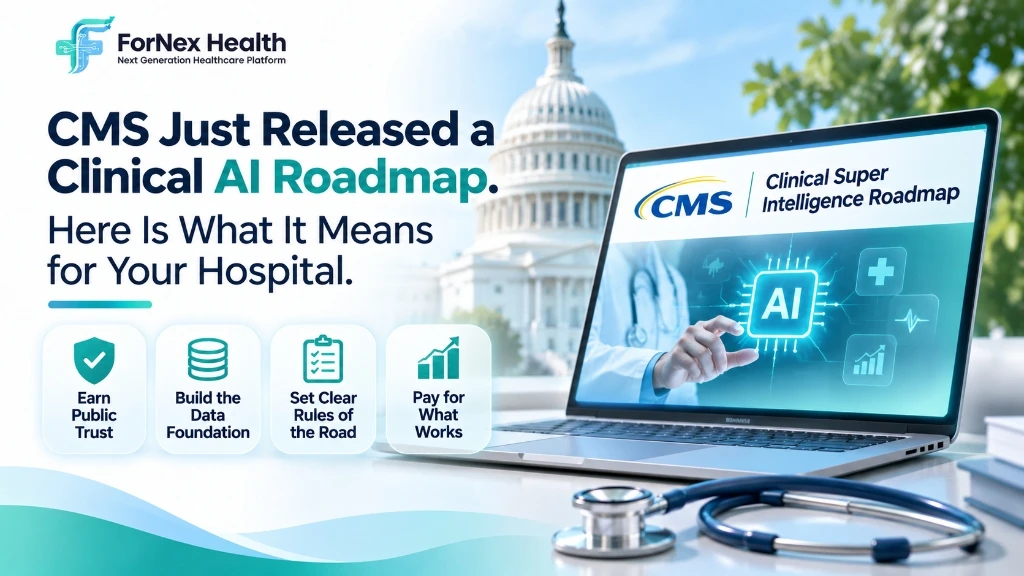
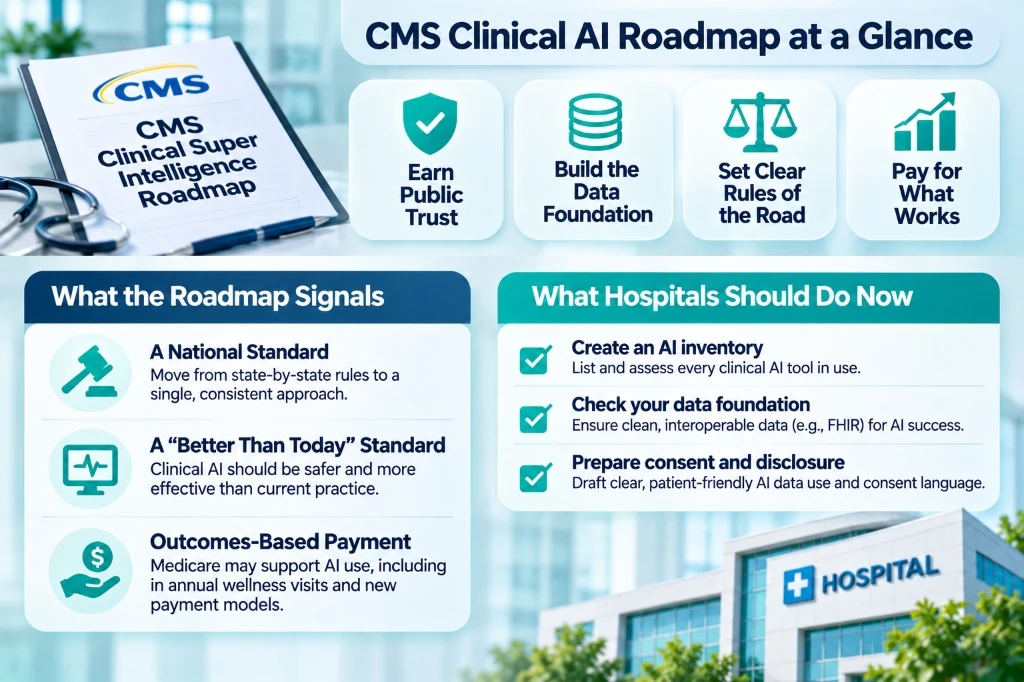
It is a non-binding, eight-page federal strategy released by CMS on November 13, 2026. It lays out how the administration wants to accelerate clinical AI adoption around four priorities: earn public trust, build the data foundation, set clear rules of the road and pay for what works. It does not require any hospital to adopt anything.
One law firm summary lists five guiding principles behind those priorities: safe and reliable outcomes, earned and progressive adoption, patient ownership of health data, affordability and market access. The document came out of CMS but spells out coordination with the FDA, which is unusual and worth noting.
What Does the Roadmap Say About Regulation and Payment?
It points toward a single national standard for clinical AI, risk-based oversight and Medicare payment tied to outcomes. Three details stand out.
First, CMS says it wants to replace state-by-state clinical AI regulation with a national standard. That is a direct response to a conflict already brewing. STAT reported in late October that federal officials were working behind the scenes to head off friction as more states set up their own AI testing sandboxes. The roadmap still talks about partnering with state sandboxes, so expect that tension to continue.
Second, the document says clinical AI should be held to a “better than today” standard for safety and effectiveness and earn trust through staged deployment. That framing matters. It doesn’t ask for perfection. It asks whether the tool beats the current human workflow.
Third, CMS suggests parts of Medicare annual wellness visits could be delivered through clinical AI and says it wants to work with states on alternative payment models that use it. On the patient side, the roadmap says data use should be transparent and patients should be told about it and consent to it.
The AMA’s CEO pushed back at a recent event, warning against overstating what AI can do without strong evidence. Physicians and the administration are not yet reading from the same page.
What the Roadmap Does Not Do
It doesn’t create a rule. Law firms covering it describe it as aspirational. It previews where proposed rules and payment models could go. It doesn’t tell you what to file or by when.
That is the reason to act on it calmly rather than urgently. You won’t be penalized in January for ignoring a roadmap. You may be at a disadvantage in 2027 if your AI tools, data and consent processes can’t meet whatever standard comes out of it.
What Should Hospitals Do Now?
Start with the three things the roadmap makes harder to postpone: an AI inventory, a data foundation check and a consent process.
An AI inventory comes first. List every tool that touches clinical decisions or patient communication, including the ones individual departments bought on their own. You can’t hold tools to a “better than today” standard if you don’t know which ones exist or what baseline they’re replacing.
Next, test your data foundation. “Build the data foundation” is priority number two, and in practice it means clean, exchangeable records. If your EHR data can’t move through standard FHIR interfaces, most clinical AI will underperform on it. Our interoperability guide covers where hospitals usually fall short: Healthcare Interoperability 2026.
Finally, draft your patient disclosure and consent language now. It’s easier to write when nobody is requiring it yet.
If you want a framework for who owns validation, monitoring and accountability once a tool is live, read AI Governance in Healthcare Is No Longer Optional.
About the Author
Written by the Fornex Health content team. Fornex builds healthcare software, EHR integrations and billing infrastructure for US hospitals and health systems. See our work at fornexhealth.com/blogs.
Frequently Asked Questions
What is the CMS Clinical Super Intelligence Roadmap?
An eight-page, non-binding strategy document released by CMS on November 13, 2026. It outlines how the administration wants to accelerate safe clinical AI adoption through trust, data infrastructure, regulatory clarity and outcomes-based payment.
Does the roadmap require hospitals to adopt AI?
No. It is aspirational and doesn’t mandate adoption. It signals possible future rules, payment models and FDA pathways.
Why does the roadmap say “super intelligence” instead of AI?
The administration uses “clinical super intelligence” as its term for what the industry usually calls artificial intelligence. The FDA has also adopted the terminology.
What does the “better than today” standard mean?
The roadmap says clinical AI should be judged against current practice for safety and effectiveness and earn trust through staged deployment, rather than being held to a standard of perfection.
How could the roadmap affect Medicare payment?
It points toward outcomes-based payment and alternative payment models with states that use clinical AI. Specific payment rules haven’t been proposed yet.
References
- National Law Review: CMS Releases Expansive Clinical Super Intelligence Roadmap
- CASRAI: HHS Clinical AI Roadmap, CMS 2026
- Holland & Knight: Health Dose, November 17, 2026
- Nextgov: Trump Administration Releases Roadmap to Boost Clinical AI
- Route Fifty: Trump Administration Releases Roadmap to Boost Clinical AI
- Fierce Healthcare: At CTA Event, Federal Officials Outline AI Ambitions as Clinicians Debate Risks
- STAT News: FDA, CMS Scramble to Avoid Regulatory Logjam as More States Look to Test AI
Preparing Your Hospital for Clinical AI & CMS Regulations?
Whether you need to conduct a clinical AI inventory, upgrade EHR data interoperability with FHIR, or implement robust AI governance frameworks, let our team guide your strategy.
Talk to Our Experts