
AI in Radiology Has Reached a Tipping Point. Most Hospitals Are Still Deciding How to Buy It.
Author
Fornex Health Team
Published
June 25, 2026
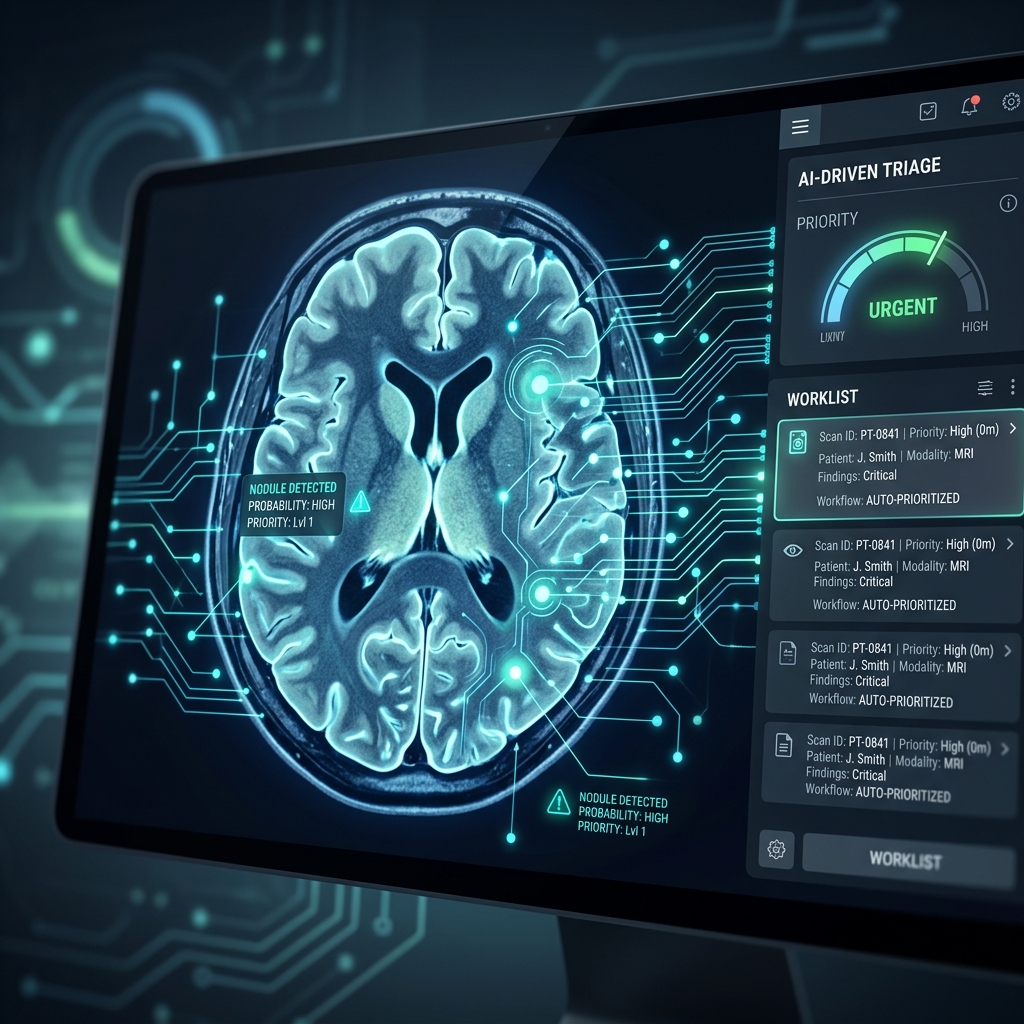
Radiology has quietly become the most AI-saturated specialty in medicine. The FDA has cleared 1,451 AI/ML medical devices. Radiology claims 1,104 of them, a full 76%. That concentration is not random. It reflects a specialty under acute pressure, facing rising imaging volumes, a shrinking radiologist workforce along with operational demands that AI can address right now, today, in production.
71% of U.S. hospitals reported using predictive AI integrated into their electronic health records in 2024, up from 66% the year prior. Yet adoption inside radiology departments specifically remains uneven. The tools that succeed are not the ones with the most sophisticated algorithms. They are the ones built around how radiologists actually work.
Here is what is genuinely changing in 2026 along with how to evaluate it before you sign a contract.
The Triage Use Case Is Where AI Is Actually Delivering Value
This is the use case worth paying attention to. Not diagnostic replacement. Worklist prioritization. The clinical value is straightforward: a radiologist working through a queue of fifty studies needs to read the patient with a brain hemorrhage before the patient with a normal scan. AI triage tools reorder that queue based on urgency rather than arrival time.
Pilot programs at several Level I trauma centers report that AI-flagged X-rays get read 20 to 30 minutes faster on average than normal work-list order, which can be critical in acute care. For stroke along with pulmonary embolism specifically, that time difference is the difference between treatable along with untreatable.
Viz.ai built its reputation on large vessel occlusion stroke detection with 50-plus FDA-cleared algorithms across 1,700-plus hospitals. That scale of deployment did not happen because the technology was novel. It happened because the clinical case for faster stroke triage is unambiguous along with the reimbursement pathway eventually caught up to support it.
Reimbursement Is the Variable That Determines Whether AI Actually Gets Deployed
Medicare's New Technology Add-on Payment program now covers certain AI-assisted analyses, with four AI tools holding NTAP status in 2025, up from one in 2023. Without a billing code, most hospital CFOs will not take the meeting, regardless of how clinically promising a tool looks.
This is the practical filter that separates radiology AI tools that will see real adoption from tools that will remain demo-stage indefinitely. Before evaluating a radiology AI vendor on clinical performance, ask the reimbursement question first. Does this tool have an established CPT code along with NTAP status? If not, what is the path to reimbursement along with how long has that path historically taken for comparable tools?
The median clearance time for AI radiology submissions is now 142 days, with a quarter of applications clearing in under 90 days. FDA clearance has become faster. Reimbursement infrastructure has not always kept pace. A tool can be cleared along with clinically validated along with still generate no margin improvement if the billing pathway is not yet established.
The Integration Failure Point Most Hospitals Underestimate
Integration hurdles reduce success rates to 19% in surveyed hospitals. That number should reset expectations for any radiology AI procurement conversation. Most AI radiology tools that fail to deliver value are not failing on accuracy. They are failing on workflow integration.
A radiology AI tool that does not integrate cleanly into PACS along with the existing reporting workflow creates a second system radiologists have to check. Radiologists already managing high case volumes will not reliably switch between two interfaces. The tool gets ignored, regardless of how accurate its findings are.
Modern AI tools are embedded directly into PACS, reporting software along with hospital workflows, not as add-ons, but as standard parts of how radiology departments operate. That embedded integration is the technical along with operational bar every vendor needs to clear before procurement. Ask for a live demo inside your actual PACS environment, not inside the vendor's sandbox. Ask how many radiologist clicks separate a flagged finding from the report. If the answer is more than one or two, adoption will struggle regardless of the underlying model quality.
The Governance Structure That Should Exist Before Deployment
This is not bureaucratic overhead. It is the structure that determines whether your radiology AI investment survives contact with real clinical practice. The committee needs to define what happens when the AI flags something the radiologist disagrees with, how model performance is monitored over time along with what triggers a re-evaluation of a deployed tool.
Limited clinical validation exists for 97% of devices cleared via the 510(k) pathway. Most radiology AI tools are cleared through a regulatory pathway that does not require the extensive clinical trials a new drug would need. That is not necessarily a problem. It does mean your organization carries more responsibility for validating performance in your specific patient population before relying on the tool clinically.
Organizations must validate AI tools within their specific deployment context, accounting for unique patient populations, clinical workflows along with operational environments, before clinical implementation. That local validation requirement applies to radiology AI exactly as it applies to every other clinical AI tool your organization deploys.
For the broader framework on what your AI vendors should be able to prove before any clinical deployment, read: AI Governance in Healthcare Is No Longer Optional
If your organization is evaluating AI integration into your radiology along with broader clinical infrastructure, our Healthcare Software Development team builds the PACS along with EHR integration layer that determines whether a radiology AI deployment actually gets used. See our complete services at Fornex Health Services.
Frequently Asked Questions
What is AI in radiology used for?
AI in radiology is primarily used for triage, prioritizing urgent cases on a radiologist's worklist, automated lesion detection in mammograms along with CT scans, workflow optimization including scheduling along with reporting assistance. It functions as a second reader that flags findings for radiologist review rather than as an independent diagnostic tool.
Is AI replacing radiologists?
No. Current FDA-cleared AI radiology tools function as triage along with decision-support tools, not independent diagnostic systems. Human radiologist oversight remains required for final diagnostic decisions in every clinically deployed AI radiology tool currently available.
How accurate is AI in detecting cancer along with critical findings?
AI triage accuracy varies by tool along with condition. Multi-condition CT triage systems have published sensitivity along with specificity rates above 95% for time-critical findings like pulmonary embolism. Accuracy depends heavily on the specific clinical use case along with the validation data the tool was trained on.
How much does radiology AI cost a hospital?
Radiology AI costs vary widely based on the number of modalities covered, the volume of studies processed along with whether the tool includes NTAP-eligible reimbursement. Most enterprise radiology AI contracts are negotiated as part of multi-year imaging vendor agreements rather than standalone purchases.
What is AI triage in medical imaging?
AI triage is the use of artificial intelligence to automatically prioritize a radiologist's reading worklist based on the urgency of findings detected in an image. Rather than reading studies in the order they arrive, radiologists see the most critical cases first, which reduces time to diagnosis for time-sensitive conditions.
Does insurance cover AI-assisted radiology?
Some AI-assisted radiology tools have achieved Medicare New Technology Add-on Payment status along with specific CPT codes, meaning they are reimbursable. Coverage varies significantly by payer along with specific tool. Reimbursement status is one of the most important factors in whether a hospital will adopt a given AI radiology tool.
What should a hospital evaluate before buying a radiology AI tool?
Hospitals should evaluate clinical validation data specific to their patient population, integration depth with existing PACS along with reporting systems, reimbursement and billing code status along with the vendor's post-deployment monitoring along with governance support. Integration failure is the leading cause of radiology AI tools failing to deliver expected value.
References
- BuildMVPFast - FDA-Cleared AI Radiology Tools Hospitals Actually Use (March 22, 2026)
- Hotshot - Medical Imaging AI News: 2026 Trends Along With Clinical Impact (April 29, 2026)
- IntuitionLabs - AI in Radiology: Trends, FDA Approvals Along With Adoption
- ArticSledge - AI in Medical Imaging: How It Is Changing Diagnosis (March 6, 2026)
- Diagnostic Imaging - The Inflection Point for AI in Radiology (May 14, 2026)
- Precedence Research - Radiology AI Market Size, Share Along With Trends
- Fortune Business Insights - AI in Radiology Market Report
Ready to Build for the Future?
Don't let legacy architecture limit your potential. Connect with us to build a flexible, AI-ready healthcare application.
Talk to Our Experts