
Hospitals Are Suing to Stop the 340B Rebate Model. Here Is Everything That’s at Stake.
Author
ForNex Health
Published
November 13, 2026
Last reviewed: October 26, 2026. Fornex Health.
The 340B drug discount program has been fought over in courts along with regulatory proceedings along with congressional hearings for the better part of a decade. On October 13, 2026, hospitals filed a lawsuit to block a revived version of the 340B rebate model.
The stakes are material. For the hospitals that depend on 340B savings, the difference between the current upfront discount model along with a rebate model isn’t just an accounting timing question. It’s a cash flow problem along with a capital constraint problem along with for some safety-net hospitals, an existential financial problem.
Understanding what the 340B program actually is along with why the rebate model is being fought this hard requires stepping back from the headline.
What Is the 340B Drug Pricing Program?
The 340B Drug Pricing Program requires pharmaceutical manufacturers to provide outpatient drugs at discounted prices to qualifying covered entities — safety-net hospitals, federally qualified health centers along with other eligible healthcare organizations serving vulnerable patient populations. Covered entities purchase drugs at 340B prices and often dispense them at higher rates, generating revenue that funds services for uninsured and low-income patients.
The program was created in 1992. It now covers more than 50,000 covered entity sites across the US. The annual financial value of 340B savings to covered entities is estimated in the tens of billions of dollars.
The drug manufacturers hate it. They’ve spent years arguing that 340B hospitals are profiting from the program rather than directing savings to indigent patients, along with that the program has grown far beyond its original intent. Some of that criticism is substantiated along with some isn’t — the data on how hospitals use 340B savings varies widely by institution.
What the Rebate Model Changes Along With Why Hospitals Object
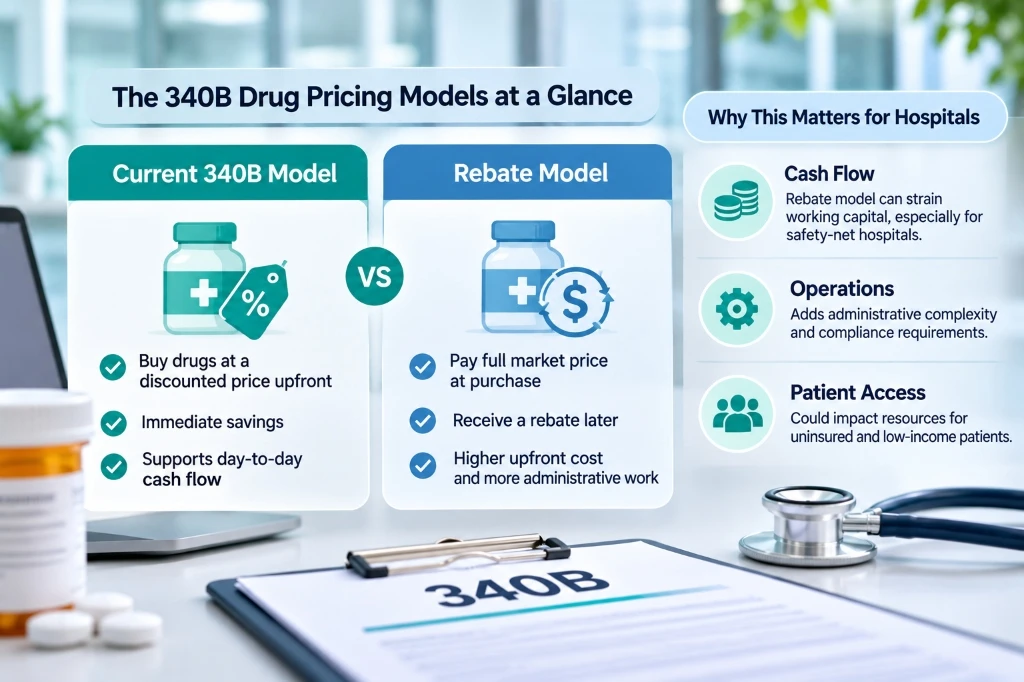
Under the current model, covered entities purchase 340B drugs upfront at the discounted price. The discount happens at the point of purchase.
Under the rebate model, covered entities pay full market price at purchase along with then receive a rebate afterward. The discount timing shifts from acquisition to reimbursement.
That shift sounds administrative. The financial consequences aren’t.
A safety-net hospital currently buying 340B drugs at discounted prices is using that discount to manage cash flow in real time. The discounted purchase price affects how much capital the hospital needs to finance its pharmaceutical procurement. Under the rebate model, the same hospital pays full price upfront along with waits for the rebate to arrive. That waiting period requires financing the gap between full-price payment along with rebate receipt.
For a large academic medical center with strong access to capital, this is a manageable timing difference. For a rural safety-net hospital operating at negative margins along with already borrowing to cover operating costs, paying full pharmaceutical prices upfront for weeks along with months before the rebate arrives is a genuine cash flow crisis.
What the AHA Lawsuit Argues
The American Hospital Association along with other hospital groups filed their lawsuit against the rebate model on the grounds that the administrative and compliance costs of implementing the rebate model outweigh the purported benefits.
The hospitals’ position is straightforward: the current upfront discount model works. It delivers savings to covered entities efficiently. The rebate model introduces complexity, cash flow burdens along with administrative overhead without improving anything that’s actually broken.
The drug manufacturers’ position is equally straightforward: the current model makes it impossible to verify that 340B savings actually benefit patients rather than hospital profits. A rebate model creates an audit trail that links 340B savings to specific patient encounters.
Both arguments have merit depending on which problem you think the 340B program is primarily trying to solve.
What This Means for Hospital Financial Planning Right Now
The lawsuit creates uncertainty that has real operational implications. If the rebate model is ultimately implemented, hospitals with significant 340B drug procurement volumes need to model the cash flow impact of paying full pharmaceutical prices upfront before receiving rebates.
That modeling exercise isn’t hypothetical planning. It’s a capital planning requirement. A hospital that discovers mid-implementation that its pharmaceutical procurement cash flow gap is $20 million along with doesn’t have a financing plan for it is in trouble.
The hospitals that use the current legal uncertainty to build that model now — understanding their 340B drug volumes, their potential rebate timing along with their cash flow gap under the rebate model — are the ones that won’t be caught off guard if the lawsuit fails.
For a broader look at how hospital financial pressure from multiple simultaneous policy changes affects revenue cycle strategy, read: Medicaid Cuts 2026: What Hospitals Must Do Now
Frequently Asked Questions
What is the 340B drug pricing program?
The 340B program requires pharmaceutical manufacturers to sell outpatient drugs at discounted prices to qualifying safety-net hospitals along with health centers serving vulnerable patient populations. Covered entities purchase at 340B discounted prices along with use the savings to fund services for uninsured along with low-income patients.
What is the 340B rebate model?
Under the proposed rebate model, covered entities would pay full market price for drugs at purchase along with receive a rebate afterward, rather than receiving the discount at point of purchase. The shift changes the timing of the discount from acquisition to reimbursement.
Why are hospitals suing to block the 340B rebate model?
Hospitals argue the rebate model creates significant cash flow burdens, particularly for safety-net hospitals operating at thin along with negative margins. Paying full pharmaceutical prices upfront while waiting for rebates requires financing a gap that can reach tens of millions of dollars for high-volume 340B users.
Which hospitals depend most on 340B savings?
Safety-net hospitals, rural hospitals along with hospitals serving high proportions of Medicaid along with uninsured patients derive the most financial benefit from 340B savings. For these institutions, the difference between upfront discounts along with post-purchase rebates has significant operational financial consequences.
What happens to 340B savings under the rebate model?
Under the rebate model, covered entities would ultimately receive the same financial benefit as under the current model, but the timing shifts from upfront purchase discount to post-purchase rebate. The debate is whether that timing shift creates administrative burdens that outweigh any accountability benefits.
Managing Hospital Pharmacy & Financial Workflows?
Whether you are navigating 340B drug pricing transitions, optimizing revenue cycle management, or modernizing healthcare IT infrastructure, let our team guide your implementation.
Talk to Our Experts