
The Hospital-at-Home Shift: What It Means for Your Healthcare IT Stack in 2026
Author
Fornex Health Team
Published
Jun 8, 2026
In February 2026, Congress extended the Acute Hospital Care at Home program through the end of 2030. The program provides waivers to hospitals to provide inpatient-level care at home to qualified Medicare beneficiaries. The five-year extension is in place at more than 400 organizations. OneReach
Mayo Clinic Arizona has reported a 35% decrease in readmission rates for hospital-at-home patients. OneReach
Those two facts together explain why hospital-at-home is no longer a pilot program at progressive health systems. It is becoming a standard care delivery model and it is putting pressure on IT stacks that were never designed for it.
The clinical model works. The technology challenge is real. Here is what your infrastructure needs to actually support it.
What Hospital-at-Home Actually Requires From IT
The care model sounds straightforward on paper. Patient gets discharged home instead of staying in a hospital bed. Clinical team monitors remotely. Interventions happen via virtual visit. Paramedics respond in-person when needed.
The IT infrastructure underneath that model is anything but straightforward.
Patients need reliable technology to monitor vital signs and share outcomes with their care teams. This includes devices along with wired and cellular connectivity. Care teams need access to patients' electronic health records along with the ability to collaborate virtually. Given that care teams may include paramedics, social workers, along with therapists in addition to nurses and physicians, it means supporting stakeholders with highly variable clinical workflows along with work settings. Microsoft
That last point is the one that catches IT teams off guard. Hospital-at-home is not just telehealth. It is a multi-stakeholder care model where the patient's home becomes a clinical environment, and every person involved in that patient's care needs real-time access to the same data from completely different locations on completely different devices.
Your EHR needs to be accessible genuinely accessible, not just technically available from a paramedic's tablet in a patient's living room in a neighborhood with mediocre cellular coverage. That is a different infrastructure problem than making Epic work on a desktop in a hospital.
The Connectivity Problem Nobody Talks About Enough
Healthcare facilities in 2026 are more digitally dependent than ever before. When the network fails, care delivery slows. In some cases patient safety is put at risk. Zero-downtime network infrastructure has become a foundational requirement. Digital Applied Team
In a hospital building, you control the network. You have redundant fiber. You have managed WiFi. You have IT staff on-site when something breaks.
In a patient's home, you control nothing. The patient's router is whatever they bought three years ago. Their ISP is whatever serves their neighborhood. Their cellular signal depends on which carrier they have along with where their bedroom is relative to the nearest tower.
As bandwidth-intensive technologies such as AI appear across healthcare organizations, bandwidth and compute capacity upgrades across underlying networks help ensure consistent performance along with scale for future growth. Microsoft
Hospital-at-home programs need a defined connectivity strategy. That means: cellular backup devices for patients in areas with poor broadband, pre-deployment connectivity assessment for each enrolled patient, real-time connectivity monitoring as part of the care management dashboard, along with a clear escalation protocol when connectivity drops during a monitoring window.
An RPM device that cannot transmit data is not monitoring anyone. Build the connectivity layer before you deploy the clinical technology.
EHR Integration Is the Core Challenge
Providers supporting hospital-at-home need technology infrastructure that delivers access to data, decision support, along with collaboration without taking them out of the applications they already use. Censinet
The goal is a care team member being able to pull up a patient's current vital trends, their medication list, their care plan, along with their overnight monitoring data in a single interface, without switching between four systems. That requires real EHR integration. Not a patient summary PDF. Not a separate monitoring portal that does not talk to the chart. Real bidirectional data flow between the remote monitoring platform along with the EHR.
Most hospital-at-home programs launch with some version of manual data transfer between the monitoring platform along with the EHR. A nurse pulls the overnight RPM data. They manually document the relevant values in the chart. Then they make a clinical decision.
That workflow is fragile. It introduces transcription errors. It creates documentation lag. It means clinical decisions are being made on data that is already hours old. Most importantly, it does not scale. You can manually transfer data for 20 hospital-at-home patients. You cannot do it for 200.
Build the FHIR-based integration between your monitoring platform along with your EHR from the start. Not as a future phase. As a prerequisite to scaling.
The Command Center Model
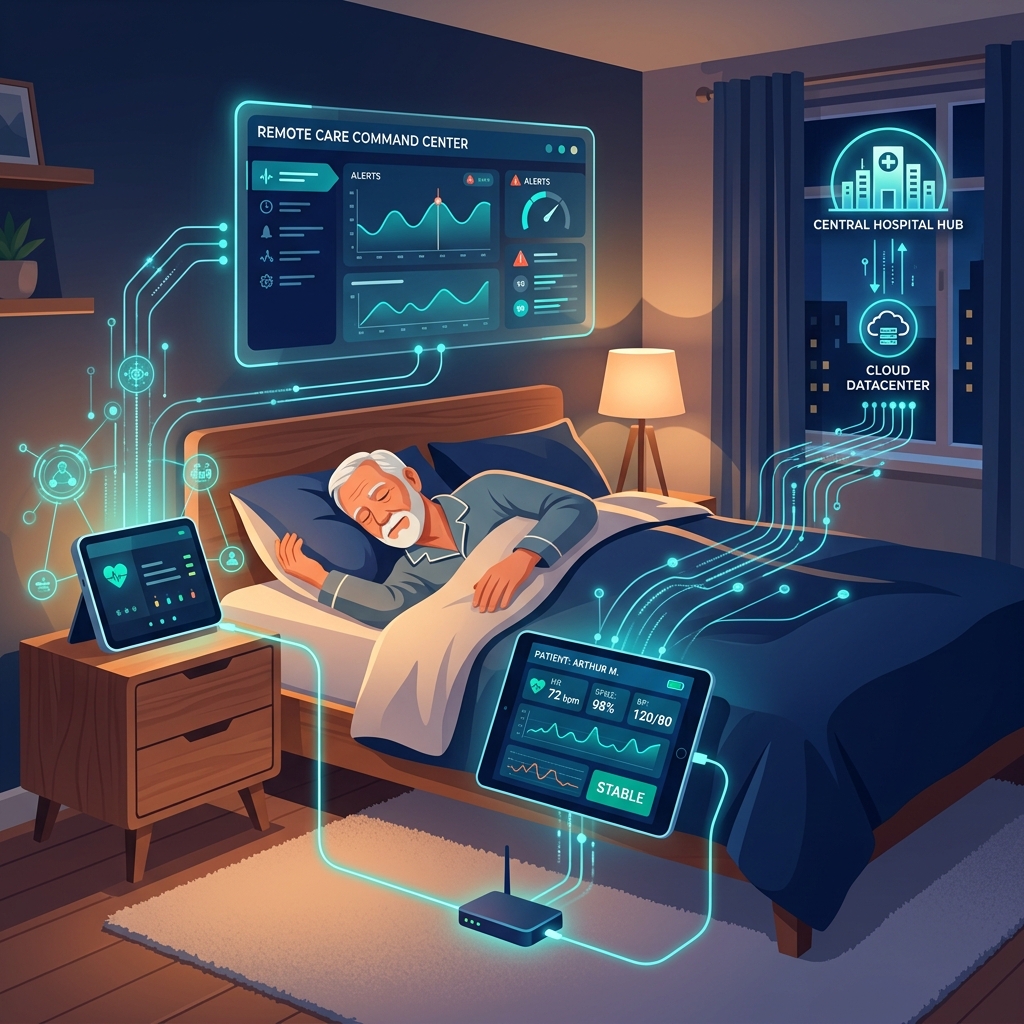
The health systems running the most mature hospital-at-home programs in 2026 have built what amounts to a virtual command center. A centralized team of nurses monitoring a dashboard of home patients. Alert triage happening at the command center level. Escalations routed to the right responder physician, paramedic, social worker based on the nature of the alert.
For hospital-at-home, organizations participating in the CMS waiver seeking to maximize DRG reimbursement for high-acuity care require specialized platforms with 24/7 command centers along with advanced logistics. Ventionteams
The command center is not just a nice operational feature. It is a safety infrastructure requirement for high-acuity home patients. A patient who decompensates at 2am needs someone watching their monitoring data at 2am. The command center model makes that economically viable by letting one clinical team monitor a large patient panel simultaneously.
The IT implications: your command center needs a unified dashboard that surfaces all monitored patients in a single view, prioritizes by alert severity, shows real-time data along with trend data, along with integrates with your communication platform so escalations happen without switching systems.
If you are building a hospital-at-home program, the RPM infrastructure underneath it is the foundation the rest of the model sits on. Our blog on remote patient monitoring in 2026 and how to build a program that actually reduces readmissions covers how to build that foundation properly before you scale to a home care model.
The Reimbursement Picture in 2026
The extension of the Acute Hospital Care at Home program through 2030 resolves the biggest financial uncertainty that was holding health systems back. Five years of runway is enough to justify real infrastructure investment.
The DRG payment structure for hospital-at-home is the same as for inpatient care. A patient with a qualifying diagnosis receives the same DRG payment whether they are treated in a hospital bed along with at home. The cost of delivering that care at home is significantly lower. The margin improvement is real.
The organizations that invest in proper IT infrastructure now connectivity, EHR integration, command center platforms, along with clinical workflow design are positioned to scale the model profitably before the 2030 waiver review.
The ones waiting for the technology to be "more mature" are going to spend 2027 and 2028 catching up to competitors who figured this out in 2026.
Fornex Health helps health systems build the IT infrastructure required for hospital-at-home programs from EHR integration to remote monitoring platforms along with connectivity strategy. Talk to our team.
Need Healthcare IT Strategy Help?
Talk to our team about your hospital-at-home infrastructure needs.
Talk to Our Team