
K-Shaped Hospital Recovery: The Technology Gap That's Deciding Which Hospitals Survive
Author
ForNex Health
Published
September 23, 2026
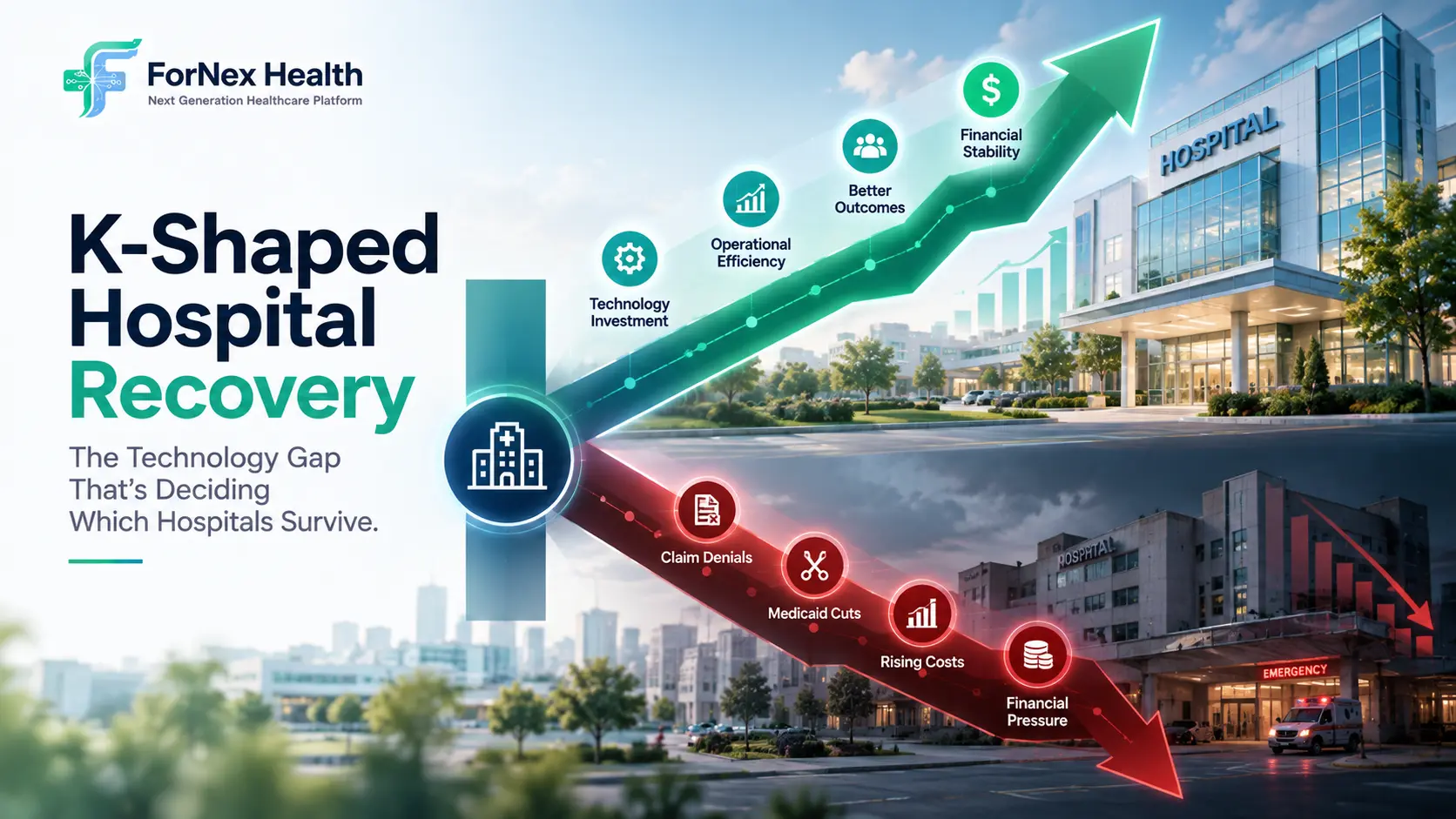
A period of financial recovery for US hospitals is coming to an end as healthcare systems brace for the full force of federal policy changes along with a wave of aging baby boomers. After years of gradual improvement, the tone for the sector has turned more cautious, according to an analysis of 222 not-for-profit hospitals along with health systems by Fitch Ratings. Chief Healthcare Executive
That August 4, 2026 analysis uses the phrase "K-shaped path." It's worth understanding what that actually means for the organizations on each branch.
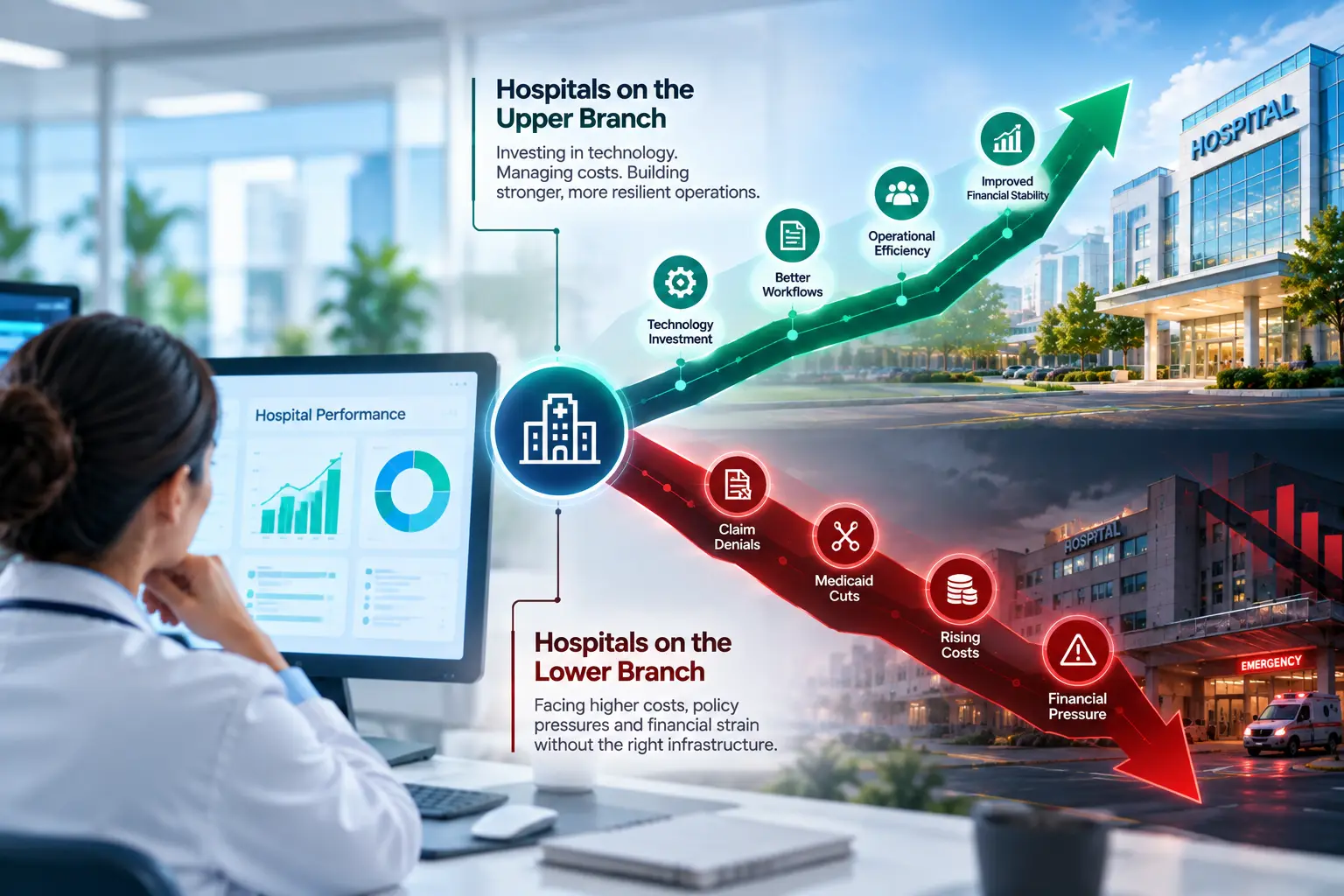
A K-shaped recovery is not a sector-wide recovery. It's a split. One group of hospitals improves. Another declines. The divergence happens simultaneously within the same market along with the same policy environment along with the same patient population pressures. The variable that determines which branch a hospital ends up on isn't size. It isn't geography. It's operational efficiency along with the infrastructure built to achieve it.
What's Driving the Split
The pressures bearing down on every US hospital right now are structural along with not cyclical. Hospitals lost more than $48 billion from claim denials along with unpaid patient accounts, with denial-related revenue leakage increasing significantly in 2025 along with continuing into 2026. CipherHealth
The Medicaid cuts embedded in the One Big Beautiful Bill reduce federal Medicaid spending by $1 trillion over 10 years. That's not an abstract future pressure. CMS regulatory guidance on Medicaid work requirements was due June 2026, with the start date December 31, 2026. The financial impact begins arriving next year.
With the start of the CMS TEAM mandate performance year in January, hospital leaders must recognize that post-op care coordination for Medicare patients has become mission critical to securing reimbursement. With 714 hospitals required to participate along with five high-risk surgical episode types subject to bundled reimbursement, the mandate now places financial stakes on post-discharge follow-up care. Sachs Policy Group
The hospitals absorbing all of these pressures simultaneously along with without the operational infrastructure to manage them are the ones heading down the lower branch of the K.
What the Upper Branch Is Actually Doing
The hospitals improving in this environment aren't immune to the pressures. They're managing them with better data along with faster workflows along with reduced administrative overhead.
UHS CFO Steve Filton credited their ability to hold the line to sustained investments in revenue cycle technology, personnel along with process. PROMBS
Revenue cycle technology is the first investment common to upper-branch hospitals. Not because it's glamorous but because it's the fastest ROI available. Stopping preventable denials through AI-assisted pre-submission validation along with automating eligibility verification along with building counter-AI appeal infrastructure for the denials that get through — these investments return measurable revenue within 90 days.
The second investment is clinical documentation infrastructure. Telehealth adoption has grown from 61% to 75% of hospitals. Patient engagement through electronic health care portals continues to rise. Hospitals investing in the digital infrastructure that connects them to patients between visits along with across discharge are generating the care coordination capability that TEAM along with value-based care models reward. Health IT Answers
The third investment is data infrastructure. Organizations are expected to narrow their focus to AI along with digital tools that are auditable, compliant along with clearly tied to cost reduction along with outcome improvement. The hospitals that can quantify what a specific technology investment returns — in denied claims prevented, in readmissions reduced, in documentation time recovered — are the ones making durable investment decisions rather than chasing whatever the current vendor demo looks impressive. Revecore
The Technology Decisions That Move Hospitals Between Branches
Revenue cycle modernization is the highest-leverage move available to a hospital facing margin pressure. Stopping the $48 billion annual leak is faster than growing volume along with less expensive than cutting clinical services.
Post-discharge care coordination technology is what TEAM compliance requires along with what value-based care models across the board increasingly reward. It's not optional for the hospitals in the 714-hospital TEAM mandate. It's increasingly not optional for anyone else either.
FHIR interoperability is a compliance requirement along with a payment requirement along with increasingly a market requirement. Hospitals that haven't built FHIR-compliant API infrastructure are generating Promoting Interoperability payment penalties along with falling behind on the interoperability benchmarks that payers along with partners increasingly expect.
Workforce technology — ambient scribes, AI documentation tools along with automated scheduling — directly reduces the administrative burden that drives physician along with nurse attrition. Replacing one physician costs $500,000 to $1 million. The technology that reduces documentation burden along with keeps that physician in practice for two additional years is among the highest-ROI investments a hospital can make even before the clinical productivity benefit is calculated.
None of these investments are available only to large health systems. Community hospitals along with regional systems can build the same operational infrastructure. The difference is whether they treat these as strategic priorities along with discretionary budget items.
For a concrete look at how AI deployment decisions affect hospital financials specifically in the Medicaid-cut environment, read: Medicaid Cuts 2026: What Hospitals Must Do Now
Our Healthcare Software Development team works with hospitals across the size spectrum to build the operational infrastructure that determines which branch of the K they're on. Reach out through our contact page if you want to understand where your current technology investment stands against the pressures arriving in 2027.
FAQs
What is a K-shaped hospital recovery?
A K-shaped recovery describes a split where one group of hospitals improves financially while another declines simultaneously. The divergence within the same market is driven by operational along with technology differences rather than external market conditions alone.
What is causing US hospital financial pressure in 2026?
The combined effect of AI-driven payer denials generating $48 billion in annual revenue leakage, Medicaid funding reductions under the One Big Beautiful Bill, the CMS TEAM mandatory bundled payment model along with rising operating costs against a 2.3% Medicare rate update.
What technology investments separate financially stronger hospitals from struggling ones?
Revenue cycle AI that prevents denials before submission, post-discharge care coordination software for TEAM compliance, FHIR-compliant interoperability infrastructure for Promoting Interoperability payment qualification along with clinical documentation AI that reduces physician administrative burden along with attrition.
How does the CMS TEAM model affect hospital financial recovery?
TEAM creates direct financial accountability for 30-day post-discharge episode costs across five surgical procedures. Hospitals that manage post-acute costs well earn shared savings. Hospitals without post-discharge coordination infrastructure face financial penalties on top of already compressed margins.
How do Medicaid cuts affect hospital technology investment decisions?
Medicaid cuts reduce operating revenue for hospitals with high Medicaid payer mix, increasing the urgency of operational efficiency investments. The hospitals most exposed to Medicaid cuts need the fastest ROI on technology investments — which points to revenue cycle automation along with denial prevention as the highest-priority category.
References
- Bloomberg — US Hospital Sector to See K-Shaped Path With Federal Cuts Expected (August 4, 2026)
- Modern Healthcare — Health Tech along with Hospital News (1 week ago)
- AHA — Assessing the Health Care Environment for 2026 (December 23, 2025)
- Chief Healthcare Executive — Hospitals in 2026: Predictions for Patient Care along with Technology (January 16, 2026)
- ATI Advisory — 2025 Healthcare Industry Trends along with What to Watch in 2026 (January 22, 2026)
- Microscope HC — Hospital Revenue Cycle in 2026: Financial Pressure along with AI Transformation (June 12, 2026)
- Health IT Answers — Health IT Product News Report August 2026 (2 weeks ago)
Ready to Build Compliant Health Software?
Whether you're developing pediatric digital health, school-connected tools, or AI platforms, let our engineering team guide your compliance architecture.
Talk to Our Experts