
CMS TEAM Model 2026: What 714 Hospitals Must Do Now Along With Why Your EHR Alone Won't Get You There
Author
ForNex Health
Published
September 22, 2026
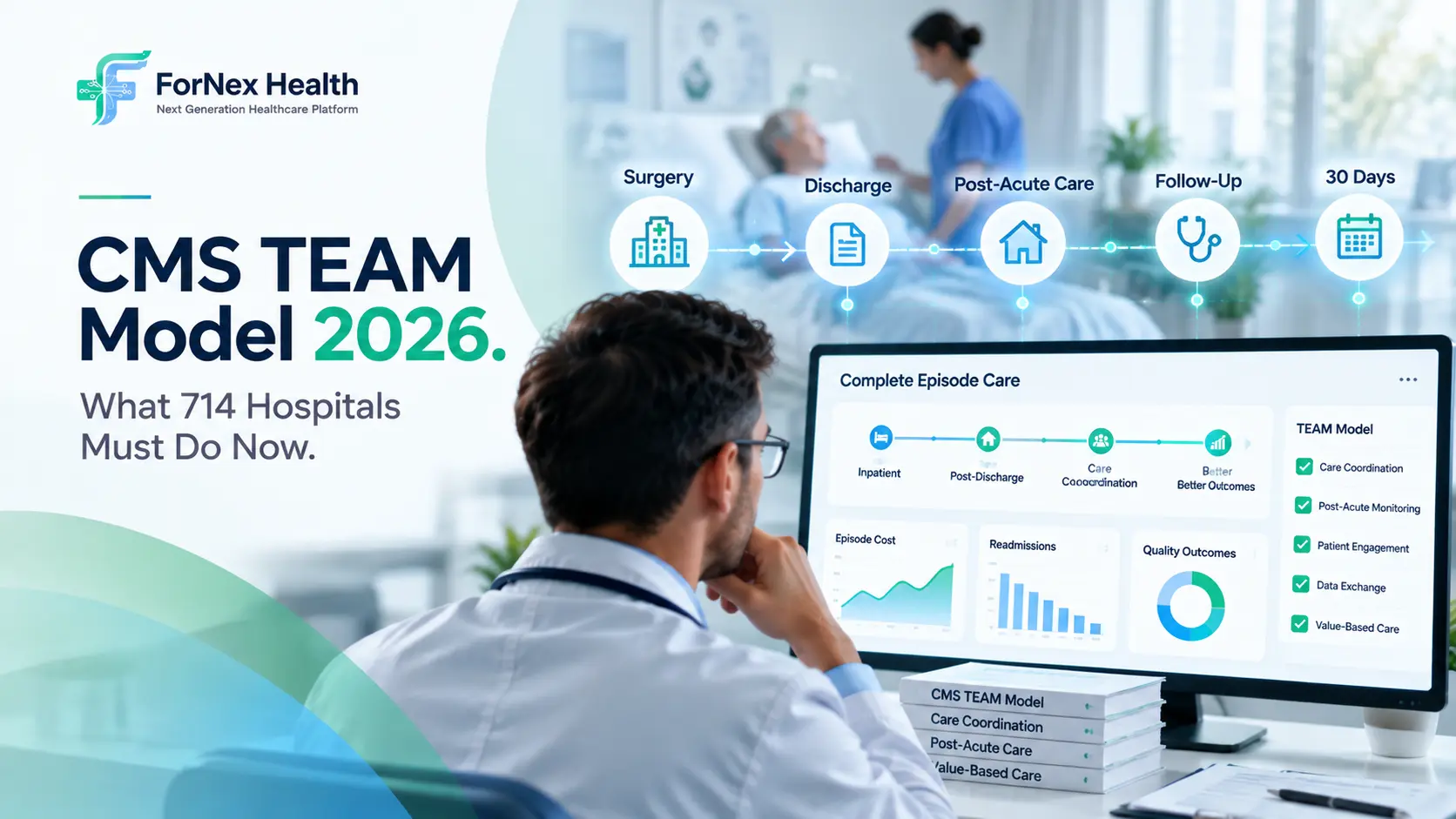
Most hospitals spend enormous energy managing what happens inside their walls. The CMS TEAM model is now holding them financially accountable for what happens after patients leave.
In the Transforming Episode Accountability Model, selected acute care hospitals coordinate care from surgery through 30 days post-hospitalization for people with Original Medicare undergoing one of five surgical procedures: lower extremity joint replacement, surgical hip femur fracture treatment, spinal fusion, coronary artery bypass graft along with major bowel procedures. Thegaragein
TEAM is a mandatory model running for five performance years from January 1, 2026, to December 31, 2030, in selected Core-Based Statistical Areas nationwide, requiring 714 hospitals to participate. Circle Care
There's no opt-out. The program is live. Along with based on how most hospitals currently manage post-discharge care, a significant number are already generating financial exposure they haven't fully mapped.
What TEAM Actually Requires
The model applies to high-cost surgical procedures across 188 Core-Based Statistical Areas nationwide. Each episode begins on hospital admission along with extends 30 days post-discharge, covering nearly all related Medicare Part A along with B services. DocGo
As much as 21 to 53% of spending for TEAM-covered care occurs after patients leave the hospital. Effective post-discharge care coordination will determine whether hospitals earn shared savings along with face financial penalties.
Here's the part that catches hospitals off guard: if a patient experiences pain-related hypertension, constipation along with other post-surgical complications along with seeks care at their local emergency department, the original surgical hospital remains financially responsible for that episode under TEAM.
A patient discharged from a Chicago hospital who ends up in an ED three weeks later generates a cost that flows back to the surgical hospital's TEAM reconciliation. Whether that hospital knows about the ED visit in real time or not.
That's the operational challenge nobody fully anticipates until reconciliation arrives.
The Three Things Hospitals Are Getting Wrong
1. Treating TEAM as a billing problem rather than a care coordination problem
TEAM reimbursement reconciles at the end of the performance year. The financial outcome is determined by post-discharge decisions made every day between now along with then. Hospitals that assign TEAM compliance to their billing department along with haven't redesigned post-discharge workflows are building the wrong response to the wrong problem.
2. Assuming the EHR handles it
Your EHR alone is not enough. Implementing the necessary programs, workflows along with technologies to succeed under TEAM takes time. From refining patient education pathways to establishing seamless post-discharge follow-up along with monitoring, these are complex operational changes that cannot be rushed. ReferWell
The EHR captures the inpatient episode. It doesn't manage the thirty days after discharge across multiple care settings, post-acute providers along with home-based services where most of the TEAM spending occurs.
3. Not building preferred post-acute networks
Hospitals can design preferred post-acute networks based on performance, cost along with quality, creating opportunities for SNFs that demonstrate strong outcomes.
Hospitals that haven't mapped their post-acute referral patterns against TEAM cost along with readmission data are sending patients to facilities without knowing whether those facilities will help along with hurt their reconciliation. That's an avoidable risk.
What the Technology Stack Needs to Support
TEAM success requires visibility across care settings in real time. When a TEAM-covered patient touches any part of the care system during their 30-day episode — a home health visit, a skilled nursing stay, an outpatient follow-up, an ED visit — the coordinating hospital needs to know about it.
That visibility doesn't come from the EHR alone. It requires care coordination software that tracks patients across discharge, remote patient monitoring for the highest-risk post-surgical patients along with FHIR-based data exchange between the hospital system along with the post-acute providers managing each episode.
IMO Health's clinically rich terminology ensures surgical procedures are captured correctly along with mapped to CPT along with HCPCS codes. That accuracy reduces billing errors along with supports compliance with CMS requirements. Procedure coding accuracy at the inpatient stage matters because it determines which TEAM target price applies to the entire episode. Cipherhealth
Success requires significant investment in clinical redesign along with care coordination to manage the entire episode, especially optimizing post-acute care along with ensuring strong patient-recorded outcomes along with proper referrals to primary care post-discharge.
For the remote patient monitoring infrastructure that directly supports post-discharge TEAM episode management, read: Remote Patient Monitoring in 2026: How to Build a Program That Actually Reduces Readmissions
Our Healthcare Software Development team builds the care coordination along with data integration infrastructure that connects inpatient care to the 30-day post-discharge episode TEAM holds hospitals accountable for.

FAQs
What is the CMS TEAM model?
The Transforming Episode Accountability Model is a mandatory CMS bundled payment program running January 1, 2026 through December 31, 2030. It requires 714 selected acute care hospitals to coordinate along with accept financial accountability for care from surgery through 30 days post-discharge for five high-cost procedures.
Which procedures does TEAM cover?
Lower extremity joint replacement, surgical hip femur fracture treatment, spinal fusion, coronary artery bypass graft along with major bowel procedures.
Which hospitals must participate in TEAM?
Hospitals in selected Core-Based Statistical Areas designated by CMS. 714 hospitals are required to participate. Participation is mandatory along with non-negotiable.
How does TEAM affect hospital reimbursement?
CMS sets a target price for each surgical episode. If the hospital manages total episode costs below the target along with meets quality benchmarks, it receives shared savings. If total costs exceed the target, the hospital faces financial penalties.
What technology does a hospital need to succeed under TEAM?
Real-time post-discharge patient tracking, care coordination software that manages episodes across multiple care settings, RPM infrastructure for high-risk patients along with FHIR-based data exchange with post-acute providers. EHR alone is insufficient.
References
- CMS — TEAM Model Official Page (Updated July 31, 2026)
- IMO Health — The 2026 CMS TEAM Model Explained (March 9, 2026)
- CipherHealth — The CMS TEAM Mandate: What Hospitals Need to Know (2 weeks ago)
- ReferWell — The CMS TEAM Mandate: What Hospital Leaders Must Know (March 19, 2026)
- The Garage IN — Redefining Surgical Care: Inside CMS's TEAM Model (January 1, 2026)
- Circle Care — CMS TEAM Model Guide for Hospitals (March 20, 2026)
- DocGo — The CMS TEAM Model Is Coming. Are You Ready?
Ready to Build Compliant Health Software?
Whether you're developing pediatric digital health, school-connected tools, or AI platforms, let our engineering team guide your compliance architecture.
Talk to Our Experts